There is a particular kind of confusion that flourishes in Washington. It begins with too much information, not too little. A commander has social posts, foreign news, geolocation, networks and chatter. A contracting officer has regulations, market research, deadlines and a blank performance work statement. Both possess data. Neither yet possesses a decision.
The Wolverine Group has arranged its business around that last mile. The Washington, D.C. company works in information operations, open-source intelligence, multilingual social media, acquisition strategy, training and software. Read as a list, it sounds like several consultancies sharing a trench coat. Read as a sequence, it is more coherent: find the signal, establish what it means, put it in front of the person who must act, then help the institution acquire and operate the capability.
That is a long way from the bland “public relations and communications” label still attached to the company in some directories. Its current market is the federal mission - Defense, the Intelligence Community and civilian agencies - with private-sector partners and procurement professionals around the edges. It is a woman-owned small business with a Top Secret facility clearance, a stated CMMC Level 2 posture, and the registration numbers that matter in federal procurement. The smallness is commercial; the readiness is institutional.
The message after the translation
The company says it has supported programs in more than 45 languages. The impressive part is not the number. A language count is easy to turn into corporate wallpaper. The useful part is the claim underneath it: literal translation is not comprehension. A phrase can be grammatically correct and culturally invisible. A network can look large and be operationally irrelevant. A viral post can be a signal, a decoy or simply Tuesday.
Wolverine’s information practice covers deep- and dark-web research, social-network analysis, GEOINT, domestic and foreign media, and Military Information Support Operations. It also includes the less cinematic labor of converting those inputs into displays a commander or analyst can use. The competitor is not merely another contractor. It is the spreadsheet no one trusts, the dashboard no one checks and the translated sentence that technically says the right thing to the wrong audience.

Founder and CEO Mary Clare Gumbleton came to this work through communications and government. The company’s own biography places her in senior roles at the White House, Treasury and Education before entrepreneurship. That background helps explain Wolverine’s bias: messages are not decorations applied after the “real” work. They are instruments. Their success depends on audience, timing, measurement and the system through which they move.
“We interpret the information environment - and help agencies buy the capability to operate in it.”The Wolverine Group’s stated mission
The contracting officer with a memo due Thursday
The newest public face of the company is less clandestine and more familiar: an overloaded procurement professional staring at a deadline. Wolverine’s AI-in-procurement practice begins with a distinction most software pitches blur. Buying AI is one job. Buying with AI is another. The first asks how an agency should acquire and govern an artificial-intelligence system. The second asks whether a contracting officer can use ChatGPT, Claude, Gemini or Copilot to accelerate market research, requirements and drafting today.
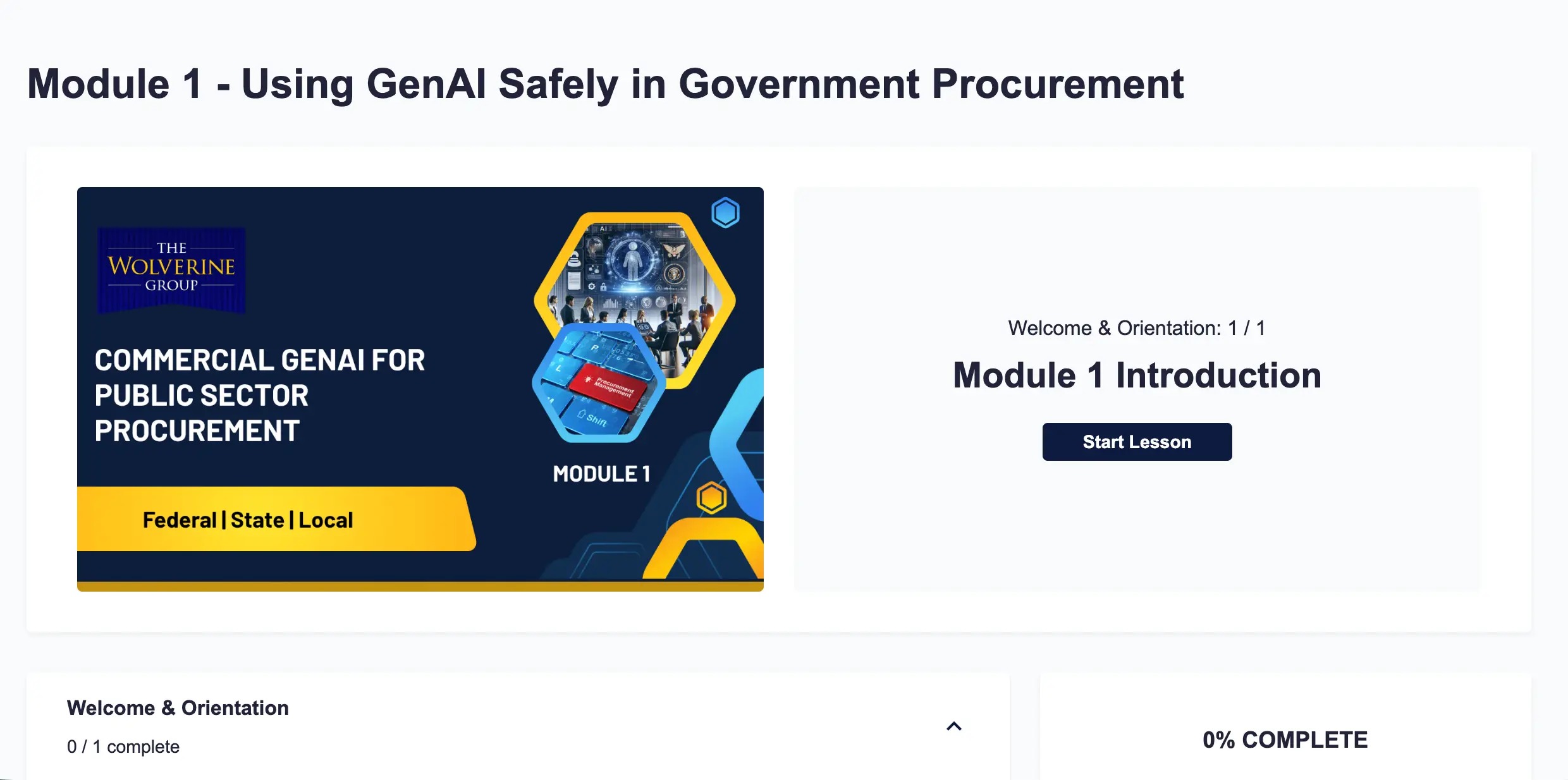
Its answer is a five-module course called Commercial GenAI for Public Sector Procurement. There are 32 videos, a capstone and an estimated 12 to 15 hours of instruction. Module one is available now; the rest are being produced and released as they are finished. The price is $395 per module. This is refreshingly specific. No “contact sales” curtain, no enterprise transformation prelude. A purchasing office can use a card or purchase order and give a learner twelve months of access.
What fails first is the first draft
The company has promoted a technique that can cut a performance-work-statement draft from hours to minutes. The speed is attractive, but the failure pattern is the more valuable lesson. A model produces plausible language before it understands the requirement. It can miss local rules, confuse jurisdictional differences, flatten evaluation logic and write certainty where the record demands caution. And if a user pastes sensitive information into the wrong commercial tool, the drafting shortcut has created a different problem entirely.
So Wolverine’s maxim is concise: “AI assists, humans decide.” The model drafts. A professional supplies context, checks the authority, documents the process and owns the judgment. This is not anti-automation. It is a theory of where automation stops being cheap. Generating sentences is cheap. Knowing which sentence survives a protest, protects data and reflects the buyer’s intent remains expensive.
The company’s free SOW/PWS Builder makes the same argument in product form. It runs in the browser, uploads nothing, guides users through a requirement and exports a draft. It is based on an open-source framework by James Jenrette of 1102tools.com and maintained by Wolverine under the MIT license. The tool structures and cites; the contracting officer owns the document. The limitation is not hidden in fine print. It is part of the design.
What another operator can copy
The obvious lesson is not “become a cleared OSINT firm.” Clearances, past performance and specialized talent do not emerge from a weekend workshop. The copyable lesson is how Wolverine packages expertise. It starts with an urgent practitioner problem, publishes a free tool that handles the repeatable portion, sells focused training for the judgment-heavy portion, and reserves consulting for circumstances that truly need people.
- Separate the two jobs. Buying a technology and using that technology in an existing workflow require different controls and different teachers.
- Give away the structure. A useful browser tool proves more than a slide deck about innovation.
- Price the first step. A visible $395 module is easier to approve than an abstract transformation program.
- Name the human decision. Adoption improves when users know exactly where their accountability begins.
The model has limits. It will not travel well into organizations that cannot establish data rules, assign a responsible reviewer or tolerate iterative learning. It is also a poor fit when the need is a commodity deliverable and the buyer gains nothing from the firm’s combination of intelligence, acquisition and training. Wolverine’s advantage lives in the seam between disciplines. Remove the seam and a narrower vendor may be cheaper.
A company built around the handoff
Most companies describe themselves with nouns. Wolverine is easier to understand through handoffs. Analyst to commander. Researcher to contracting officer. Software to practitioner. Prime contractor to cleared specialist. A public federal-award database shows the firm as a subcontractor to General Dynamics Information Technology on an OASIS task order, with a $7.8 million obligation listed in December 2023. The figure matters, but the role matters more: this is a business accustomed to fitting specialist capability inside a larger federal machine.
That positioning can be awkward. Breadth invites skepticism, particularly when a company crosses from influence operations to procurement classrooms. Yet the bridge is not artificial. Both jobs involve deciding which information deserves trust, what action it supports and who remains accountable. The same disciplined skepticism that asks whether a social-media pattern is real should also ask whether an AI-generated requirement is defensible.
Washington’s information problem will not be solved by one more dashboard or one more model. It will be solved, in small increments, by people who can read the room - including the regulations, incentives and missing context inside it. The Wolverine Group has made that act of interpretation its product. The interesting part is that it knows interpretation still needs an owner.