Digital Adoption Platforms and the Fight for Your First Click
Appcues, UserGuiding, Inline Manual and Cast all sell the same quiet promise - software that teaches people how to use software. Here is how a market built on tooltips and checklists turned into a billion-dollar scramble for the moment a new user decides to stay or leave.
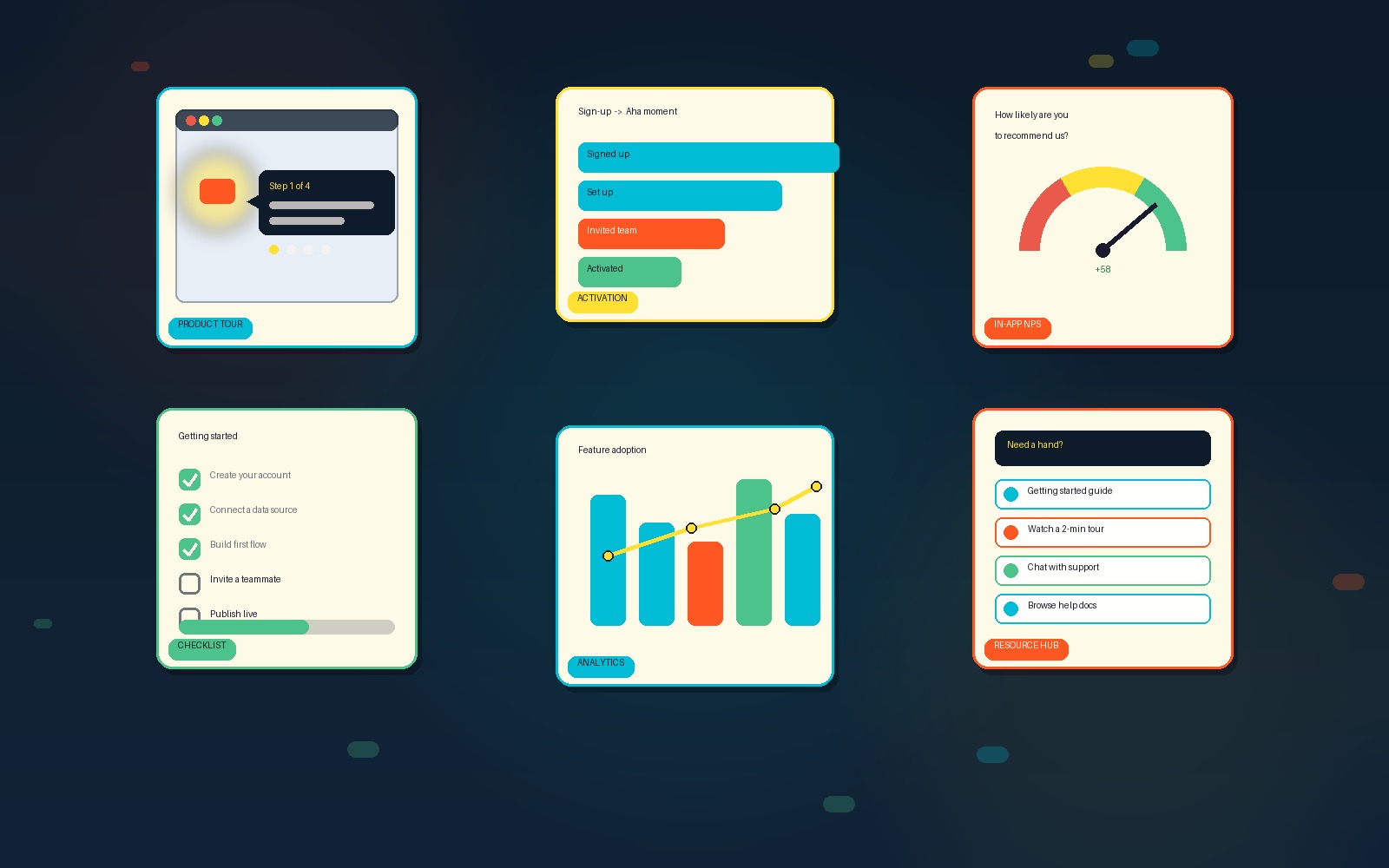
Open almost any app you signed up for this year and something greeted you. A little card in the corner. A yellow dot pulsing next to a button you had not noticed. A checklist promising you were "80% set up," even though you had done almost nothing. It felt like the product. It was not the product. It was a separate piece of software, bolted on top, whose entire job is to walk you from confused to comfortable before you give up and close the tab.
That layer has a clunky industry name - the digital adoption platform, or DAP - and a growing roster of companies fighting to own it. Appcues has been at it since 2013. UserGuiding arrived in 2017 with a cheaper, faster pitch. Inline Manual quietly powers walkthroughs inside complicated enterprise tools. Newer names like Cast keep showing up in the "best onboarding software" roundups that these vendors themselves publish. They are all selling the same odd product: software that teaches you how to use other software.
For a long time this looked like a feature, not a business. Then SAP paid about $1.5 billion for WalkMe in a deal that closed in September 2024, and the joke stopped being funny. The tooltip had grown up.
The empty state is the most expensive screen you own
Every founder eventually meets the same wall. You ship the feature. You are proud of the feature. Then you watch the session recordings and nobody finds the feature. They log in, stare at a blank dashboard, click one thing, and leave. The technical term for that blank dashboard is the "empty state," and it is where most software goes to die.
The core insight behind this whole category is almost embarrassingly simple. Users do not read documentation. They never did. A PDF manual, a help center, a "watch this 20-minute demo" email - all of it assumes a patience that does not exist. So the manual moved. Instead of sitting in a separate tab that no one opens, the guidance moved inside the product, appearing exactly when and where you need it.
This is why the language changed. Product teams stopped talking about "acquisition" - getting people in the door - and started obsessing over "activation," the moment a user first gets real value. The gap between sign-up and that moment is narrow, unforgiving, and measurable. Close it and retention follows. Miss it and your funnel is a bucket with the bottom cut out.
Illustrative funnel. The steep drop between sign-up and activation is the exact stretch DAPs are sold to flatten. Every step recovered compounds into retention.
Same idea, four different bets
What makes this market interesting is that everyone agrees on the problem and disagrees on the customer. The tools look similar in a demo - tours, tooltips, checklists, in-app messages, a help widget in the corner. The difference is who they are built for and how much friction they will tolerate.
Appcues, founded in Boston by Jonathan Kim and Jackson Noel, leaned early into no-code and has since pushed toward deeper analytics and heavier customization. It tends to price higher and courts teams that want to segment users and instrument every flow. UserGuiding took the opposite angle: cheaper, simpler, quick to set up, cheap enough for a small team to buy without ever talking to a salesperson. Its founders have described dragging the business up from roughly $9,000 in monthly recurring revenue by keeping it that accessible.
Inline Manual plays a quieter game, strong on contextual help and walkthroughs for complex or internal enterprise applications, the kind of legacy systems where an employee genuinely needs a guide to survive a multi-step workflow. Cast and a rotating cast of newer entrants keep the low end crowded and the "best alternative to Appcues" blog posts flowing. And looming over all of them are the giants - WalkMe, now inside SAP, plus Pendo and the fast-growing Whatfix - who sell the same idea to Fortune 500 IT departments rolling software out to tens of thousands of employees.
| Player | Since | The bet |
|---|---|---|
| Appcues | 2013 | No-code with depth - analytics and customization for growth teams that want to measure everything. |
| UserGuiding | 2017 | Cheap, fast, self-serve. Built for startups and small teams that hate sales calls. |
| Inline Manual | Enterprise-leaning | Contextual help for complex and internal apps, including employee training on legacy systems. |
| Cast & newer entrants | Recent | Keep the low end competitive; often pitched as the lighter, friendlier alternative. |
One technology, two very different buyers. On one side, a SaaS growth team chasing signups and conversion. On the other, an enterprise IT lead trying to get resistant employees to actually use the $20-million system they were told to adopt. Same tooltips. Wildly different stakes.
Why not just build it yourself
It is the obvious objection. A tooltip is not rocket science. Any competent engineer could build a product tour in a sprint. And plenty of teams do, right up until they learn the real cost is not building it once - it is maintaining it forever.
Onboarding is never done. The product changes, the tour breaks. Marketing wants to target the message to trial users on the enterprise plan who signed up last Tuesday. Someone needs to A/B test the checklist copy. Someone needs a dashboard showing where people drop off. Suddenly a "quick tooltip" is a small internal product with its own backlog, and it is competing for engineering time against the actual thing you sell. The pitch of the DAP is blunt: let product and growth people ship and change all of this without filing an engineering ticket for every tweak.
The money caught up to the idea
For years, digital adoption was a rounding error in software budgets - useful, unglamorous, easy to cut. Product-led growth changed that. Once onboarding was reframed as a revenue lever rather than a support cost, the spending logic flipped. If a better checklist moves activation by even a few points, and activation drives retention, and retention drives everything, then the tooltip layer is no longer overhead. It is leverage.
Directional figures drawn from published market forecasts; estimates vary widely by analyst. The trend line, not the decimal, is the point.
The SAP-WalkMe deal was the clearest signal. A legacy enterprise giant did not buy digital adoption as a novelty. It bought the layer that decides whether anyone inside a company actually adopts the software they were sold - a problem SAP knows intimately, having shipped complex systems to reluctant users for decades.
Then AI walked in
The uncomfortable question hanging over every vendor in 2026 is whether AI eats the whole category. If a copilot can answer "how do I export this report?" in plain language the instant you ask, do you still need a scripted four-step tour written weeks in advance?
So far the answer looks less like replacement and more like reshaping. AI is generating tours automatically, personalizing which nudge you see based on your behavior, and adding in-app assistants that respond to questions instead of guessing them ahead of time. The scripted checklist is not dead. It is getting a co-writer. The teams that win the next few years will likely be the ones that treat AI as a way to make guidance feel less like a canned tour and more like a helpful colleague sitting next to you.
There is a nice irony buried in all of this. The best possible outcome for a digital adoption platform is to be invisible. When it works, you never think "what a great tooltip." You just find the button, finish the task, and get on with your day. An entire industry, worth well over a billion dollars, has been built to do its finest work precisely when you do not notice it at all.
The next time a small card slides into the corner of an app and offers to show you around, look a little closer. Somewhere, a product manager tuned that exact sentence, a dashboard is logging whether you clicked it, and four companies you have never heard of are quietly competing over what you do in the next five minutes.
Explore the players
Questions people actually ask
What is a digital adoption platform?
Software that layers guidance - product tours, tooltips, checklists, in-app messages and help widgets - on top of an application so users learn it in context, usually without the vendor writing custom code for every change.
How is Appcues different from UserGuiding?
Appcues leans toward deeper analytics and customization and tends to price higher, which appeals to larger teams. UserGuiding positions itself as simpler, faster to set up and more budget-friendly, which makes it popular with startups and smaller teams.
Where does Inline Manual fit?
Inline Manual focuses on contextual help and walkthroughs, and is often favored for complex or internal enterprise applications and employee training rather than only consumer SaaS onboarding.
Why pay for this instead of building it in-house?
Building the first tour is easy. Maintaining, targeting, testing and measuring in-app guidance forever is not - it quietly becomes an internal product competing with your core roadmap. DAPs let product and growth teams own that work without shipping code for every tweak.
Is the market actually growing?
Yes. Estimates put the global DAP market in the low-single-digit billions in 2025-2026 with double-digit annual growth, and SAP's roughly $1.5 billion acquisition of WalkMe in 2024 signaled serious enterprise demand.