A double scull is a poor place for bluffing. Two rowers, four blades, one narrow shell: every hesitation travels through the boat. Strength helps. Rhythm decides whether the strength becomes speed or expensive splashing. In November 2012, Dhruv Madappa and Tarun Nithin represented Karnataka in the boys' double scull at India's Junior National Rowing Championship. They finished fourth. There is no grand mythology in that result, which is precisely why it is useful. The boat moved only when two people agreed, stroke after stroke, on what moving together meant.
Fourteen years later, Madappa works in another field crowded with power and starved of synchronization. He is part of the founding go-to-market team at Basis, a New York company building AI agents for accountants. The software is meant to take on long, multi-step work: gathering material, performing calculations, filling workpapers and returning something a professional can review. It is not enough for the machine to arrive at a number. In accounting, the route matters almost as much as the destination.
This makes Madappa's résumé look less like a sequence of pivots than a long argument about coordination. Rowing supplied the physical version. Cybersecurity supplied the adversarial version. Consulting supplied the organizational version. Enterprise AI has bundled all three and added a buyer who is professionally suspicious of miracles.
The fine print before the frontier
At Indiana University Bloomington, Madappa pursued a master's degree in cybersecurity risk management. He was a graduate research assistant and participated in the Cyber Ethics and Technology Society. His public record from those years is full of the questions that appear after technology's sales pitch has left the room. What permissions has a user really granted? Who is responsible when a third-party library quietly gets more access than expected? What would peace on the internet require from institutions that are usually busy responding to the latest attack?
He co-authored work on "over-privileged" mobile permissions, examining the gap between a tap on a consent screen and an informed decision. He also provided research and citation support for scholarship on cyber peace, blockchain-enabled microgrids and the governance of internet-connected devices. The topics sound academic until an AI agent is given access to a firm's email, files, ledgers and internal knowledge. Then permissions stop being a seminar question and become Tuesday.
His LinkedIn profile lists three credentials from this period of technical formation: Certified Information Systems Security Professional, AWS Certified Solutions Architect - Associate and AWS Certified Cloud Practitioner. Certifications are not character witnesses. They do show, however, that Madappa learned technology through the disciplines of architecture, access and risk before he began asking companies to reorganize work around it.
The interesting question is not whether an agent can finish the task. It is whether a professional can understand, review and stand behind the result.The operating problem at the center of accounting AI
A career in translation
After Indiana came a run through institutions that each speak a different dialect of confidence. PwC sits inside the world of assurance and professional services. Boston Consulting Group turns ambiguity into frameworks, meetings and decisions. At BCG, Madappa was associated with Versed, a team publishing about emerging technologies. Sana, the AI company from Stockholm, brought him closer to products meant to change how organizations learn and access knowledge.
The sequence matters because enterprise technology is rarely rejected for one reason. A technical team worries about architecture. A security team worries about access. An executive worries about economics. An employee worries, quite reasonably, about what happens to the shape and value of the job. A go-to-market operator has to hear all four conversations, often in the same meeting, without pretending they are one conversation.
Madappa's public manner offers a small clue about how he handles the human part. His comments are brief, warm and usually aimed outward. Congratulating a former colleague: "Boom. Congrats fam." Teasing a Basis teammate who had ordered the same Glaze dinner 100 times: "Demo king by day glaze influencer by night." Neither line belongs in a strategy deck. Both belong in the life of a team, where morale is built from tiny recognitions far more often than from declarations about culture.
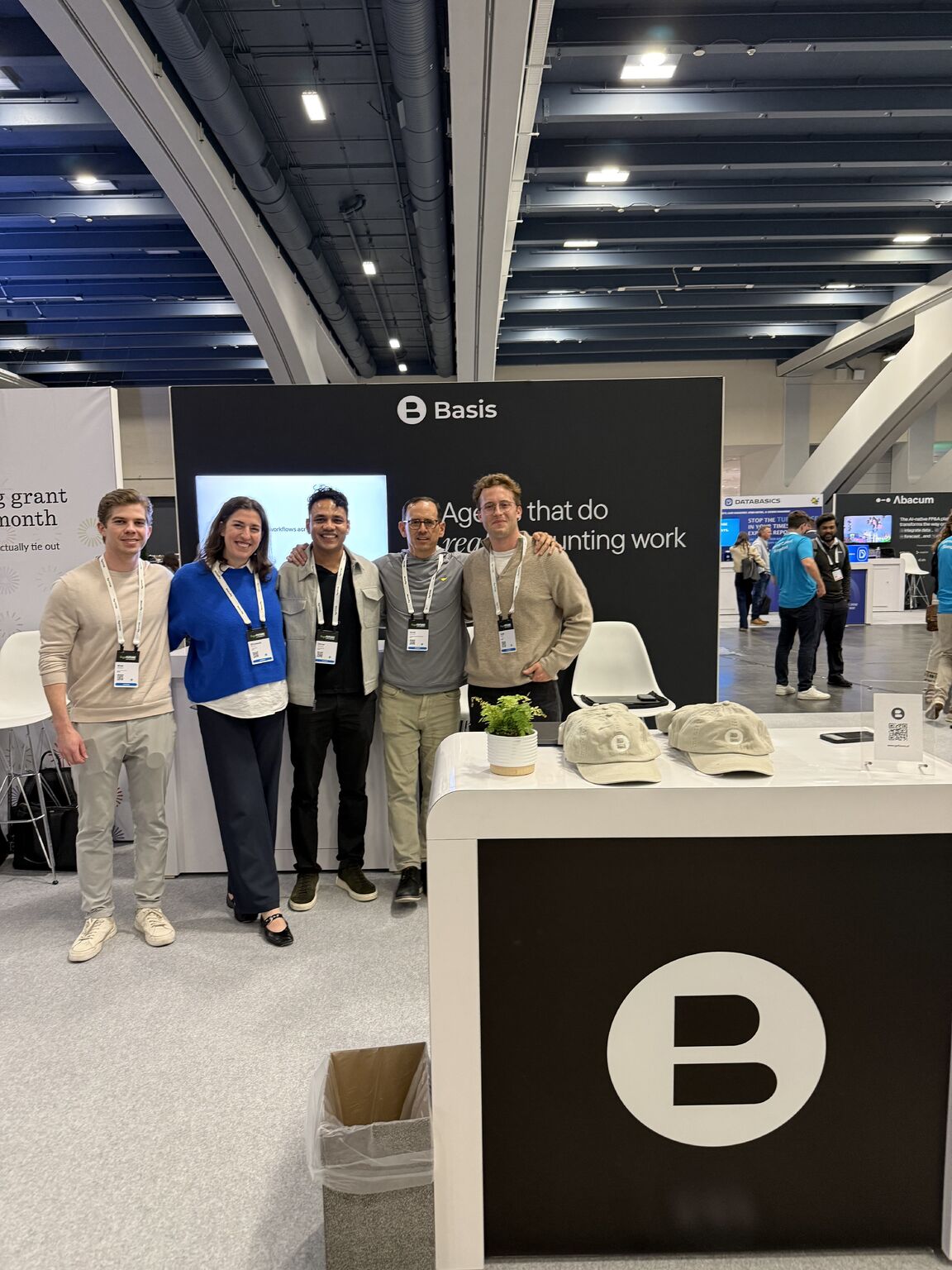
The room full of accountants
At Sage Future, Madappa joined colleagues Kenji Kuramoto, Elizabeth Kirchner, Nick Ardakani and Seth Parker in more than 250 conversations with CFOs, controllers and accounting-firm leaders. Parker's account of the week distilled the theme: excitement was abundant, but trust and reviewability were non-negotiable. "You can't delegate accountability in finance," he wrote.
That sentence is a useful brake on almost every breathless claim about autonomous work. An agent can gather documents at midnight, trace transactions across systems and draft a reconciliation before breakfast. The human signer still owns the judgment. The trick is not to make accountability disappear. It is to give the accountable person a better view: sources beside assertions, formulas beside totals, an audit trail beside the finished work.
Basis describes its agents as a scalable team behind each accountant. The company's larger proposition is organizational, not merely computational. If an accountant moves from doing every step to directing agents that do many steps, the job acquires a new management layer. Instructions have to become explicit. Context has to be maintained. Review has to be designed rather than improvised at the end.
One skill compounds into the next: coordinate the crew, model the risk, translate the change, preserve the review.
The discipline of showing the work
Basis raised $100 million in early 2026 at a reported $1.15 billion valuation. Capital makes the company larger; it does not make the adoption problem smaller. More customers mean more variations in firm structure, data quality, software stacks and review habits. An agent that behaves beautifully in a demonstration still has to survive the unruly particulars of a real close, audit or tax workflow.
This is the terrain of founding go-to-market work. It includes selling, but the interesting part happens before and after the signature. Early customers expose the distance between the product's elegant model of work and the work as it is actually done. Their objections become features, implementation practices and sometimes a firm refusal to automate a step that is better left to judgment. The operator carries information in both directions: capability to the customer, friction back to the builders.
There is also an unglamorous educational job. Accountants have to learn what makes an instruction useful to an agent, how much context a task needs and where a review checkpoint belongs. Product teams, in turn, have to learn the language of materiality, evidence and firm methodology. Neither side can simply hand the other a glossary. The shared understanding forms in live work, with real deadlines and numbers that will be seen again. For a founding operator, every deployment is partly a sale, partly a field study and partly a lesson in how quickly a good abstraction encounters an exception.
Madappa's background does not prove he will get every call right. Biography is not destiny, and rowing metaphors should be rationed before someone reaches for a coxswain. But his route gives him a practical vocabulary for the hard bits. He has studied systems where permissions matter, worked in organizations where change has to be explained, and competed in a sport where feedback is immediate and collectively felt.
At Indiana University's Media Services desk, Madappa once wrote about the gap between technology in movies and technology in life. Today, that gap is his market.
No clean finish line
The public version of Madappa is still a sketch. He does not maintain the sprawling content apparatus that turns some operators into permanent narrators of their own careers. What is visible comes in fragments: a race result, a conference paper, acknowledgments in scholarly work, a consulting newsletter, a trade-show photograph, a joke under a colleague's post.
The fragments are enough to show a consistent appetite. He is drawn to systems that promise leverage and demand restraint. A rowing shell amplifies a synchronized stroke. Cloud architecture amplifies access. Consulting amplifies a decision through an organization. AI agents amplify instructions into hours of work. In each case, the gift and the risk arrive together.
This may be why accounting is a fitting present chapter. The profession has little use for the theatrical fog that follows fashionable technology. It asks impolite, productive questions. Which source? Which permission? Which formula? Who reviewed it? Madappa has spent years learning to stay in the room after those questions begin.
There is no final stroke in this story yet. Basis is hiring, deploying and revising. Its customers are discovering which tasks belong to agents and which judgments remain stubbornly human. Madappa's work is to help a cautious profession cross that distance without losing the habits that made caution valuable. The boat, as ever, moves when capability and control find the same rhythm.