The first useful fact in Weyman Cohen's professional story is that he once admitted he did not have the answer. In the autumn of 2020, Cohen was a Duke senior, a political science major with graduation coming in May and an ambition to work in marketing. College life had been squeezed into laptop screens. Recruiting had followed it there. Cohen did what many young people are advised to do and rather fewer actually do: he asked for help, then kept showing up.
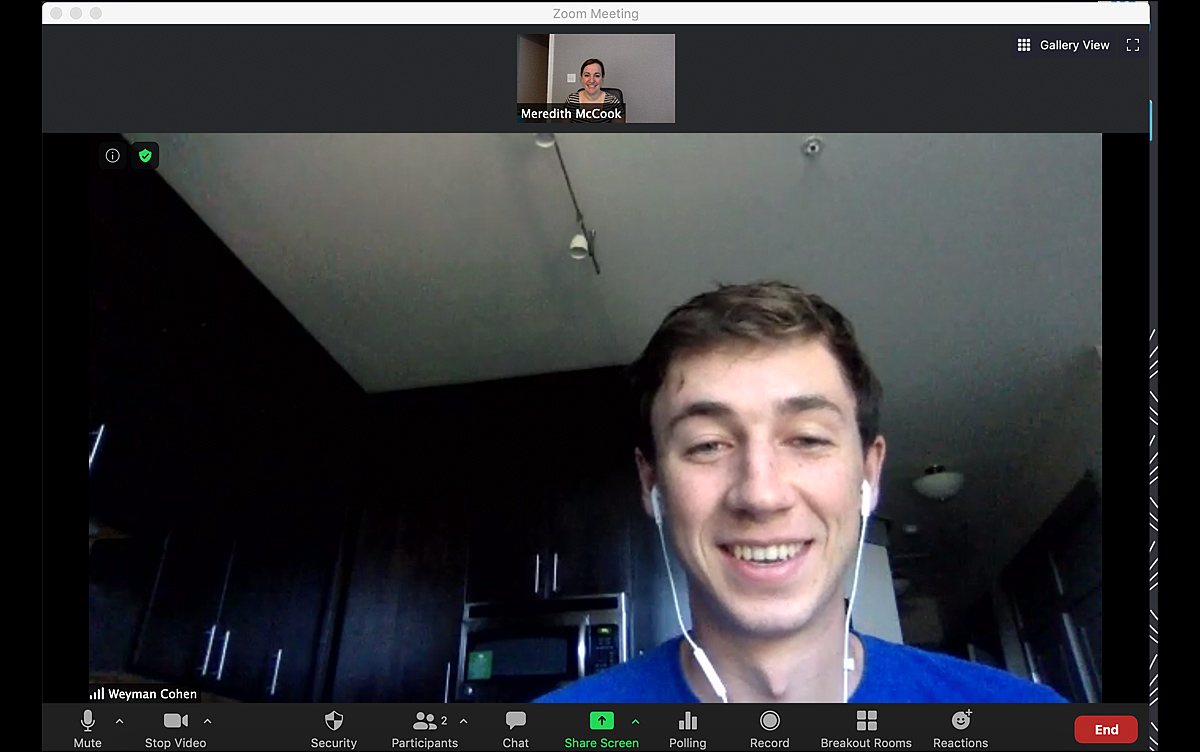
Since June of that year, he had been meeting with Meredith McCook of the Duke Career Center. Their conversations happened over Zoom, but the relationship was not casual or anonymous. Cohen valued the repetition. “You can build a relationship by talking with a person consistently,” he said at the time. The sentence is modest, almost procedural. It also contains the operating system for the career that followed.
Six years later, Cohen's work still depends on talking with people consistently about what they are trying to do. The nouns have become more specialized: distributed SQL, event sourcing, columnar execution, object storage, analytical workloads, AI agents. The question underneath has barely changed. Where are you trying to go, and what is making the journey harder than it needs to be?
Before the databases, a translator
Political science was not an obvious feeder program for database sales, which may be why it proved useful. At Duke, Cohen worked with anthropologist Orin Starn and Honduran construction workers on a project documenting their lives and working conditions. He conducted in-home interviews and translated them from Spanish into English for a showcase on migrant workers and the American dream. Translation here meant more than changing words. It meant carrying experience across context without flattening it.
The work had roots. Cohen had won the 7A Division 1 Florida State Spanish Conference in 2016 and scored in the 99th percentile on the National Spanish Exam. His public profile describes full professional proficiency in Spanish. Long before he had to explain why a database might distribute writes across regions, he had practiced listening carefully enough to represent someone else's meaning.
There was another kind of training before college ended. In high school, Cohen co-captained a boys' cross-country team that qualified for the Florida state meet. The team finished 20th. Distance running is a sport of repeated, visible discomfort, but its social unit is the pack. Leadership happens on ordinary afternoons, not just beneath a finish banner. His later interests sound similarly participatory: basketball, ping-pong and hiking around greater New York. None makes a database easier to sell. All put conversation within reach.
“You can build a relationship by talking with a person consistently.”Weyman Cohen, as a Duke senior in 2020
An apprenticeship in difficult software
After graduating in 2021, Cohen entered technology through one of its least forgiving doors: databases. His early stops included Cockroach Labs and Event Store. CockroachDB sells the idea that an operational database can remain available and consistent while spanning machines and regions. Event Store centers on event sourcing, a way of treating changes in a system as an ordered record. Both products ask a seller to understand what breaks when software grows, where data lives and why reliability cannot be pasted on at the end.
Cohen's posts from the Cockroach period show an appetite for the engineering case. In one, he pulled apart DoorDash's decision to change the database behind its new-verticals fulfillment system: a single writer, rising CPU use, slower inserts, regional latency and the risk of one location becoming a point of failure. The post did not begin with a congratulatory slogan. It began with the failure mode.
That distinction matters in infrastructure sales. A customer rarely wakes up yearning for a consensus algorithm. The customer wakes up because orders slowed during a peak, a regional outage exposed a brittle design, or a dashboard now takes eight seconds to load. Cohen learned to enter through the symptom and work toward the architecture.
The translation stack
In August 2024, he joined Superblocks as a sales development representative in New York. The product category changed. Superblocks helps companies build internal applications, the peculiar software employees use to approve refunds, inspect operations or manage a process that never earned its own commercial app. Cohen described the appeal as “the power of building internal tools fast.” His posts there returned to the tension between speed and control: how to let teams generate or assemble applications without abandoning governance, security or maintainability.
Then came MotherDuck, and a pleasing architectural reversal. Cohen's LinkedIn biography says he started by evangelizing distributed SQL. MotherDuck's premise is that analytics has often been over-distributed. Modern individual machines are powerful; DuckDB can perform analytical work inside a laptop, notebook, browser or application; cloud resources can join when collaboration, persistence or more compute is required. For many workloads, the answer is not a larger cluster. It is a better use of one machine, joined neatly to the cloud.
The seller changes sides of the database
This is not a contradiction so much as evidence that “database” names a family of problems. Operational systems handle frequent small transactions. Analytical systems scan and aggregate many rows. Resilience across regions can justify distribution in the first case. Locality, columnar storage and scale-up compute can be decisive in the second. The mature answer depends on the workload.
Two workloads, two shapes
Cohen's clearest public writing at MotherDuck begins with that practical distinction. “Nobody decides to do analytics on Postgres,” reads one line he shared. “You back into it, one reasonable choice at a time.” The wit works because the trap is familiar. A company selects Postgres for an application, adds reporting, adds dashboards, adds indexes and replicas, and one day discovers it has quietly given a transactional database a second career.
His version of technical selling is diagnostic. Aggregates take minutes. Materialized views are stale or expensive. Customer-facing pages encounter timeouts. These are not presented as moral failures or evidence that Postgres is bad software. They are signs that a good tool has accumulated the wrong job. The proposed change sounds less like a divorce than a division of household labor: Postgres stays; analytics moves.
A useful seller does not remove the complexity. He puts it in the correct order.The pattern across Cohen's public work
The same method appears in his explanation of DuckLake. File-based lakehouse formats can require several trips to object storage just to gather metadata. Cohen's pitch begins there, with waiting. DuckLake places the catalog metadata in a SQL database, so one query can retrieve it. Only after establishing the nuisance does he name the design. The engineering stays intact; the reader is given a reason to care about it.
Now the customer might be an agent
By 2026, Cohen's subject had shifted again. AI agents do not merely need models. They need permissioned access to data, an understanding of schemas, a place to execute queries and a way to recover when the first query is wrong. Cohen called the data layer the next AI bottleneck. In his account of MotherDuck's remote MCP server, the important behavior was exploratory: the system could inspect a messy schema and iterate, closer to the way an analyst works than a one-shot parlor trick.
That emphasis fits his career. Cohen has never publicly presented expertise as a lightning strike. The formative image is a recurring Zoom appointment. The selling motion is a sequence of questions. The agent, too, is valuable because it can look around, try something and revise. Progress arrives through feedback, which is less glamorous than revelation and considerably more useful.
At MotherDuck, his title is Founding GTM, an elastic phrase common to young companies. The job sits between market and machine. It means finding customers, certainly, but also helping a category explain itself: why local and cloud compute can cooperate, why an analytical engine belongs beside an operational database, why every AI agent may benefit from isolated compute, why the expensive architecture built for hypothetical scale can distract from the real workload.
Cohen now writes to roughly 9,000 LinkedIn followers. His feed is dense with diagrams, benchmarks, product launches and architectural distinctions. It is also sprinkled with the sociable shorthand of someone at home in a team: congratulations, invitations to dinner, quick notes of encouragement. The technical vocabulary grew. The instinct to keep the conversation going did not.
The long route to a simple sentence
Good technical communication can look effortless after the fact. The dashboard is slow because an operational database is being asked to scan like an analytical one. The lakehouse is slow because its metadata needs too many round trips. The agent struggles because the model cannot safely reach the context behind the data. Each sentence is short. Behind it sits a stack of systems and several years of learning how they fail.
Cohen's route through that stack is what gives the simplicity weight. He has stood on the operational side of the database debate and the analytical side. He has sold the machinery for recording events and the tools for turning company data into internal applications. His degree taught him to examine institutions and people; his early project required literal translation; his first public career lesson was to build a relationship through repeated conversation.
There is no tidy finish to the story because the category keeps moving. Data systems are being redesigned around agents even as companies are still untangling the warehouses they built for humans. Cohen's present work is to make that movement legible, one customer and one post at a time. The student who wanted help finding marketing landed in a field where the hardest marketing problem is explaining invisible machinery. He appears to have found his question.