At ChemStation International, a company that makes industrial cleaning chemicals, the software problem was rather less tidy than the product. Logan Laux was developing an in-house manufacturing resource planning system that also needed to work with an outside accounting package. Data had to move. Database structures had to change. Development had to continue while all this happened. Several third-party tools had failed to cover the requirements. The difficulty lived in the handoffs.
- Connect: drivers let applications reach databases and cloud services.
- Work: dbForge brings SQL coding, comparison, and administration into database tools.
- Move: Skyvia handles cloud integration, synchronization, and backup.
Laux settled on dbForge Studio for SQL Server, made by Devart. The appeal was its range: editing data, developing stored procedures, profiling queries, building reports, and managing source control. In Devart’s published account, the software became his everyday working environment. One phrase captures the purchasing decision: “my go-to platform on a day-to-day basis.”
There is a useful distinction here. Buying a database gives a business somewhere to put information. Getting that information into an application, through a development cycle, and into another system creates a second set of jobs. Devart sells tools for those jobs.
A business built in the gaps
The story begins in 1997 with Oracle Data Access Components, or ODAC. It gave developers a way to connect applications to Oracle. Today the component library supports Delphi, C++Builder, and Lazarus, including a direct connection option that avoids installing Oracle Client. The product addresses a very specific irritation: needing another layer of software before an application can reach its own data.
The portfolio expanded as the places needing connections multiplied. Devart added dbExpress drivers and dotConnect data providers in 2002. dbForge tools for Oracle and MySQL arrived in 2005. Skyvia brought cloud integration and backup in 2014. Python connectors joined in 2023. The sequence suggests a business following a recurring problem across changing development environments.
Its customers include database administrators, developers, analysts, and teams running business applications. Devart reports more than 500,000 users and customers at 65% of Fortune 100 companies. Those are company figures, but the customer stories offer something more concrete than a logo wall: a view of the work people were trying to finish.
Devart occupies several markets at once. JetBrains DataGrip is an alternative for database development; Redgate’s SQL Toolbelt Essentials overlaps in SQL Server coding and delivery. Devart’s distinguishing feature is the spread of its catalog, from application connectivity components to desktop tools and a cloud integration service. Buyers can enter through one small problem.
The first thing to wear out was the workflow
At Hexagon’s Israel-based Asset Lifecycle Intelligence operation, the problem was an accumulation of everyday inconveniences. The internal database toolset was insufficient. Routine data operations took too long. The team wanted one environment that covered more of its Oracle work.
IT manager Vladimir Gorscov chose dbForge Studio for Oracle for its interface, range of functions, and documentation. Devart’s case study reports a 20% productivity increase during the first month. That is a customer account published by the vendor, not a controlled benchmark. Still, the mechanism is plausible: fewer trips between separate tools to complete related tasks.
Reported productivity gain at Hexagon ALI after adopting dbForge Studio for Oracle. A customer result, not a forecast.
The transferable idea is modest. List the steps in a recurring database job. Count the applications, exports, and manual corrections involved. Trial a tool against that exact sequence. A large feature list matters when its features remove steps you actually perform.
Read the price. Then read the clock.
Devart earns money through software licenses and subscriptions. dbForge offers perpetual licenses, with a selected support and upgrade period, as well as subscriptions that stop providing access when their term ends. Cloud services have their own recurring charges. Founder Dmitry Nikolaenko said in a February 2025 interview that the company had grown profitably without external funding.
Skyvia makes the buying calculation tangible. Its data integration Basic plan lists $99 a month with monthly billing, or $79 a month billed annually. The free plan permits 10,000 records a month and daily scheduling, but its two scheduled integrations expire after 30 days. These are October 2026 advertised terms; the schedule matters as much as the dollar figure.
For a small daily transfer, that allowance may be enough to evaluate the service. A workflow needing updates every minute requires a different tier. Likewise, a desktop SQL tool will not solve every cloud integration problem. Match the product, supported source, operating environment, and license to the job before paying.
The next connection needs a chaperone
Devart’s newest work puts AI alongside those established tools. September’s dbForge 2026.2 release added broader context for its AI Assistant, including file attachments, alongside an embedded PostgreSQL debugger and visual object editors. The combination is revealing. Generating a query and understanding its behavior remain separate activities.
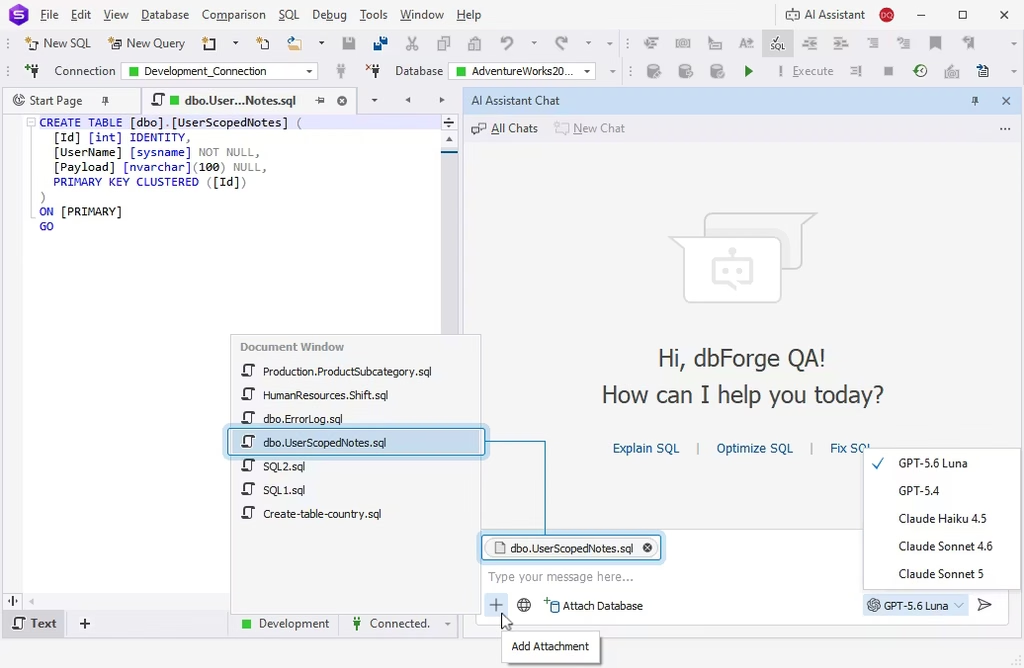
In a May 2026 interview, managing director Anton Onufriienko described requiring measurable workflow value before scaling AI initiatives. He also argued for human oversight of database changes. The distinction matters because a query can execute successfully while answering the wrong business question. Better syntax does not settle what “active customer” means.

“every initiative pays its way, or it dies.”Anton Onufriienko · Managing director · May 2026
That makes the useful lesson from Devart fairly practical. Start with a troublesome handoff, choose the tool that addresses it, and measure the finished job. Keep someone responsible for the data and the result. ChemStation needed manufacturing and accounting to cooperate. The next customer may need an AI assistant to understand a schema. The connection is still where the work begins.