A drug test can end with a color. That sounds wonderfully economical until someone has to decide what the color means, remember where the sample came from, and explain the result to someone who was not there. DetectaChem built a business around that awkward interval. The company makes portable screening and identification tools for people whose workplace might be a roadside, a border checkpoint or a suspicious package. Its most revealing product pairs a chemical pouch with something decidedly less exotic: a smartphone.
- Physical kits do the chemistry; MobileDetect reads compatible pouch reactions and records results.
- Customers include military personnel, police, hazmat teams and other first responders.
- Free software sits alongside paid consumables and quotation-based instruments.
- A presumptive field result remains a first answer, with limits.
That last distinction matters. DetectaChem sells speed and portability into settings where a useful preliminary answer can change the next step. The appeal is easy to understand. So is the temptation to ask a small device for more certainty than the test supports.
01 The camera has something to read
MobileDetect arrived in January 2018. DetectaChem’s launch announcement identified the motive plainly: demand for trace drug detection at a price suited to broader adoption. The technology came from its dedicated SEEKER detector family. Moving part of the job onto an existing phone offered a different route to the same customer problem.
The process is physical before it is digital. A removable swab samples the material. The swab goes back into the pouch, chemical reagents are released, and a color reaction develops. The app scans the pouch and interprets the reaction. A phone sitting beside an unknown powder has no such ability on its own. Chemistry supplies the signal; the camera supplies the image.
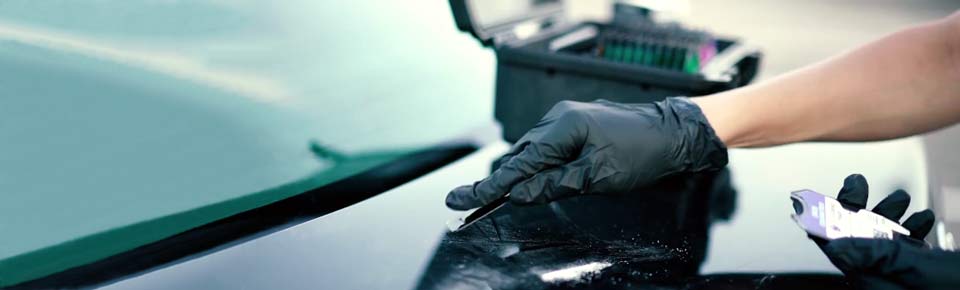
There is some unglamorous engineering in between. DetectaChem’s image color-balancing patent describes calibration blocks that help correct the captured image before analysis. Lighting, in other words, gets a vote unless the system accounts for it. The pouch also has a hard protective cover around its reagent glass. A testing product must survive the fingers operating it, as well as the substance being tested.
02 Paperwork is part of the product
Once the app has a result, it can assemble a report with time, date, notes, photographs and GPS location. Reports can leave the phone as PDF or JPG files. This is a practical advantage for work performed by teams: the person reviewing a case later receives more than a remembered shade of purple.
- 01SampleRemovable swab
- 02ReactCompatible pouch
- 03ReadPhone camera + app
- 04RecordExportable report
The economics follow the workflow. DetectaChem currently offers the app free and sells the things that make it useful: pouches, strips, field kits and instruments. Its public catalogue lists a ten-count multi-drug and trace-fentanyl combo kit at $68.90. Instruments are sold by quotation. The recurring purchase is built into the task because a single-use pouch is spent when the test is run.
That price is one dated catalogue example, not a department’s total cost. Stock, training, device compatibility and the mix of tests all affect deployment. DetectaChem offers free online training and certification, an acknowledgement that even an approachable tool needs a practiced operator.
03 Different questions need different tools
The range extends beyond phone-read pouches. SEEKER Pro is a dedicated trace drug and explosive detector weighing less than a pound. APEX R7 uses Raman spectroscopy for chemical identification and connects to the MobileDetect app. Its published library contains more than 23,000 items. These tools sit together because detecting a trace threat and identifying an unknown substance are related jobs with different requirements.
Dedicated handheld detector with consumable test cards.
Raman instrument with library matching and app integration.
Competition follows those distinctions. DetectaChem explicitly pitches MobileDetect against traditional NIK and NARK field kits. On the instrument side, Thermo Scientific’s TruNarc Tau and Delta analyzers offer an alternative in Raman narcotics identification. DetectaChem’s case rests on its combination of sampling formats, portable hardware and shared reporting. A comparison still has to start with the sample and the operator’s intended decision.
Military and law enforcement buyers also need ways to purchase and support equipment. LAURUS Systems lists MobileDetect on its GSA contract. DetectaChem’s German subsidiary covers sales and marketing across Europe, the Middle East and Africa. Distribution is part of getting a specialized tool into ordinary operational use.
04 A pandemic found a familiar capability
In 2020, DetectaChem entered COVID testing. Its government customers were confronting the pandemic, and its own experience already included detection, mobile reporting and manufacturing. The company announced emergency authorization for its molecular BCC19 test kit that September. A separate BCP19 pouch project was also described as advancing through the NIH’s RADx initiative.
“We didn’t actually have to pivot that hard.”
Travis Kisner, COO, in a September 2020 MD+DI interview
The explanation was more concrete than the fashionable word “pivot” suggests. Kisner described manufacturing robots already used to handle government orders of varying sizes and short turnarounds. The inference is useful for other businesses: an adjacent opportunity becomes more plausible when the production capacity and reporting machinery already exist. COVID testing required new diagnostic work, but it did not require inventing every surrounding capability.
05 The next sensor keeps the same app
In May 2026, DetectaChem announced MobileNIR, a near-infrared spectrometer operated through MobileDetect. The company advertises identification in five seconds or less, including organic materials such as cannabis and mushrooms. It offers quotes and preorders. Those are manufacturer claims and an ordering status, rather than evidence that every field sample will resolve that quickly.
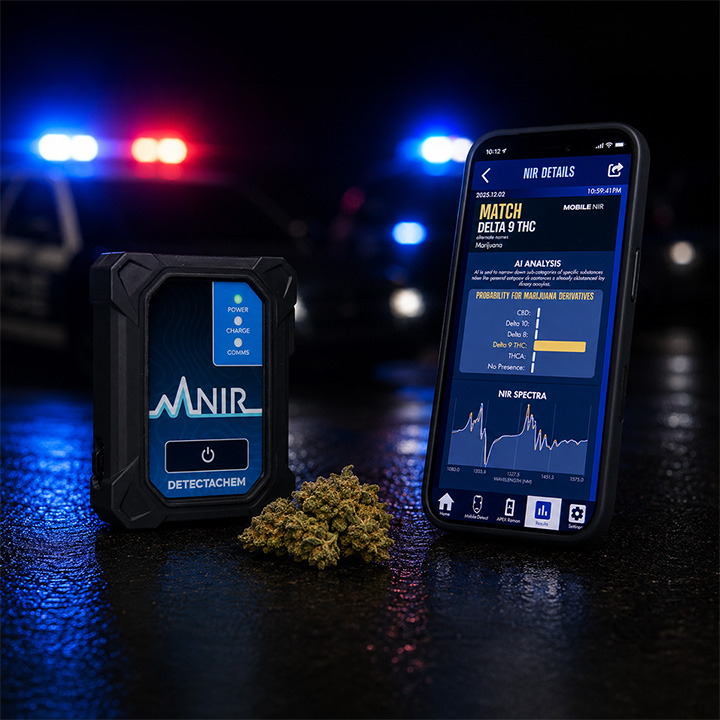
The continuity is the interesting part. A new sensing method arrives inside a familiar software workflow. For a buyer, that can reduce the amount of procedural change surrounding new equipment. For a product builder, the lesson is to pay attention to what customers must learn again each time the hardware changes.
There are limits to copying the approach. A compatible phone does not repair poor sampling, supply the wrong pouch with the right chemistry, or turn a presumptive finding into laboratory confirmation. DetectaChem’s app listing expressly calls its pouch results presumptive. Training, correct test selection and a clear follow-up procedure belong alongside the purchase. The pocket-sized answer earns its place when the person holding it understands what question it has actually answered.
Take a closer look
Explore DetectaChem, its MobileDetect kits and product video library. Watch the MobileDetect explosive-testing demo on YouTube or read the MobileNIR announcement.