There is a particular kind of problem that looks simple from a distance and grows teeth as you approach it. Connect a car to a computer. Put a device on a cellular network. Pay a contractor across borders. Insure an invoice. Match a buyer and seller of steel. Each can be made to fit on one clean presentation slide. Each, in practice, is a thicket of exceptions, institutions, old habits, and humans who need the thing to work before lunch.
Derrick Wolbert keeps walking toward that thicket. His public career crosses embedded engineering, go-to-market leadership, fintech, and private marketplaces. The nouns change wildly. The work beneath them is unusually consistent: take a fragmented system, learn how its participants already behave, and build connective tissue that reduces the number of ways a transaction can die.
It makes for a résumé that sounds as though several people shared a name. Wolbert worked at Jeep and Chrysler on the embedded computing platform used in Waymo vehicles. He then helped a cellular IoT company grow from no annual recurring revenue to $20 million. Later came a Y Combinator fintech launched with contractors in Nigeria. By January 2026, he was writing as chief executive of a metals marketplace about privacy, receivables financing, and why steel traders should still be allowed to send a text.
A computer inside a car is never just a computer
Before the revenue titles, Wolbert was an engineer inside the bureaucratic and mechanical reality of an automaker. The platform he worked on at Jeep and Chrysler became part of the computing foundation used in Waymo vehicles. The detail matters because automotive software has none of the forgiving lightness of a weekend web app. Hardware, safety, suppliers, release cycles, and corporate processes all arrive at the meeting together.
That experience appears to have supplied useful scar tissue for what came next. At Hologram, a global cellular network for the Internet of Things, the product had to make devices behave across a patchwork of carriers and countries. Wolbert's later co-founder Reuben Balik was Hologram's first engineer, wrestling carrier integrations into a unified SIM platform. Q Carlson brought design experience from similarly unruly industries. Wolbert ran go-to-market.
The scale is the headline, but the more transferable education was likely in the machinery behind it. Selling an IoT network means translating invisible technical complexity into an outcome a buyer can trust. A scooter should connect when it is switched on in a new country. A drone should remain reachable. A fleet operator should not need a telecommunications doctorate. The product wins when the complexity recedes.
Wolbert also wrote public explainers on drones, low-power wide-area networks, and blockchain for IoT. That combination - technical fluency and commercial translation - became the bridge into his founder chapter.
The upside-down Deel and a room in Lagos
In 2023, Wolbert, Balik, and Carlson founded The New Money Company. Its first public face was Numo, a product for international contractors earning from American companies. The founding trio described the idea with a pleasantly economical phrase: “upside-down Deel.” Instead of beginning with an employer's global payroll problem, Numo began with the contractor's need to be verified, invoice professionally, receive dollars, and move money into a local account when needed.
The company launched in Nigeria. Its YC announcement said 105 contractors were already live and sending invoices. Weeks later, TechCrunch described 1,000 sign-ups and 330 verified contractors. Wolbert called the product “financial infrastructure for a new generation of tech workers.” The phrase was ambitious, but the feature list remained concrete: a verified profile, an invoice, a U.S. payment rail, a dollar balance, and a local transfer.
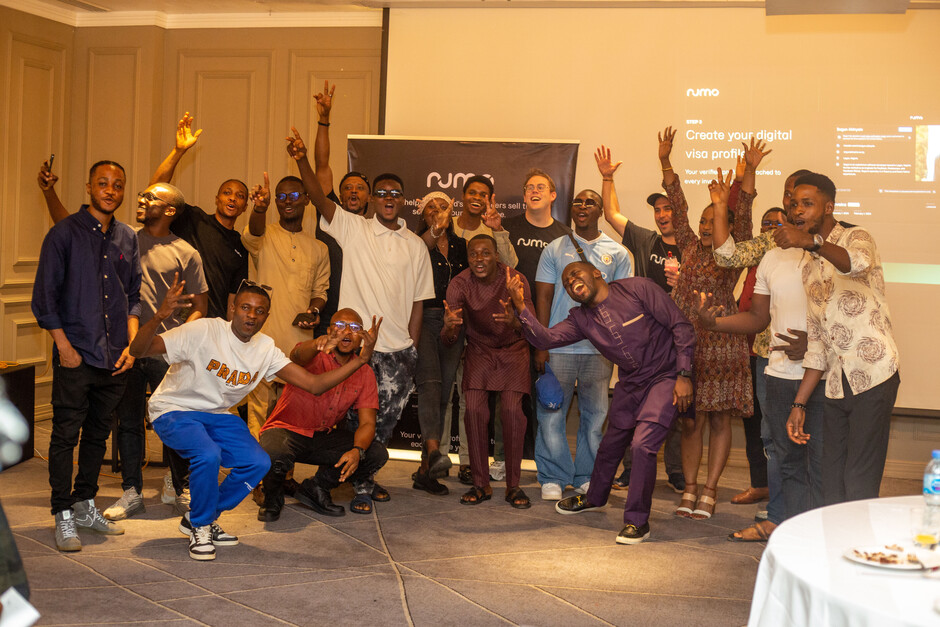
The photograph from an onboarding event is more revealing than another diagram of payment rails. People crowd together in front of a Numo banner, many with both hands in the air. A founder can describe a cross-border system in basis points and settlement windows. The people in the picture live at the other end of those abstractions.
There was precedent for this kind of field-facing project. As a first-year MMM student at Northwestern in 2014, Wolbert was part of a four-person team that won the university's opening round of the Hult Prize. Their proposal offered preschool resources as a service to schools serving children in African cities. The project became SharEd and piloted curricula and shared materials with eight schools in Pune, India. It was a different domain and a different decade. Still, it put users, constrained infrastructure, and iteration ahead of elegant theory.
A fintech changes its sentence
The New Money Company's current public description is no longer centered on offshore banking for contractors. It protects invoices against nonpayment, underwrites buyers, manages orders and documents, moves payments globally, and offers integrated financing. The customer story shifted from “help me receive dollars” to “help this trade reach paid in full.”
This is a meaningful change in product surface, but not a departure from the underlying obsession. An invoice is a small document with a surprisingly dramatic life. It carries information about trust, terms, delivery, credit exposure, timing, and the uncomfortable possibility that a buyer simply will not pay. The company's promise is to wrap that document in enough underwriting and workflow that a seller can enter a new market without volunteering its balance sheet as collateral for optimism.
There is wit in the company's public language. “Get paid. For sure.” is blunt enough to survive a finance meeting. A line about moving millions “around the world in 80 days seconds” turns Jules Verne into a settlement-time joke. Beneath the copy sits a sober proposition: complicated commerce becomes possible when risk, payment, and paperwork are handled as one system.
Modern software, old-fashioned discretion
The latest public chapter places Wolbert at Hedron Private Markets, a Chicago-born marketplace for industrial metals. In January 2026, he announced that Hedron had acquired the Reibus Metals Marketplace. His note reads less like a software manifesto than a negotiated peace treaty with reality.
Metals transactions contain dozens of variables. They happen through emails, phone calls, texts, and durable relationships. Buyers and sellers do not want to broadcast their positions. Previous software, Wolbert wrote, tried to change how the trade worked and failed. Hedron's pitch is to preserve discretion and familiar communication while improving matching, maintaining context, and embedding financing and liquidity inside the deal.
That sentence could serve as the quiet thesis of Wolbert's career. At Hologram, the global carrier maze disappeared behind a SIM. At Numo, a contractor could present a verified identity and let an American client pay through a familiar bank transfer. At The New Money Company, underwriting sits behind an invoice. At Hedron, a trader can keep using the phone while software works in the wings.
The design choice is easy to underestimate. Technology companies love forcing migrations because migrations make adoption visible. But in relationship-heavy industries, a new dashboard can be a tax disguised as progress. Hedron says users do not have to move their relationships onto a platform. The machinery is new; the manners are traditional.
Make the investor lean back, then get back to work
Wolbert once offered a speaking coach an image for a successful pitch: the investor should lean back in the chair. Not slump, presumably. Lean back in the presence of an opportunity large enough to create fear of missing it. His three ingredients were conciseness, confidence, and purpose.
Three ideas worth stealing
- Compress after understanding. A short pitch carries weight only when the messy details have already been studied.
- Preserve trusted behavior. Remove dead ends before demanding a new workflow.
- Build across the transaction. Risk, payment, context, and financing often fail together, so design them together.
The “lean back” standard could be mistaken for theater. Wolbert's operating record suggests something more disciplined. Hologram's growth number was not a metaphor. Numo's contractors had to clear verification and move actual money. An insured invoice must survive a default. A metals deal has specifications, counterparties, credit needs, and a closing date. The pitch earns its drama from the density of practical work behind it.
This may be why Wolbert's varied career hangs together. He has been close enough to machines to respect constraints, close enough to revenue to respect buyers, and close enough to financial infrastructure to respect trust. The founder's job, in this version, is neither to worship the old workflow nor to demolish it for sport. It is to decide what people value, keep that intact, and make the rest move faster.
Cars, cellular networks, contractor payments, invoices, and steel all resist the clean story. Good. The clean story is usually where the interesting work has been edited out. Wolbert's career has unfolded in the part that remains: the awkward, expensive, oddly human middle where a system either becomes useful or becomes another login everyone forgets.