In 1998, Deepthi Bathina was a master’s student in computer science at Worcester Polytechnic Institute, negotiating with C, Java, and Perl. The machines were literal. The feedback was curt. Hours of debugging might purchase a single word on a terminal: “Success.” Nearly three decades later, she returned to that memory in a public reflection on artificial intelligence. The tools had changed beyond recognition; the old patience had not. Her conclusion was sharper than the usual speech about disruption: knowledge itself was becoming less defensible. Judgment - knowing what to do with knowledge - was becoming the advantage.
That distinction explains more about Bathina’s career than any list of titles. She has worked across strategy, product, engineering, operations, customer success, and boards. She has sat inside large companies and started new ones. In October 2023, she founded RhythmX AI with an initial $50 million investment from SAIGroup. In November 2025, RhythmX AI combined with Get Well to form GW RhythmX, and Bathina became chief executive of the combined business. The corporate facts are tidy. The operating philosophy beneath them is more interesting: technology earns its place when it shortens the distance between information and action.
“The moat is no longer what you know. The moat is how wisely you apply it.”Deepthi Bathina, reflecting on 28 years in technology
An education in where software meets reality
Bathina’s formal education paired the two languages her later work would demand. WPI gave her a master’s degree in computer science in 2000. Babson College’s F.W. Olin Graduate School of Business gave her an MBA in global strategy in 2008. The pairing matters. Code asks whether something can be made. Strategy asks whether an organization can be persuaded, equipped, and disciplined enough to make it matter.
By 2008, she was vice president for product management and marketing at TyMetrix, responsible for software, analytics, and professional services. Before that, she had been senior director of strategy and product marketing at ADP. Former GE chief Jack Welch personally selected her as a strategy consultant, a wonderfully old-school credential in a career now associated with generative AI. It also hints at a recurring quality: Bathina has long moved between an idea and the machinery required to spread it.
The machinery grew. At Wolters Kluwer Health, she served as chief operating officer of the clinical decision-support business that included UpToDate, leading product, technology, engineering, customer operations, implementations, and infrastructure across 170 countries. At Nuance Communications, she became general manager of operations for a healthcare technology division used by more than 450,000 clinicians at over 10,000 institutions. At Humana, as chief product officer, she oversaw broad product portfolios and customer-success functions at a company serving more than 16 million medical members.
Scale is an unforgiving tutor. A prototype may need to delight one room. An enterprise product must survive procurement, integration, training, regulation, budgets, and the quiet rebellion of a person who already has too many tabs open. Bathina’s résumé reads like a tour through those constraints. It also makes her later insistence on workflow feel less like positioning and more like scar tissue.
The founder arrives after the operator
After Humana, Bathina founded HealthTech Ventures and advised executives, boards, and investors. She joined the advisory board of ManagingLife, served on the board of TCV Acquisition Corp, and became chair of the advisory board for Babson’s Kerry Murphy Healey Center for Health Innovation and Entrepreneurship. These roles widened the lens again. She was no longer responsible only for a product line; she was watching how companies choose markets, capital, partners, and timing.
Timing was central to RhythmX AI. Predictive models were not new. Clinical software was certainly not new. What changed was the possibility of joining large stores of longitudinal data, generative interfaces, and existing clinical systems in a way that could surface a specific recommendation while a decision was still live. SAIGroup announced the company in October 2023 with $50 million in initial funding. Romesh Wadhwani chaired it. Bathina was the founder and chief executive.
Bathina’s operating thesis
The wager was not merely that AI could retrieve or summarize. It was that software could assemble relevant context and provide patient-specific guidance inside the systems clinicians already use. Bathina has framed the mission in human terms: “Technology must restore time, judgment, and trust to clinicians, and outcomes to patients.” Notice the verbs. Restore, not replace. The ambition is considerable, but the posture assigns the final judgment to the professional in the room.
In February 2024, RhythmX AI announced a strategic collaboration with Sentara Health to develop its approach with a large integrated system. Bathina described it as a “big, shared vision,” yet the work focused on a mundane and decisive inconvenience: clinicians often have to hunt for information. The company’s proposed value was to do more of that assembling before the moment passed. Enterprise software is full of grand nouns. “Hunt” is a useful little verb because everyone recognizes the wasted time inside it.
The company gets larger; the idea gets simpler
The November 2025 combination with Get Well changed the scale of Bathina’s assignment. The new GW RhythmX joined RhythmX AI’s precision-care technology with Get Well’s patient-engagement footprint. The announcement said the combined organization served more than 150 health systems and had touched more than 85 million patients, including eight million U.S. military veterans. Michael O’Neil, Get Well’s founder and CEO, became vice chair. Bathina became CEO.
Mergers are where elegant strategy decks meet the sociology of actual companies. Two product histories, two groups of customers, and two vocabularies must learn to inhabit one plan. Bathina’s background makes the appointment legible: she had already moved between technology and operations, customer experience and product, large institutions and founder-led work. The new role did not abandon the startup thesis. It enlarged the number of places where that thesis had to function.
“With our companies coming together as one, we have the opportunity to forever change the way medicine is practiced.”Deepthi Bathina, November 2025
There is an obvious temptation to tell an AI founder’s story entirely through the technology. Bathina’s story resists that reduction. Her public comments repeatedly credit teams, clinical advisers, health-system partners, and mentors. She has described her team as a mix of physicians, AI scientists, technologists, product builders, and go-to-market leaders. The list is part org chart, part argument: a consequential system cannot be built by a monoculture.
Three things worth stealing
Bathina’s career offers a compact playbook for builders in complex markets. First, learn the work before redesigning the workflow. Her route passed through the daily realities of product delivery and global operations. Second, treat distribution as part of the invention. Integrations, partnerships, and customer trust are not the wrapping around enterprise software; they are among its essential materials. Third, preserve the user’s agency. A recommendation should clarify judgment, not perform a little coup against it.
Her own taste in ideas fits this pragmatic streak. On a 2024 podcast, she recommended Geoffrey Moore’s Crossing the Chasm, the classic book about moving technology beyond enthusiasts and into mainstream markets. It is almost too neat. Bathina has spent her career at the chasm’s edge, where an impressive capability must become a dependable product, and a dependable product must become normal enough to disappear into work.
Yet she has not lost her sense of wonder. In a 2023 conversation, she said technology felt like magic when she first encountered it and still did. The line is revealing because her career is otherwise rich in the least magical words in business: operations, implementation, customer success, infrastructure. Perhaps durable optimism requires knowing exactly how the trick is done and loving it anyway.
The terminal is still waiting for “Success”
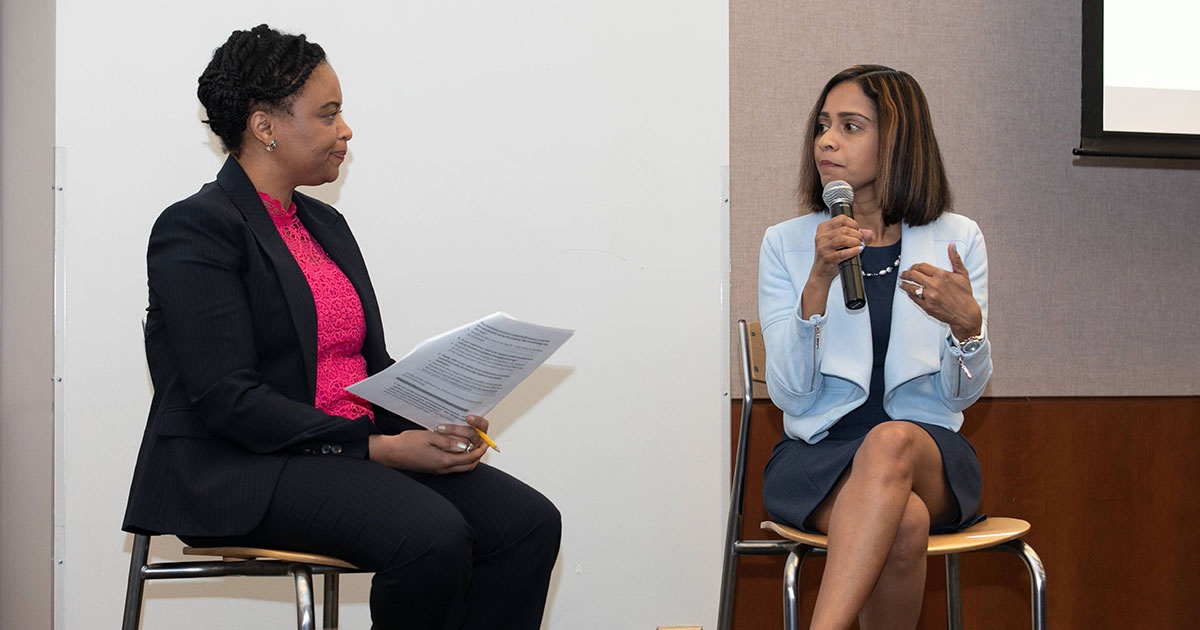
In 2024, WPI invited Bathina back for a panel on AI and the future of work. The student who once labored over manual syntax returned as a founder thinking about what happens when high-level capability becomes widely available. Her answer was not nostalgia for harder tools or blind enthusiasm for easier ones. It was a demand for wiser application.
That is the thread connecting the student, the product leader, the operator, the adviser, and the CEO. Bathina’s subject has always been translation: code into products, products into institutions, scattered information into usable context, and technical possibility into a decision someone can defend. The work is less cinematic than asking a machine a brilliant question. It involves integration meetings. It involves validation. It involves persuading people who have good reasons to be careful.
The magic, in other words, has paperwork.
GW RhythmX is the largest test yet of Bathina’s thesis. The company must make sophisticated intelligence feel timely, trustworthy, and ordinary across more than 150 health systems. The scale invites sweeping language. Her most useful idea remains modest enough to fit on that old terminal: knowledge matters when it produces the right action. The rest is debugging.