A partnership at KPMG is a respectable place to stop climbing. Dee Ann Remo treated it as a place to change direction. She had worked in tax and wealth management, learning how one financial decision could upset several others. In 2005, she founded Heritage Wealth Advisors in Richmond with a more demanding proposition: bring the people responsible for those decisions into the same conversation.
Investment management, tax planning, estate questions, philanthropy. Each discipline had its own vocabulary and timetable. Remo wanted a firm that could work across them. The arrangement would require specialists, coordination and a willingness to take responsibility for the details between departments. Simplicity for the client would involve considerable complication for the adviser.
Two decades later, Heritage reports $5 billion in assets under management and three locations in Virginia and Pennsylvania. Those are the visible measures. A quieter measure appeared much earlier, when Remo explained that a single client relationship might include three generations of a family. Her unit of work was already larger than an account.
To understand why she built it that way, it helps to leave the investment office for a moment. Long before she advised affluent families, Remo worked as a teenager in her family’s store in rural Maryland. She noticed how financial constraints affected people’s ability to direct their own lives. Money meant room to choose. The question of who gets that room would eventually follow her back into business.
The accountant adds more chairs
Remo graduated magna cum laude from West Virginia University in 1985 with a bachelor’s degree in accounting. She spent 17 years at KPMG. She became a Certified Public Accountant, a CERTIFIED FINANCIAL PLANNER professional and a Personal Financial Specialist. Her route into wealth management ran through the close reading of a financial life, including the obligations that remain after an investment has performed well.
A tax background supplies a particular kind of attention. The number at the top of a statement is only the beginning; what a family can spend, give or pass on depends on the decisions surrounding it. At Heritage, that relationship between taxes and investments became part of the service itself. Remo’s founding choice was to organize the firm around the whole problem.
She also knew which experience she needed beside her. Jay Jordan joined as a partner in 2012, bringing a background as an analyst and portfolio manager. Remo openly acknowledged that investments had not been her original professional world. Recruiting someone with his skills was essential. For a founder, knowing where another person belongs can be as consequential as knowing where to sit yourself.
“We can’t have a cookie-cutter approach.”
Dee Ann Remo · 2014
That observation had a practical business model behind it. Heritage offered its services on a fee-only basis rather than earning commissions. Its work combined investment and family-office advice, tax planning and compliance, and broader financial planning. Remo was asking clients to trust a coordinated process, and asking colleagues to make that process work.
Three generations count as one
By 2014, Heritage had 130 client relationships. The wording mattered: one relationship could encompass grandparents, parents and children. A family could be a long conversation with several people entering at different points, carrying different assumptions about what the money was for.
Stuart Siegel, the former chairman and CEO of menswear retailer S&K Famous Brands, had been a client since the beginning. He valued access to a team with different areas of expertise and sought its advice on a range of matters. Remo’s work also brought her into contact with outside attorneys, including Richmond lawyer Farhad Aghdami. Coordination extended beyond the people on Heritage’s payroll.
The firm still describes a family-office approach built around continuity between generations. It includes getting to know a family’s financial structure, communicating clearly and revisiting plans as circumstances change. That makes the relationship an ongoing assignment. Children grow up. A business changes hands. A charitable interest becomes an institution with its own responsibilities.
One family. Connected decisions.
purpose & plans
Different disciplines, considered together.
A conceptual view of Heritage’s service model.
Philanthropy makes the need for coordination particularly clear. A family has to decide what it wants to support, how long that support should last and how the gift fits into its other commitments. Heritage’s process connects giving goals to estate and tax planning. A charitable decision may begin with an enthusiasm; somebody still has to work through the consequences.
This is where Remo’s profession becomes more personal than its paperwork suggests. Advising across generations requires making space for people whose lives are connected but whose priorities may differ. The firm’s emphasis on family governance puts the way decisions are made alongside the decisions themselves. Having everybody’s name on a chart is the easy part.
An office ballet, with a larger cast
Remo once called the movement of meetings inside Heritage an “office ballet.” It is a pleasingly unbankerly description of a workplace: several people moving through a shared space, with a fair amount depending on timing. She described clients as belonging to the firm as a whole, a principle supported by morning collaboration sessions.
Her explanation for combining disciplines was blunt: “Because it’s harder. It’s more labor-intensive and complex.” The complexity was deliberate. Shared responsibility demands time from colleagues who could otherwise remain in their own professional lanes.
Growth gave that arrangement a larger cast. In October 2023, Heritage announced the acquisition of Charlottesville-based Mangham Associates, an investment partner serving foundations, endowments and selected families. The combination was expected to bring assets under management to nearly $4 billion. Founder Joel Mangham was to continue as a managing director.
The attraction was complementary experience. Mangham brought institutional investment expertise; Heritage brought its family-office capabilities and operating infrastructure. The announcement also said Heritage would remain independently owned. Expansion involved a decision about the kind of organization Remo wanted to preserve, alongside the services she wanted to add.
- 2005Remo founds Heritage in Richmond.
- 2012Jay Jordan joins as a partner.
- 2023Mangham acquisition announced; Charlottesville joins the map.
- 2025Heritage marks its twentieth anniversary.
At the twentieth anniversary in May 2025, Heritage reported nearly $4.5 billion in assets under advisement and more than 35 professionals. Its current website reports $5 billion under management. Those measures describe the firm’s scale at different moments; neither is a measure of Remo’s personal wealth. The founder’s managerial task was becoming larger, too: keep specialists working together as the organization grew.
The other end of the balance sheet
In late 2021, Heritage created the Foundation for Financial Independence. The following November, its first grants went to two Richmond organizations: the Neighborhood Resource Center and Southside Community Development & Housing Corporation. Each received $10,000. The money supported work that included financial coaching, employment assistance and help preparing for homeownership.
The connection to Remo’s teenage experience is specific. She had seen people with limited resources struggle to exercise control over their lives. The foundation backed organizations helping people gain practical financial options. Rather than inventing a new program inside an advisory office, it funded people already doing that work in the community.
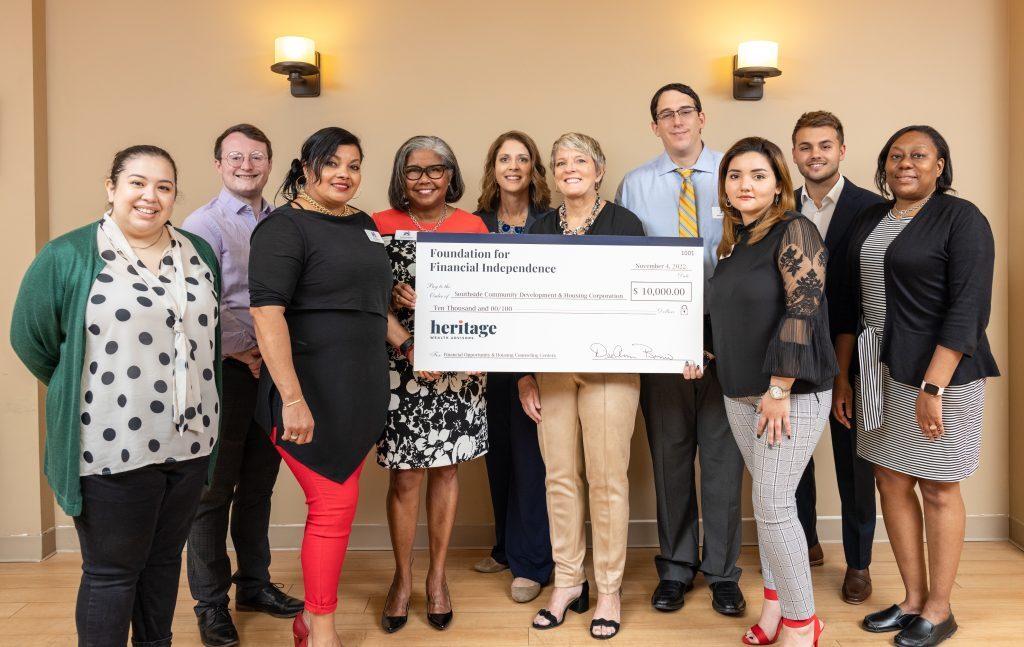
Southside’s grant supported bilingual financial services, employment coaching and homeownership counseling. The foundation’s giving continued: its 2023 recipients included the Fountain Fund and Neighborhood Resource Center. Later awards included organizations in Charlottesville as well as Richmond. The work gave the firm a way to support financial capability beyond its own client base.
Remo’s civic commitments also include museum, arts, youth and community organizations. She has served on boards associated with The Valentine, the Visual Arts Center of Richmond, the Richmond SPCA, Boys & Girls Clubs of Metro Richmond and Sports Backers. She joined the West Virginia University Foundation board in 2016, returning professional experience to the university where she had studied accounting.
In 2023, YWCA Richmond honored her in the business category of its Outstanding Women Awards. Its account of her work included mentorship of younger financial professionals and nonprofit service. The recognition placed the company she had built beside the people and institutions she had helped support.
A succession plan for the planner
Building a firm around relationships creates a question for its founder: how will those relationships carry on? Remo has spoken publicly about developing future leaders, integrating teams after an acquisition and establishing a succession plan. A company that advises families about continuity has its own continuity to arrange.
Her public conversations in 2025 show those interests taking shape. In June, she sat down with Carrie Mills Miller, Heritage’s new director of philanthropy and business development, to discuss giving and the work Miller would bring to families. In September, she and Sarah Simmer, who leads the Pittsburgh office and client experience, revisited Heritage’s early years and its future.
A December 2025 video appearance covered integrated planning, diverse talent and growth. The subjects fit the founder’s continuing assignment: bring in capable people, let them contribute distinct knowledge and keep the client’s decisions connected. The work depends on expertise traveling between colleagues.
The university connection has a family dimension. Her husband, Jim, and their children, Ben and Sarah, are also West Virginia University graduates. Remo’s own education became part of a shared family history, followed by her service on the university’s foundation board. Away from work, she enjoys travel, time with family and Richmond’s arts and culture. The institutions in her biography have a habit of becoming relationships that last.
The distance from a Maryland family store to a multibillion-dollar advisory firm is considerable. The concern linking them is easier to recognize: financial resources affect what people can do next. Remo built a business to help families handle those choices, then helped fund organizations that could widen the choices available to others. For an accountant, that is a satisfying set of entries to have on the same page.
Keep the conversation going
- Heritage Wealth Advisors
- Dee Ann Remo’s official biography
- Dee Ann Remo on LinkedIn
- The Foundation for Financial Independence
- Bold Women: Dee Ann Remo · 2020
- An early look at Heritage’s expansion · 2014
- Remo joins the WVU Foundation board · 2016