A utility bill is a small document with a remarkably large talent for evasion. It might sit behind a provider's login, a six-digit code, three tabs, and a button labeled something unhelpful like “Documents.” Now multiply that task by dozens of providers, each convinced it has invented the perfect portal. The work is simple for a person and tedious for a company. Deck has built its business in that gap.
- Deck gives AI agents isolated computers to operate existing software through its interface.
- It handles the stubborn parts around the click: credentials, sessions, MFA, records of actions, and structured output.
- Customers use it for utility data, invoices, payments, legacy workflows, and product integrations.
- Its published plans run from free to $250 a month, with custom enterprise pricing.
The company began with user-authorized data access, especially utility accounts. That was a sensible first quarry. Utility data is scattered across a huge number of organizations, and a building manager who needs this month's usage usually cannot wait for every provider to publish an elegant API. Deck's 2025 pitch was essentially: let a user grant access, send a browser-based agent into the account, and return the data in a form software can use. By 2026, the description had grown. Deck now calls itself infrastructure for computer use agents - software that can log in, look at a screen, make decisions, and act across applications.
The login is the product
The flashy bit of an agent demo is the cursor gliding across a screen. In business, the expensive bit arrives earlier. Whose account is it? Where is the password stored? What happens when the session expires, the site asks for a code, or an employee needs to approve a payment? What proof remains after an agent has clicked “Submit”?
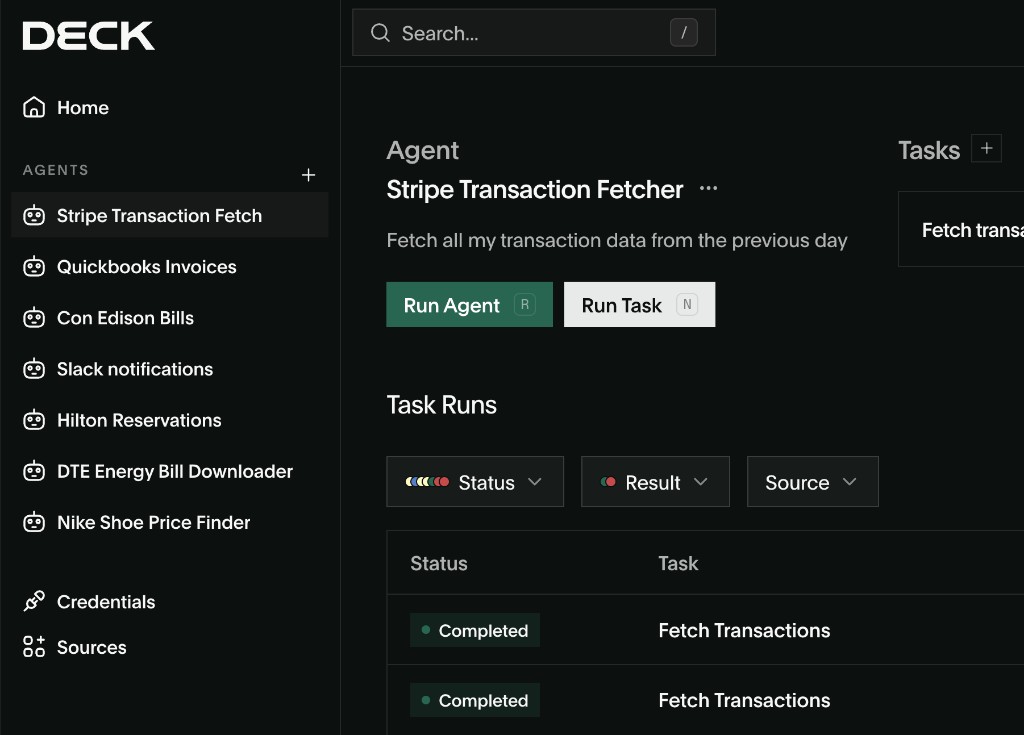
Deck's answer is a stack rather than a single clever bot. It provisions isolated desktop environments, keeps credentials in an encrypted vault, manages authenticated sessions, and lets teams watch or replay what an agent did. Developers can create and run work through the Console, API, SDK, or command line tool. Outputs arrive as structured data, so the agent's visit to a messy portal can become a predictable input to another application. A person still grants the initial access, and sensitive actions can require human approval.
That places Deck in an odd but useful market position. Playwright and Selenium give developers ways to drive a browser. RPA products record and repeat workflows. Direct integrations use an application's API when one exists and does the job. Deck sells the managed layer for cases where the target system is a moving, authenticated interface and the customer does not want to own a small civilization of scripts. It is especially useful when a product must work across many unrelated portals, rather than one page a team controls.
A bill, a portal, a sales contract
Rampart, a procurement company, needed invoices and purchase orders from hundreds of vendors. Those documents sat behind separate logins, two-factor checks, and sites that were not particularly eager to make automated retrieval easy. Rampart says one developer built about 20 Deck integrations in half a day. Its case study also puts the avoided work at two to three engineering employees and roughly a year of development. Those are customer-reported results, but they reveal the economics: a vendor portal is cheap to visit once and expensive to maintain forever.
Deepki tells a different version of the same story. Its real estate sustainability platform processes about six million invoices annually. It kept high-volume data pipelines in-house, where its own expertise and per-document costs made sense, and routed roughly 300 difficult, lower-volume sources to Deck. New sources that had taken months to bring live could go live in days. The useful lesson is selective: buy relief from the long tail, keep the work whose volume justifies your own machinery.
BuildVision, which turns construction documents into structured data, uses Deck at an earlier stage of the sale. A manufacturer wants to see an actual workflow inside its own legacy systems before signing. Building every possible integration first would consume months of engineering time. BuildVision demonstrates one working branch with Deck, then makes the longer-term integration investment after a contract is signed. Here the agent is not replacing a final product. It is helping a prospective customer believe the final product can be built.
The range matters. PaySitters uses Deck for bill information and payment-related tasks; Smartbills connects electricity, gas, and water accounts. The published customer list stretches into construction, procurement, retail and sustainability. Deck's common denominator is not a vertical. It is software that makes people perform the same authenticated dance again and again.

The company behind the cursor
Deck was founded in Montreal in 2024 by Yves-Gabriel Leboeuf and Fred Lavoie, alumni of Flinks, the Canadian open-banking company acquired by National Bank of Canada. TechCrunch also identified Bruno Lambert as a co-founder and CTO in 2025. The connection to banking is more than a résumé detail. Open banking taught a generation of founders that the interesting data is frequently owned by the user but trapped in systems built to serve the institution. Deck applies that instinct well beyond accounts at a bank.
In April 2025, Deck raised a $12 million Series A led by Infinity Ventures. TechCrunch reported $16.5 million raised in total at the time. The company's current site says it has raised $25 million overall; it does not spell out every intervening round there. The money supports an infrastructure business with a deceptively physical cost structure: virtual machines must start quickly, sessions must stay separate, and failed runs must be observable rather than mysterious.
The public price list gives the business model a clearer outline. A free tier lets a developer try one concurrent agent and ten monthly task runs. Starter is $25 a month; Pro is $250. Higher limits, additional storage and extraction, and custom enterprise arrangements carry the platform into larger deployments. Buyers can test an awkward portal before negotiating a company-wide contract. That is a sensible funnel for a product whose value often becomes obvious only when it meets a real login screen.
There are boundaries. A system must permit the access and the account holder must authorize it. A portal that cannot be reached through a workable interface, or one that requires physical hardware at every step, may demand another route. For a stable, high-volume integration with a good official API, direct code can be cheaper and simpler. Deck's own Deepki example makes the point: the difficult long tail was its assignment, while the core pipes stayed with the customer.
The company has also had to address a less charming fact about agents: they may touch sensitive data or take consequential actions. Deck says sessions are isolated and replayable, credentials are vaulted, and operators can stop agents. In August 2026 it announced PCI DSS Level 1 compliance through an independently assessed Report on Compliance. Those controls do not make every possible automation wise. They make it possible to ask the right questions before letting an agent press a button that matters.
A useful test for readers is almost embarrassingly plain: list the work your team repeats behind a login, count the different portals, and ask what breaks first when a page changes. If the answer is “our script, every Tuesday,” Deck has a serious argument. The web may have been designed for fingers and eyes. It is beginning to acquire a second class of worker.