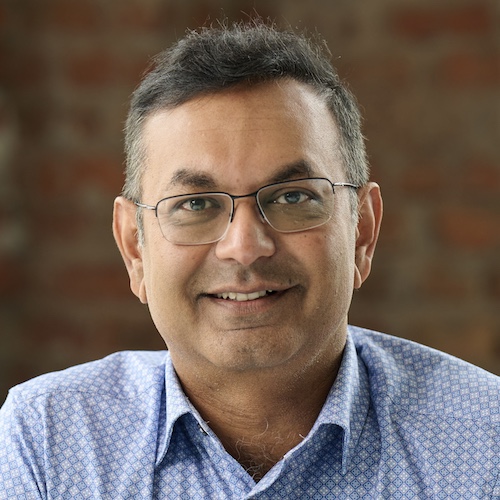
Profile
Closing the Gap Between AI Promise and Business Proof
The Uber driver didn't care about platform architecture. He just wanted to talk about ChatGPT. Debanjan Saha had just walked out of a Morgan Stanley investment conference in San Francisco — the kind where investors probed every angle of generative AI's market potential — and his driver spent the entire ride home asking questions that Wall Street and Silicon Valley had been asking for months. "I realized that AI has arrived," Saha said. The moment stuck. It wasn't the conference that convinced him. It was the cab.
That granularity — reading the room through the unexpected signal — is characteristic of how Saha operates. He is the CEO of DataRobot, a Boston-headquartered enterprise AI company that has raised over $1.3 billion and currently serves some of the world's largest financial institutions, manufacturers, and government agencies. But the way he frames his job isn't about AI at all. It's about the two gaps he thinks every enterprise must close: the value gap (can AI prove it makes the business better?) and the confidence gap (can anyone trust that the answer is actually right?).
"Bringing AI to business is not easy because you need to speak AI and the business language, and it's very difficult to find people who speak both," he has said. DataRobot is his answer to that problem — a platform that tries to translate between the two without asking enterprises to rebuild their entire data strategy.
It's like a human being who needs both the left and the right brain: You need generative AI and predictive AI together to solve many use cases.
- Debanjan Saha, CEO of DataRobot
The analogy he reaches for most often is neurological. Generative AI handles language, synthesis, creativity — the right brain. Predictive AI handles numbers, forecasting, causal inference — the left. Building an enterprise AI platform that only does one is like trying to navigate a city with half a map. DataRobot, in his telling, is the whole map.
Tea Country to Technology
Debanjan Saha grew up in Darjeeling — a Himalayan town perched at roughly 7,000 feet, known internationally for the particular muscatel character of its tea leaves. It is not, conventionally, where careers in enterprise cloud infrastructure begin. He earned his undergraduate degree at the Indian Institute of Technology in Kharagpur, one of India's most competitive engineering programs, then left for the United States to pursue graduate work at the University of Maryland.
He completed his Master's in Computer Science in 1993 and his PhD in 1995. The dissertation years coincided with the early public internet — a technology that was, at the time, still widely misread as a novelty. Saha saw it differently. He considered staying in academia; he was a teaching assistant in the Computer Science department and had advisors who could have kept him on that path. But the internet's pull was stronger than the faculty track. He chose industry.
That instinct — to move toward the technology that was about to change everything — has repeated itself across his career with a consistency that looks, in retrospect, like a strategy but was probably just a disposition.
Field Dispatch
While stationed in Shanghai during his IBM international assignment, Saha attempted to drive to Everest Base Camp via Tibet. At 17,000 feet, severe altitude sickness stopped the journey. He spent three days recovering in a Tibetan hospital. He did not reach the summit. He did, apparently, keep going back to China.
IBM, Tellium, and the Infrastructure Years
After his PhD, Saha joined IBM Research — a logical landing spot for a computer scientist in 1995, when IBM's research division was still one of the few places in the world doing serious systems work at scale. He moved through several roles, eventually leading projects tied to Defense Department data analytics and growing a data storage business into a billion-dollar line. He ran IBM's labs in India and China, including a two-year international posting in Shanghai that included, among other things, the altitude-sickness episode at 17,000 feet.
In between IBM stints, he joined Tellium — an optical networking startup that was betting on a specific kind of switch architecture as the internet's fiber infrastructure scaled. He helped take the company from early stage to a public offering valued at over $3 billion. The experience of watching a technical bet become a market position, under conditions of real uncertainty, shaped how he would think about product leadership later.
AWS: The Launch That Changed a Company's History
When Saha moved to Amazon Web Services, he took on database services — a category that sounds unglamorous until you consider that every application running in the cloud eventually hits a database. His team's most significant release was Amazon Aurora, a MySQL- and PostgreSQL-compatible relational database designed to operate at the scale that cloud-native workloads demanded. Aurora became, by AWS's own accounting, the fastest-growing service in the company's history. He also led the development and launch of AWS Glue, a data integration and transformation service that became foundational to AWS's data lake strategy.
Those weren't adjacent projects. Aurora addressed storage and query at scale; Glue addressed the messy, labor-intensive process of getting data ready for analysis. Together, they traced the full pipeline from raw data to usable insight — which is, not coincidentally, the same pipeline that DataRobot is now trying to own end-to-end for enterprise AI.
Google Cloud: When the Analytics Business Found Its Scale
At Google Cloud, Saha served as Vice President and General Manager of Data Analytics Services, carrying full P&L responsibility for the analytics business. The role required running engineering, operations, and go-to-market simultaneously — a combination that is common in the job description and uncommon in practice. During his tenure, his team launched BigQuery Omni (Google's multi-cloud analytics capability), Dataplex (a data mesh and governance platform), Data Fusion, and Data Catalog.
The launches were each technically significant, but the strategic thread connecting them was the same one Saha has been pulling since 1995: the infrastructure that handles data at scale is the infrastructure that handles everything eventually. When he left Google for DataRobot in February 2022, he was joining a company that had already built a serious platform — but needed someone who understood what serious infrastructure looks like at enterprise scale.
AI is now at an inflection point that demands proof of measurable business value and impact. It's a new era we call 'value-driven AI' and it has long been our sweet spot.
- Debanjan Saha, DataRobot CEO
DataRobot: From COO to CEO in Seven Months
Saha joined DataRobot as President and Chief Operating Officer in February 2022. By July of that year he was named interim CEO. By September, the "interim" designation was removed. The speed of that progression reflected DataRobot's circumstances — the company was navigating a period of significant turbulence, having reduced its workforce by 26 percent amid broader market pressures on growth-stage technology companies. Mark Hawkins, DataRobot's Board Chairman, described Saha as embodying the company's "innovation and customer-first culture" and possessing a "clear vision for the future to capitalize on the tremendous market opportunity in AI."
His first major public statement as CEO was a letter to customers and employees framing the company's path forward around operational discipline and customer focus. "We're taking decisive action to reorganize the company to focus on our strengths — innovation and delivering value for our customers," he wrote. Under his leadership, DataRobot secured its position in Gartner's Magic Quadrant for Data Science and Machine Learning Platforms, earning Leader designation in 2025 for the second consecutive year.
In February 2025, DataRobot acquired Agnostiq and its open-source distributed computing platform Covalent — a move designed to accelerate the company's agentic AI roadmap and give enterprises more tools for deploying generative AI solutions securely across complex infrastructure environments.
The Two-Brain Theory of Enterprise AI
The intellectual frame that Saha returns to most consistently is the distinction between predictive AI and generative AI — not as competing approaches, but as complementary capabilities that enterprises need simultaneously. Predictive AI tells you what is likely to happen based on historical patterns. Generative AI synthesizes, interprets, and communicates. Deploying one without the other leaves gaps that are easy to underestimate until something goes wrong.
"It's not difficult to put together a chatbot that answers some questions," he said. "It's hard to guarantee that they are going to answer the question correctly." That qualification — the gap between technically possible and reliably correct — is where DataRobot positions itself. The platform is designed to give enterprises the governance, monitoring, and validation tooling that makes AI trustworthy enough to deploy in high-stakes decisions, not just in demos.
His view on leadership follows a similar logic of necessary complements: "Provide clarity on vision and mission. The Why is just as important as the What." And on company culture: "A company fundamentally is just people and ideas. Culture is the fabric of the two, the secret sauce." These aren't platitudes from a keynote deck. They're the operating principles of someone who has navigated three of the largest technology companies in the world and learned, at some cost, what happens when the fabric tears.
Career Path
IIT Kharagpur→
Univ. of Maryland PhD→
IBM Research→
Tellium (IPO $3B+)→
IBM (Global)→
Amazon Web Services→
Google Cloud→
DataRobot CEO