The support tickets arrived with the reliable monotony of rain. Cancel my subscription. Where is this feature? Can I get a refund? Martin, the AI personal assistant Dawson Chen had spent two years building, was growing roughly ten percent a week at its fastest clip. Growth made the graph handsome. It also produced 30 or more daily reminders that software success involves people asking why the software has disappointed them.
Chen hired a virtual assistant in the Philippines to help. He opened Zendesk, moved between the inbox, Stripe and Martin's database, and kept answering. The awkwardness was instructive. The tools appeared built for a vice president of support with a department, not for a founder with two hands and an alarming queue. Martin eventually reached 100,000 users and $1.3 million in annual recurring revenue. Yet Chen and co-founder Ethan Hou could see the less flattering number: the chance that a new customer would still be using Martin eight weeks later was close to zero.
So they stopped admiring the revenue and listened to the retention. In January 2026, the pair began a hard pivot. Their eventual destination was not a vision imported from a trend report. It was the tool they had already built to survive their own customer support. They called it Letterbook.
The robot before the revenue
Long before Chen built agents to read calendars or customer records, he built a robot to read grass. At the Harker School in San Jose, he spent two years on the Intelligent Robotic Irrigation System, or IRIS, an autonomous lawn-watering machine. In a volunteer profile, he called the robot his pet. It is a revealing joke. Chen's projects tend to become companions before they become companies.
The teenage engineer also volunteered with Our City Forest. He began in 2018 because his school offered volunteer hours, then stayed because he liked the people and the work. Later, through the Houseless Environmental Volunteers Initiative, he worked with the organization to arrange weekend tree-planting jobs for 100 unhoused people. His public profile says ten participants went on to find jobs. The effort paired a local environmental task with paid work, a practical arrangement rather than an airy promise.
IRIS earned science-fair recognition, and Chen became a 2022 Coca-Cola Scholar. Yale followed. He studied computer science, but the classroom competed badly with side projects. He built a marketplace where visitors could pay college students for campus tours. Another app, Flick, assigned users a nearby stranger and gave them a day to take a photo together. Chen has said he compressed schoolwork into short sprints so he could spend the rest of his time building.
“I have dedicated the past two years to building an irrigation robot, which has basically become my pet at this point.”Dawson Chen, 2021
A better Siri, blurted out
At Y Combinator in the summer of 2023, Chen and his original team attempted to reason their way toward an idea. A whiteboard ranked possibilities by founder-market fit, market size and ease of starting. They brought six to office hours. The partners disliked all six. Advertising technology, grocery-store point-of-sale systems and research tools made little sense for a group of teenagers without experience in those industries.
At the end, Chen offered the idea that had not earned a place on the board: he had always wished Siri were better. What if they wrapped a voice around GPT-4 and built something closer to Jarvis from Iron Man? Y Combinator partners Jared Friedman and Wayne Crosby considered that the strongest proposal. Martin began as the thought too obvious and technically unruly to score.
The name came from Chen's high-school robotics mentor; Chen has said the assistant's voice partly echoed him. The product could be reached by text, call, email and Slack. It worked across calendars, inboxes and to-do lists, and could send messages or make calls for its user. In January 2025, Chen and Hou announced a $2 million seed round. Chen was 19, a Yale dropout; Hou had left Berkeley. They were pitching a personal agent while much larger companies were promising their own.
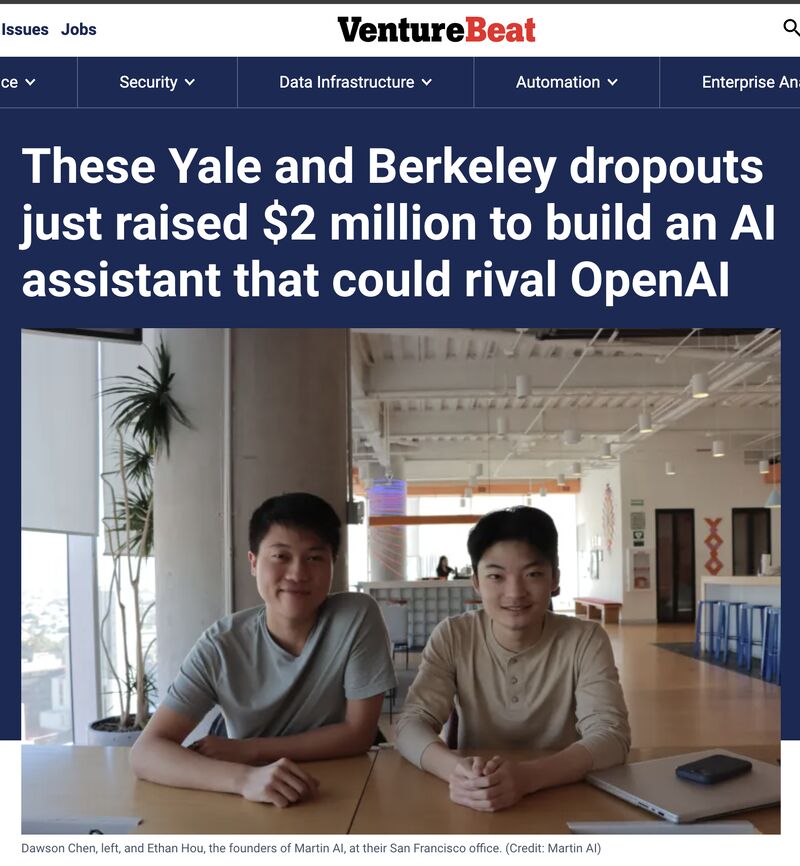
The partnership had not arrived neatly. Chen had spent about a year building Martin before meeting Hou. Both had tried life as solo founders; both had watched earlier co-founder arrangements dissolve. In Chen's telling, Hou had little personal runway left when they met. What joined them was an old wish for a Jarvis-like assistant and a refusal to stop. They later left the United States under a self-imposed rule: no return until the company reached $500,000 ARR. Seven months later, in Ho Chi Minh City, they bought the return ticket.
The channel worked. The habit did not.
Martin's growth was not an accident. For a year, the team sampled channels like impatient diners: Reddit, then Twitter, then short video. Nothing had time to compound. Chen eventually spent two months concentrating on Meta ads. The fit was sensible. Few people search for an AI personal assistant, but a video of a working Jarvis can interrupt a scroll. Growth reached roughly ten percent week over week.
This is the uncomfortable middle of Chen's story. Marketing had found a repeatable way to bring people in. It had not found a reason for them to remain. Martin offered many impressive actions but, Chen concluded, no single essential one. Ten mediocre use cases could put on a convincing demo; none could carry a relationship after the novelty passed.
Revenue is usually treated as the stern adult among startup metrics. Here it behaved more like a charming accomplice. The money was real, and so was the churn. Chen and Hou chose the second signal. Their decision did not invalidate what they had learned about paid acquisition. It separated a working channel from an unfinished product.
“The truth is, we never found 1 killer use case and settled for 10 mediocre ones.”Dawson Chen on Martin's retention problem
Pivot hell has a workshop
The search that followed was busy and unserious in the productive sense. The team made a command-line tool to order DoorDash. They tried a personalized feed to replace Instagram, a Twilio competitor with improved fraud detection, and a voice assistant that could see the user's calendar and inbox. Chen has called the period “Pivot Hell,” but his list has the rhythm of a small experimental theatre.
The builds kept morale alive. Each had long odds, and the team knew it. Fun mattered because a pivot is not merely strategy; it is a test of whether the people performing it can remain interested long enough to recognize a useful result. Eventually, the useful result was behind them. Martin's internal support agent already understood the job that had made their days miserable.
Letterbook manages tickets from email, in-app feedback and website forms. It connects with a company's database, knowledge base and Stripe account, then triages a request, drafts the reply and prepares the resolution for review. Its target is deliberately narrower than every business with customers: startups and lean software teams whose founders are still close enough to the inbox to feel every extra click.
The lineage is visible. Martin was built around deep integrations and actions, not conversation alone. Letterbook applies the same preference to a less cinematic problem. A refund is not an eloquent paragraph; it is a customer record, a payment system, a decision and a message. The agent must know which account it is looking at and do the next piece of work.
The useful part to steal
Chen's path offers no tidy commandment about dropping out, joining an accelerator or pursuing AI. Its more portable lessons are operational. Choose a growth channel and stay with it long enough to learn its grammar. Keep retention close enough that acquisition cannot flatter you indefinitely. Watch the manual work accumulating behind your product. Internal tools are often a team's least theatrical and most honest inventions.
There is also his habit of attaching ambition to something he has physically encountered. Dry lawns preceded IRIS. Weekend volunteer work preceded HEVI. A frustrating voice assistant preceded Martin. A support queue preceded Letterbook. Even the dream of Jarvis became credible only when translated into calendars, calls and messages.
Chen's public voice is candid and lightly comic. He tells young founders that saying “we're cooked” is normal, then adds that everyone is, in fact, cooked. He describes pivot hell without dressing it as a heroic wilderness. The humor leaves room for an unfashionable truth: building companies includes long stretches of being wrong in public while trying to remain good company for the person at the next desk.
On Waymo rides home, Chen and Hou debate which startups they would invest in. They ask about the market and the route to customers. Chen says they have begun dropping the question of whether a problem is technically feasible. Sitting inside a self-driving car makes some software doubts sound quaint. The confidence is broad; the product is specific. Letterbook's immediate world remains a ticket, a customer and a founder who would like the queue to be shorter by dinner.
The curious achievement is not that Chen walked away from $1.3 million ARR. It is that he noticed what remained after the impressive number lost its authority. Martin's support burden was not collateral damage. It was evidence. The next company had been quietly answering emails all along.