Dawn Owens knows something about the peculiar demands of a handover. You can give someone a title in a sentence. Giving them room to lead takes considerably longer. In July 2020, she became chief executive of TripleTree Holdings, succeeding its founder, Kevin Green. The appointment had a history: she had joined as president in 2015, with growth and founder succession already part of the assignment.
Five years is a generous amount of time for a press release to leave out. It is also the part that makes this story interesting. Before the announcement came a working relationship, a division of responsibilities, and a future that two leaders had to prepare together. Green moved to Executive Chairman. Owens took the chief executive’s role. The business continued with both of them involved.
Today, she is CEO and Partner at Truehelm, the investment firm formerly called TT Capital Partners. Between the two names sits another consequential handover: the sale of an investment banking business and the emergence of a separate, independent investment organization. Owens’s career has become a study in how authority moves, and what people owe one another while it does.
A career with room to turn
Her education offered two ways of looking outward. At Grove City College, she studied International Business and German. The class of 1990 graduate would later return to the college in a different capacity, but first came the work of learning businesses from within. She began in sales at Aetna and subsequently moved into UnitedHealth Group, where her responsibilities expanded across operating and executive roles.
Sales, operations, marketing, investment: the nouns sound tidy when placed in a biography. Each describes a different relationship with a business. Sales begins with someone else’s problem. Operations requires getting an organization to deliver. Marketing asks how a company explains its usefulness. Investing adds the question of where capital should go, and what the people responsible for it should expect.
Owens has worked across those boundaries. Her background includes leading Uniprise and serving as chief marketing officer of Ingenix. By September 2007, she had become CEO of OptumHealth. Those titles establish the range of her operating experience without reducing it to a single specialty. Before she was advising management teams from an investor’s seat, she had occupied the seat where the decisions eventually land.
There was room for restlessness along the way. Discussing a move from running a business into marketing leadership, she supplied a wonderfully unadorned explanation: “I was bored.” Three words, and considerably less varnish than the customary statement about pursuing exciting opportunities. A career decision can look puzzling if the only available measuring instrument is the height of the next title.
The interesting question is what the new job teaches. Moving across functions changes which assumptions get tested. It puts an experienced executive back in the position of needing to learn. In Owens’s case, the sequence eventually carried her into investing, where experience running companies could inform decisions about backing them.
The five-year handover
When Owens joined TripleTree Holdings in 2015, her remit included working with Green to scale the business and prepare for founder succession. The arrangement deserves attention because it puts succession inside the operating plan. A founder’s eventual change of role was something to work toward while the company was still growing.
A founder is more than a name on an organizational chart. Relationships, habits, and expectations gather around the person who started a firm. A successor inherits those expectations along with the formal responsibilities. The practical challenge is allowing a new leader to exercise judgment while the founder’s experience remains useful. Too little clarity, and every decision acquires an extra destination.
The July 2020 announcement made the destination explicit. Owens became CEO; Green became Executive Chairman after 22 years as founder and chief executive. He would remain involved in strategy and principal investing. The change gave each leader a defined role in the next stage of the organization.
“A strategic and decisive leader”
Kevin Green, on Dawn Owens’s appointment as CEO, July 2020
Green’s description gives the handover a personal dimension. He was publicly endorsing the colleague who would assume his former responsibilities. That endorsement cannot tell us what every working conversation was like. It does show that the succession was presented as a continuing collaboration. The founder was making room, and the successor was accepting responsibility for what happened next.
Two businesses, two destinations
The next structural change arrived in 2021. Capital One completed its acquisition of TripleTree’s investment banking business on November 29. What had been two businesses within TripleTree Holdings became separate organizations. The investment bank joined Capital One. TT Capital Partners continued as an independent, Minneapolis-based principal investor.
The distinction matters when following Owens’s career. An investment bank advises on transactions. A principal investor puts capital into companies and stays involved as an owner. They may speak to some of the same executives, but the obligations differ. One transaction changed the organizational setting in which those relationships would continue.
Independence also creates a practical communication task. Employees, investors, and company leaders need to know what the new arrangement means for them. A familiar name can carry several businesses in people’s minds. Once the businesses separate, the explanation has to become more precise. The paperwork finishes on a date; understanding the organization can take longer.
For Owens, the independent investment platform became the setting for her next chapter. The experience of leading businesses remained relevant, but the means of influence had changed. An investor can help shape priorities and ask difficult questions. The management team still has to run the company. Expertise earns its value through the quality of the exchange.
A new name, an old obligation
On April 2, 2026, TT Capital Partners announced that it was becoming Truehelm. The rebrand followed completion of the firm’s third fundraise in September 2025. In the announcement, Owens described the firm as “reliable, principled partners.” The phrase sets a standard that is easier to say than to demonstrate, which is a useful quality in a promise.
Reliability becomes visible when people need an answer. Principle becomes visible when the convenient decision and the defensible decision diverge. Partnership becomes visible when responsibility is shared without becoming vague. A name can introduce those expectations. The work that follows determines whether anyone finds the introduction convincing.
The firm currently reports $1 billion in assets under management and dates its founding to 2012. Those figures describe the investment platform, rather than Owens’s personal wealth or an individual accomplishment. Scale gives context to the role: a chief executive is responsible for an organization whose commitments extend well beyond a single investment or announcement.
Truehelm’s reported firm scale. Capital carries obligations to investors and company leaders.
There is outside recognition of the firm’s relationship with founders, too. In October 2025, TT Capital Partners announced its fourth consecutive inclusion on Inc.’s Founder-Friendly Investors list. The distinction belongs to the firm and its team. In this story, its relevance is specific: supporting founder-led businesses is part of the organization Owens leads, as well as part of the succession she experienced herself.
The work between the announcements
Much of an executive’s job happens away from milestones. Owens’s current responsibilities include the investment committee and committees covering risk and compliance, valuation, and ESG. She also holds portfolio board seats. These are places where judgment has to be translated into questions, decisions, and oversight. They bring the daily obligations behind the public title into view.
In August 2026, the firm promoted Donnacha O’Sullivan to Partner. Owens called him a “thoughtful investor, steady leader, and trusted colleague.” The words offer a small window into the qualities she chooses to recognize publicly. Investment skill sits alongside steadiness and trust. A promotion is also a statement to everyone else about what the organization values.
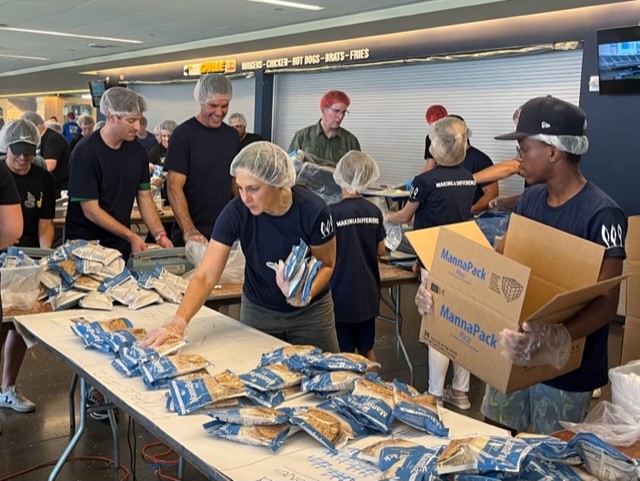
Then there is the work with a less glamorous uniform. A photograph on the firm’s careers page shows Owens and colleagues packing meals at a volunteer event. Boxes, packets, hairnets, and a crowded table replace the familiar boardroom scenery. The picture records a shared task. It needs no elaborate theory of leadership to explain why it belongs here.
Truehelm’s careers material also encourages community involvement through volunteering and nonprofit board service. Such activities give colleagues another setting in which to work together. The photograph’s charm lies in its ordinary detail: everyone has something to do, and the cardboard box is indifferent to anyone’s title.
People before the org chart
Owens’s relationship with Grove City College has continued across several stages of her career. She received its Alumni Achievement Award in business in 2005 and joined its Board of Trustees in 2008. Her current biography places her on the board’s Executive Committee. The institution where she studied remains an organization for which she takes responsibility.
The college connection adds duration to a story otherwise marked by changes in role and structure. A career has appointments and departures; it also has relationships that continue. Both belong in the account. Her work in investing, corporate governance, and college stewardship brings her into organizations with different purposes and different constituencies.
She has put the human obligation directly: “Once you get away from seeing people as people, you lose perspective.” That is a sensible sentence to carry into a boardroom. An organizational chart is useful precisely because it simplifies. The danger begins when the simplification becomes the whole picture.
Owens’s public milestones chart a movement from operating authority toward investment leadership, followed by succession and independence. The thread is responsibility as it changes hands. Someone has to explain the decision, make room for another leader, and remain useful after the announcement. The wheel can move. The people who depend on its direction are still there.