David Yu had a complaint about college that required no market research: the lecture video was still playing, and he still wanted a better way to understand it. At Michigan State University, he and fellow students Achyut Byanjankar and Soami Kapadia spent weekends working on the problem with laptops and a whiteboard. They called the sessions Dormathons. The name has the optimism of students who believe a weekend can accommodate both a new company and the rest of their coursework.
Their project became YouLearn, an AI tutor built around the materials a student already has. The premise is easy to grasp. A lecture should be something you can question. A textbook should lead to a conversation. A set of notes should help you discover where your understanding gives out. Yu’s route into that business brings together writing software, teaching AI, and making educational content. It also brings a founder face to face with a stubborn distinction: people can enjoy discovering a tool without making it part of their lives.
The weekend had a name
The early record starts before the date on the company profile. Work on YouLearn was underway in January 2023. The student team then included Advait Paliwal alongside Yu, Byanjankar, and Kapadia. They entered a prototype in SpartaHack 8, Michigan State’s student hackathon, and won a category award for improving asynchronous visual communication and knowledge sharing. It was an appropriately unwieldy prize name for a fairly direct idea: help people understand something they are watching.
That June, the project was among five concepts competing in Michigan’s EdTech Innovation contest. Yu and Paliwal went on to take third place. The competition’s description put educators in the picture, with a model that let them upload curriculum for students to use with AI tutors. From the beginning, the work concerned the relationship between an explanation and the person receiving it. A lecture can be delivered perfectly well and still leave a listener with a question.
- 2023Student prototype, SpartaHack award, Michigan competition
- 2024YouLearn’s formal founding year in its YC profile
- 2025Y Combinator’s Spring batch
Yu’s beta announcement later in 2023 credited all four builders. That detail deserves to survive the tidying-up that happens to startup histories. An early project and a later founding team can have different boundaries. YouLearn’s current founding roster lists Yu, Byanjankar, and Kapadia; its earlier work also involved Paliwal. The sequence makes room for the actual collaborators, rather than asking the past to pose for the latest company photograph.
There was another useful early milestone: work through buildspace’s nights and weekends program. In a contemporary post shared by Yu, Paliwal described the team attracting more than 4,000 unique visitors and processing over 1,200 videos. Those figures belong to the prototype chapter. They show a tool being tried on real material, well before the later milestones made the company easier to summarize.
A builder with a distribution habit
Yu’s personal portfolio gives a compact account of the work behind the title. He lists full-stack development, AI, interface work, and marketing at YouLearn in 2023 and 2024. He also lists a 2024 digital marketing engineering internship at TWA. The job descriptions cross boundaries that a larger organization might turn into separate departments. For a young project, getting the thing built and getting someone to try it sit very close together.
His side projects reflect the same mixture. PromptGPT applied language models to academic questions. Another experiment, AI or Human, asked whether people could distinguish a chatbot from a person. He reports that 45 percent of 150 students mistook the bot for a human. It is a small, self-reported project result, with a revealing question behind it: what does a convincing interaction look like from the other side of the screen?
The portfolio also records workshops for the MSU AI Club. His founder biography describes teaching AI to more than 1,000 students in college. Teaching puts a particular demand on a builder. A feature can function while its explanation fails. The person in front of you can follow the instructions and still miss the point. For someone making a tutoring product, that gap is part of the job.
Then there is the portfolio’s modest prank. Its two writing entries, Design and Reflect, promise an essay about art and a new beginning. Both links take the visitor to Rick Astley’s music video. A reader arrives expecting reflections on design and receives an unexpectedly durable piece of internet tradition. Even an educational founder is allowed to set a small trap for the curious.
“Minimize friction and make learning extremely easy.”
David Yu
The second session
The product that emerged turns uploaded study materials into notes, a conversational tutor, and personalized tests. PDFs, recorded lectures, and YouTube videos give it something specific to work with. That matters because a student’s question usually belongs to a particular course, a particular explanation, or a particular passage. The useful conversation begins where the course material becomes difficult.
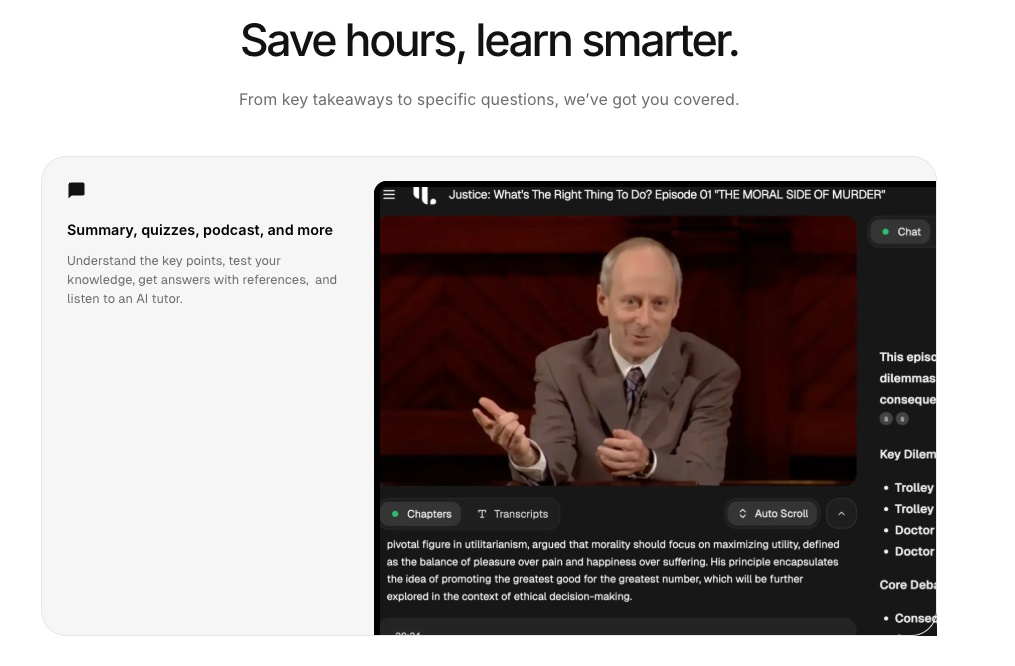
Imagine the difference between watching a video through to the end and being able to ask about the part that lost you. The first experience has an obvious finish line: the progress bar reaches the right-hand edge. The second has a less convenient one. You have to decide whether the explanation makes sense. You may need another example. Software built for that second experience has to leave room for the learner to interrupt.
Yu’s team came to focus on repeat use, simplifying uploads and watching where students stopped. The ambition was a two-step route into the material. That is an unusually practical expression of an educational mission. Before a tutor can help with an argument or an equation, the student has to get the document into the system. An elaborate welcome screen is poor company when an assignment is due.
A workflow illustration, rather than a measure of learning outcomes.
The second session offers a useful editorial lens on his story. A first visit can follow a good demonstration, a recommendation, or curiosity about AI. A return asks more of the product. The student brings another piece of work and expects the tool to be worth opening again. There is little ceremony in that decision. The browser is already crowded.
Yu describes college’s lasting lesson as “learning how to learn.” It is an ambition that sounds abstract until it meets an interface. Where do you ask the next question? How do you check your understanding? Can you find the material again? Those are mundane design questions with educational consequences. They give the founder’s larger aspiration something tangible to attach to.
A sign outside, a problem inside
In 2025, YouLearn joined Y Combinator’s Spring batch. Michigan State’s Burgess Institute later included Yu in its account of university founders reaching the accelerator, identifying him with the class of 2024. The route from East Lansing to San Francisco had acquired recognizable markers: a student competition, a company, and an accelerator. Each marked a different stage of the work.
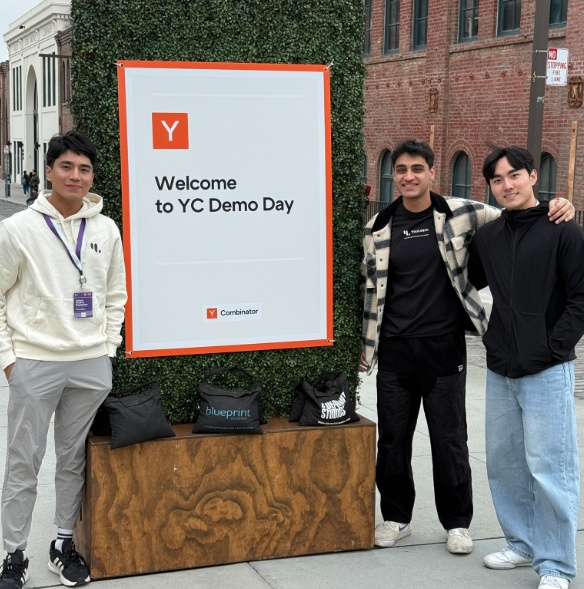
The launch account described growth from $1,000 to $70,000 in monthly recurring revenue over eight months, alongside 150,000 monthly active users. These were company-reported business figures at that stage, with a useful distinction between paying subscriptions and people using the service. Neither figure by itself says what happened inside a student’s head. Together, they describe a business finding an audience.
over eight months
at that launch stage
Yu’s experience with educational content belongs here, too. Demonstrating a study tool means showing a use for it quickly enough that someone pays attention. But a short demonstration and an extended study session ask for different kinds of patience. The founder has to understand both. The video can invite someone in; the product has to carry the conversation after the invitation has done its work.
That is why the photograph at Demo Day is a milestone without being a conclusion. It provides the satisfying scene that a startup story tends to want. The actual task continues indoors, in the unphotographed details of a learner’s next visit. A sign can announce arrival. It cannot answer the next question.
Seventy million pages later
A later chapter followed the documents themselves. The YouLearn team said it had processed 70 million pages for 2.5 million users. Long textbooks, handwriting, and scans with awkward tables led it to build a document parser, which became Hanji. The tutoring application had produced an infrastructure problem of its own. Before software can explain a page, it has to read the page correctly.
Hanji turned that internal work into a separate offering for extracting usable data from difficult documents. Its hosted API and dashboard subsequently went offline on August 28, 2026. The team’s notice points users to the open-source API and parsing model. The sequence includes both the launch and the closure, with the code available for people to run themselves.
The detour is part of Yu’s story because it shows how far a simple complaint can travel. The original problem lived at the point where a student pressed play. A later problem lived inside the file, before the tutor could begin. Between them sits the same practical demand: make the material usable by the person who needs it.
Yu’s stated ambition is an AI tutor for everyone. The scale of that ambition makes the small decisions more consequential. Someone still needs to upload a lecture. Someone still needs to ask a question that feels obvious. Someone still needs to try again when the first explanation leaves them puzzled. The Dormathons began with impatience. The work they produced keeps returning to the student’s next question.