The deal David Rowe remembers began with engine maintenance. Fred Smith had aircraft to keep flying and a business to build. Brian Rowe, David’s father and a GE aviation executive, offered a line of credit and terms for overhauling the engines. The collateral was the aircraft. The agreement, David later recalled, was made on a handshake. Brian asked that, if Smith’s business succeeded, he would buy GE engines.
Smith’s business was FedEx. There are worse customers to acquire with a handshake. The episode also supplies a useful opening to David Rowe’s own career: a machine, someone who understands it, and a financial arrangement that lets it get to work. Flight tends to attract photographs of the aircraft. Rowe’s professional life gives the paperwork a turn in the picture.
A handshake, an engine, a line of credit
“Fred came to my dad over the maintenance of his engines,” Rowe said, recalling the arrangement. It is a compact description of a relationship that joined technical knowledge with commercial judgment. The aircraft were Falcon 20 jets powered by GE’s CF700 engines. Brian had led the CF700 program earlier in his GE career. When a customer needed help, he knew the equipment under discussion.
The story belongs to Brian and Smith. David’s part is to remember and recount it. Still, it offers a revealing family connection to the industry in which he later built his own business. Engines carried a service obligation and a financing problem as well as thrust. A prospective customer could become a lasting commercial relationship. The machinery and the money were already in the same conversation.
In 1998, Brian and David founded AeroEquity. Their names appear together at the beginning of the firm’s history. David brought experience of his own to the partnership, including years spent managing commercial aircraft and engine assets. The son’s route into investing ran through the financial lives of machines that had already been built.
The useful life of a flying machine
Rowe spent 12 years at GE Aerospace and GE Capital. His responsibilities included fleet management, trading, repossessions and restructuring asset portfolios. The combination is worth pausing over. Trading concerns what an asset can command. Fleet management concerns what happens to it while it remains in service. Repossession introduces the rather less festive question of what happens when an agreement stops working.
He subsequently became an executive vice president at Gulfstream Financial Services, where he created a leasing portfolio for the aircraft manufacturer. His education included a BA from Tulane University and GE’s Financial Management Program. The route joined a university degree to company training and then to decisions involving aircraft, customers and capital.
Leasing makes the distinction between using a machine and owning it visible. The operator needs access to the equipment; the financing arrangement determines how that access is paid for. Rowe’s earlier jobs put him around these decisions before he became a founder. They are a useful lens for the investment business that followed, which still includes aerospace leasing alongside company ownership.
and engine assets
leasing portfolio
investment firm
Sixteen years before the flagship funds
AeroEquity’s first chapter lasted a considerable time. Between 1998 and 2014, the firm completed 15 platform investments and 22 add-on acquisitions as a fundless sponsor. In that model, capital is assembled for individual transactions rather than drawn from a committed flagship fund. Sixteen years is a substantial apprenticeship in finding businesses and getting deals done.
The next change came in 2014 and 2015. The firm adopted the AE Industrial Partners name, launched its first institutional private equity fund and opened its Boca Raton office. The father-son starting point had become a different organizational undertaking, with institutional capital and a growing team. Rowe’s career now included building the investment organization itself.
Michael Greene, who joined in 2008, shares the co-CEO and managing partner role with Rowe today. The partnership gives the firm’s history another point of continuity across its earlier and later periods. In an industry fond of marking time by the next fund, the dates of people’s arrivals tell a longer story.
The first flagship fund closed in 2016 with $680 million in commitments. Fund II followed in 2018 with $1.36 billion. Fund III closed in July 2024 at $1.28 billion. These are separate pools of committed capital raised at different times, each attached to an investment program. Together, they mark the distance traveled from the firm’s years of arranging individual deals.
A lectern beneath a space shuttle
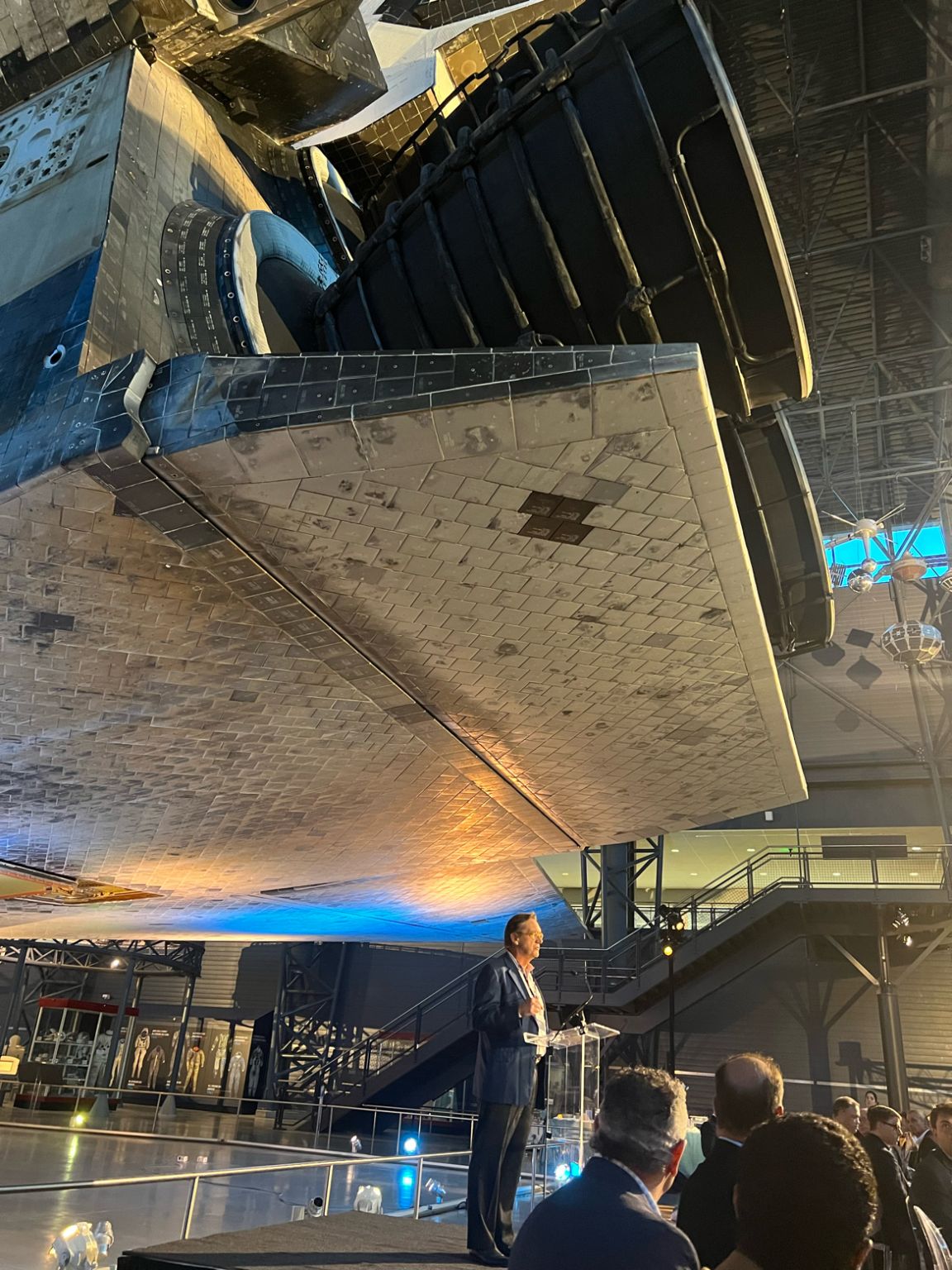
One photograph from the firm’s 2023 annual meeting places Rowe at a lectern beneath a space shuttle at the Steven F. Udvar-Hazy Center. The scale is almost comical. A speaker with a microphone occupies the bottom of the frame; the machinery commands the rest. For an aerospace investor meeting, the room had already delivered a fairly persuasive opening slide.
By then, the investment business had reached into venture capital as well. In 2021, Boeing entered a partnership with AE Industrial to manage and expand HorizonX, its venture investment arm. Brian Schettler, who had led Boeing’s venture team, would lead the platform. Boeing remained a strategic investor. The arrangement brought an established aerospace manufacturer and a specialist investment firm into a shared venture structure.
That development widened the kinds of agreements the firm could make. A controlling investment in an operating company and a minority investment in a developing technology carry different responsibilities. Both can sit within the same industrial field. The firm’s present mix of private equity, venture capital and leasing reflects that range.
People with operating experience are part of the picture too. When former Airbus executive Chris Emerson joined as an operating partner in 2022, Rowe pointed to his background and relationships as resources for the portfolio. The emphasis is practical: experience accumulated inside aerospace companies can be useful when an investor is deciding how another aerospace business should grow.
The toll gates on the way to orbit
For Fund III, AE Industrial described a focus on critical “toll gates” in aerospace and defense supply chains. The phrase gives a concrete shape to an investment strategy. A supply chain contains capabilities that other businesses need to pass through. Expanding those capabilities can matter to customers trying to increase production.
At the fund’s close, investments already included satellite business York Space Systems, cyber technology company RedLattice, Firefly Aerospace, aviation services provider Yingling Aviation and specialty chemicals business Calca Solutions. The variety is instructive. A launch company makes an obvious aerospace headline. Maintenance services and chemicals help show the broader industrial territory behind it.
Rowe’s own board history includes Gryphon Technologies. AE Industrial bought the defense engineering services company in 2018 and combined it with CDI’s government services business. Gryphon’s work included naval architecture, marine engineering, testing and program management. By the time ManTech agreed to buy it in 2021, the company had expanded through acquisitions into capabilities including analytics and cloud engineering. Rowe’s board tenure ended with the sale.
Meanwhile, aircraft leasing continued. In May 2025, the firm closed its second aerospace leasing fund with $418 million in commitments. At that point, more than 35 percent of its capital had been committed to a fleet of 20 assets. The platform covers commercial aircraft and engines, business jets and aircraft modified for government missions. It returns the story to equipment with an operating life still ahead.
“investors are looking for longer-term opportunities with strong underlying assets”
David Rowe · May 2025
Rocketdyne, back on its own
The next chapter arrived in August 2026, when AE Industrial completed its purchase of L3Harris’s space propulsion, power and electronics units and launched the business as Rocketdyne. L3Harris retained a minority stake. Kristin Houston became chief executive. The revived name came with an existing workforce and technologies already serving space customers.
Rocketdyne’s portfolio includes the RL10 upper-stage engine and in-space propulsion systems. The new business is a defined collection of operations drawn from L3Harris. Its announced plans include investment in RL10 manufacturing, increased thruster production and work on nuclear power and energy for space applications. Those are concrete operating tasks, with capital assigned to the equipment and capabilities behind them.
Rowe’s current board responsibilities include Rocketdyne and Global Jet Capital. One concerns propulsion and space systems; the other finances business aircraft. Put beside his earlier GE and Gulfstream work, the two appointments give his career a recognizable shape. The vehicles and ownership structures have changed. The relationship between a working machine and the capital around it keeps reappearing.
Global Jet Capital adds another connection to the earlier career. Launched in 2014 with backing from GSO Capital Partners, Carlyle and AE Industrial, it entered the financing market for large-cabin, long-range business aircraft. Rowe was part of its executive committee alongside Shawn Vick and Bill Boisture. The business brought together investors and executives familiar with the aircraft being financed. For a buyer, an aircraft purchase can tie up capital that might otherwise stay in the operating business. A financing company sits at that intersection, arranging access to the aircraft while considering the value of the asset. It is familiar ground in Rowe’s working history.
A handshake makes a memorable opening. The subsequent career has required portfolios, partners, funds and boards. Rowe’s story is most interesting where those arrangements touch something tangible: an engine to overhaul, an aircraft to lease, a supplier to expand, a propulsion business to equip for its next production run. There is plenty of sky in this business. Much of the work happens on the ground.