David Meyer’s early version of a night out involved a semitruck and a tractor. He would spend the day selling equipment, then deliver it in the evening, sometimes with his wife riding along. A return journey could become another sales call: collect the customer’s trade-in, stop at a different farm, find a buyer, and unload again. Romance had acquired an inventory-management function.
In Lisbon, North Dakota, Meyer had opened a dealership in 1977 with a parts employee and a mechanic. He covered sales, accounting, warranty paperwork, and whatever else needed doing. The work offered a practical education in how closely the departments depended on one another. A promise made in the showroom eventually landed in somebody’s service bay.
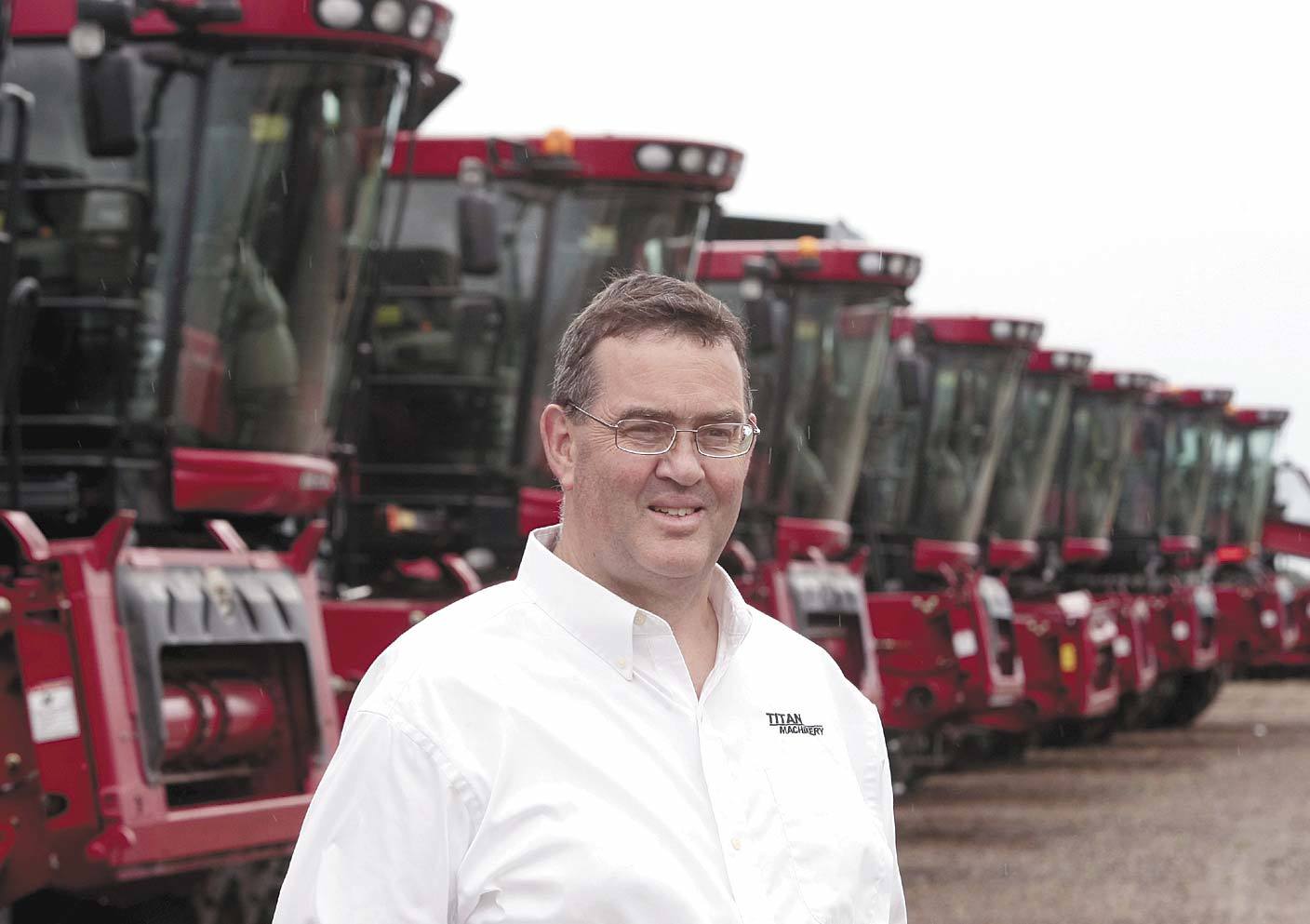
That small operation became part of Titan Machinery, the company he co-founded with Darrell Larson in 1980. Over the following decades, Meyer helped turn a North Dakota dealership business into an international network selling and supporting agricultural and construction equipment. He eventually handed over the CEO’s job. The central question of his career stayed remarkably close to that delivery truck: how do you keep being useful when the customer needs you?
The arithmetic of a tractor sale
Meyer graduated from the University of Minnesota’s Carlson School in 1975 and joined J.I. Case as a four-wheel-drive tractor product specialist. His territory took him through the Upper Midwest, meeting dealers and demonstrating equipment. He liked the machinery. He also noticed the economics of the people selling it.
On an early dealer visit, he watched a tractor transaction produce more money for the dealer than his own annual pay. His verdict was succinct: “I figured I was on the wrong side of this thing.” Within months he had moved into retail in Wahpeton. In 1976 he acquired a minority interest. The owner’s eventual retirement offered a route into ownership for a young employee willing to take it.
The timing was uncomfortable. The farm crisis of the 1980s put enormous pressure on customers and dealers. Expensive borrowing, weak crop prices, and drought made a tractor business an exacting place to learn confidence. Meyer’s response combined expense discipline with an insistence on continuing to sell and move equipment. Letting used machines sit could turn caution into another loss.
In a later account of those years, he described the same determination that would recur in his business advice: keep working the problem. Confidence, in this setting, had paperwork attached. The balance sheet mattered, the inventory mattered, and a convincing conversation with a farmer still mattered. A pleasant manner could open the door; the business had to survive long enough to answer it again.
Two North Dakota dealerships
The Christiansons join
December IPO
Let the store run the store
By 2009 Meyer was explaining an organizational idea he called the strong-store model. Put capable managers and resources into the dealerships. Support them with shared accounting, human resources, computers, marketing, and executive functions. The store manager could then concentrate on employees, customers, and the equipment that customers had bought.
There is a distinctly local logic to that arrangement. Farmers do business in particular places, with particular people. A combine does not break down at headquarters. The challenge for a growing chain was to gain the benefits of a larger organization while keeping someone close enough to understand the problem in front of the customer.
His practical advice to other dealers was equally specific. Spend on facilities, tools, trucks, and the ability to do the job. Keep premises orderly. Be accessible when farmers are working. The machinery might look splendid in a sales photograph, but the useful test arrived later, when someone needed a part or a technician at an inconvenient hour.
Meyer’s published guidance also stressed watching cash, avoiding obsolete parts inventory, and treating skilled technicians and their families with respect. These concerns belong together. A dealer needs stock available, yet money tied up in the wrong stock cannot pay for something else. Service capacity depends on people staying. The cheerful slogan about putting customers first becomes rather more demanding when translated into staffing, working hours, and a balance sheet.
People
Customers
Equipment
A rival becomes a partner
Meyer’s expansion eventually brought him together with Peter Christianson, another equipment dealer, and Peter’s brother Tony, an investment banker. Peter and Meyer had first met as competitors in 1988. By 2003 the Christiansons had joined the Titan group, which had 13 stores. Their partnership joined Meyer’s appetite for action with additional operating and financial experience.
The combination made a difference beyond signing acquisition agreements. Buying dealerships meant absorbing businesses whose customers and employees already had loyalties. A family’s name and working life could be wrapped up in the store being sold. A buyer needed enough financial discipline to integrate it and enough tact to understand what was changing for the people inside.
Meyer had also begun thinking about a problem familiar to the owners he hoped to buy from: succession. A dealership can outgrow the capital of its founders. It can also outlive their interest in managing it. Equipment gets more expensive, facilities need investment, and the next generation may prefer another line of work.
His answer led toward public ownership. Titan went public in December 2007 with 34 locations and roughly $300 million in revenue. Meyer saw public capital as a way to keep ownership transitions from repeatedly draining the business of resources. It offered room to recruit professional managers and to invest beyond the working lifetime of any one dealer-principal.
That choice carried its own obligations. Public investors expect forecasts and results. Employees and customers can read the same numbers as shareholders. Meyer spoke openly about the pressure of quarterly reporting and the need to balance it against investments whose value might take years to appear. The farmer’s calendar and the stock market’s calendar do not always make easy dinner companions.
“Titan Machinery has the permanent capital that actually survives the generations.”
David Meyer, on public ownership and succession, 2017
The founder changes the machinery
Growth did not leave Meyer’s management model untouched. By the time of Titan’s tenth anniversary as a public company, he was discussing a move toward expert teams working across groups of stores. The company had grown beyond the scale at which every important function could rely on one broadly capable local manager.
He put particular emphasis on careers in product support. Historically, the route upward had often favored sales and store management. Under the evolving structure, experienced parts and service employees could move into broader leadership jobs. For a business that depended on repeat customers, recognizing those skills at senior levels made operational sense.
The equipment itself was changing just as visibly. Looking back in 2023, Meyer contrasted old service pickups with vehicles carrying cranes, generators, welders, compressed air, fluids, and tools. Parts records once maintained by hand had given way to business systems. Electronics, positioning technology, and connected machines had widened the knowledge a dealership needed.
His attention to these details gives his account of consolidation some texture. A larger dealership requires more than another sign beside the highway. It needs technicians who can diagnose the machines, parts employees who can locate what they need, and enough investment to equip both. Bigger machinery raises the cost of an interruption as well as the price of the purchase.
What remains after the handover
Meyer’s connection to Minnesota extended beyond his degree. He is a third-generation University of Minnesota alumnus; his son Grady continued the family connection as a Carlson graduate and university golf captain. Meyer returned to speak to entrepreneurship classes and received the university’s Entrepreneur of the Year award in 2018. The former tractor specialist had become an example for students considering businesses of their own.
Recognition from the equipment trade followed too. Meyer and Peter Christianson entered Farm Equipment’s inaugural Dealer Hall of Fame class in 2024. That January, Meyer received the North American Equipment Dealers Association’s Merit Award for Dealer of the Year in Dallas. The honors arrived around a more consequential change in his working life.
On February 1, 2024, Bryan Knutson succeeded him as CEO. Knutson had joined Titan in 2002 and worked through sales, store and regional management, and senior operations roles. Meyer spent the next year as executive chairman, then left full-time employment at the end of January 2025. He continues as board chairman, a role confirmed in Titan’s 2026 proxy materials.
Retirement from the daily executive job did not end his willingness to discuss the work. At a StartupBREW Fargo appearance in February 2025, he talked about persistence, decisions, communication, and frugality. His spending advice had little need for a consultant’s translation: “Don’t spend money like a drunken sailor.” One suspects the sailor would have faced several questions about inventory turns.
In a March 2025 reflection, Meyer described dealership succession through a particular encounter. Employees from Watertown, South Dakota, had driven to Lisbon to ask him to buy their struggling dealership. Their appeal concerned jobs and customer relationships as much as ownership. Titan bought the business and invested in it. For Meyer, the episode illustrated what a dealership’s continued existence could mean to a town.
He also wrote about the letters and calls he received from employees and their spouses as he stepped away from the CEO position. Their appreciation for opportunities at Titan mattered to him. After decades of acquisitions and financial reporting, he was still describing the business through people who worked in it and depended on it. The delivery routes had become considerably longer. The obligation to show up remained.