On the morning of October 9, 2024, David Baker was at home in Seattle, talking on the phone. The photograph of the moment is wonderfully ordinary: a light blue shirt, a sunlit room, and a man trying to take in an extraordinary call. The Royal Swedish Academy of Sciences had awarded him half of the Nobel Prize in Chemistry. It was recognition for computational protein design, a field that had once sounded to its own pioneers like a slightly unreasonable proposition. At a campus news conference later that day, Baker put it more plainly. “We were actually kind of on the lunatic fringe for many, many years.”
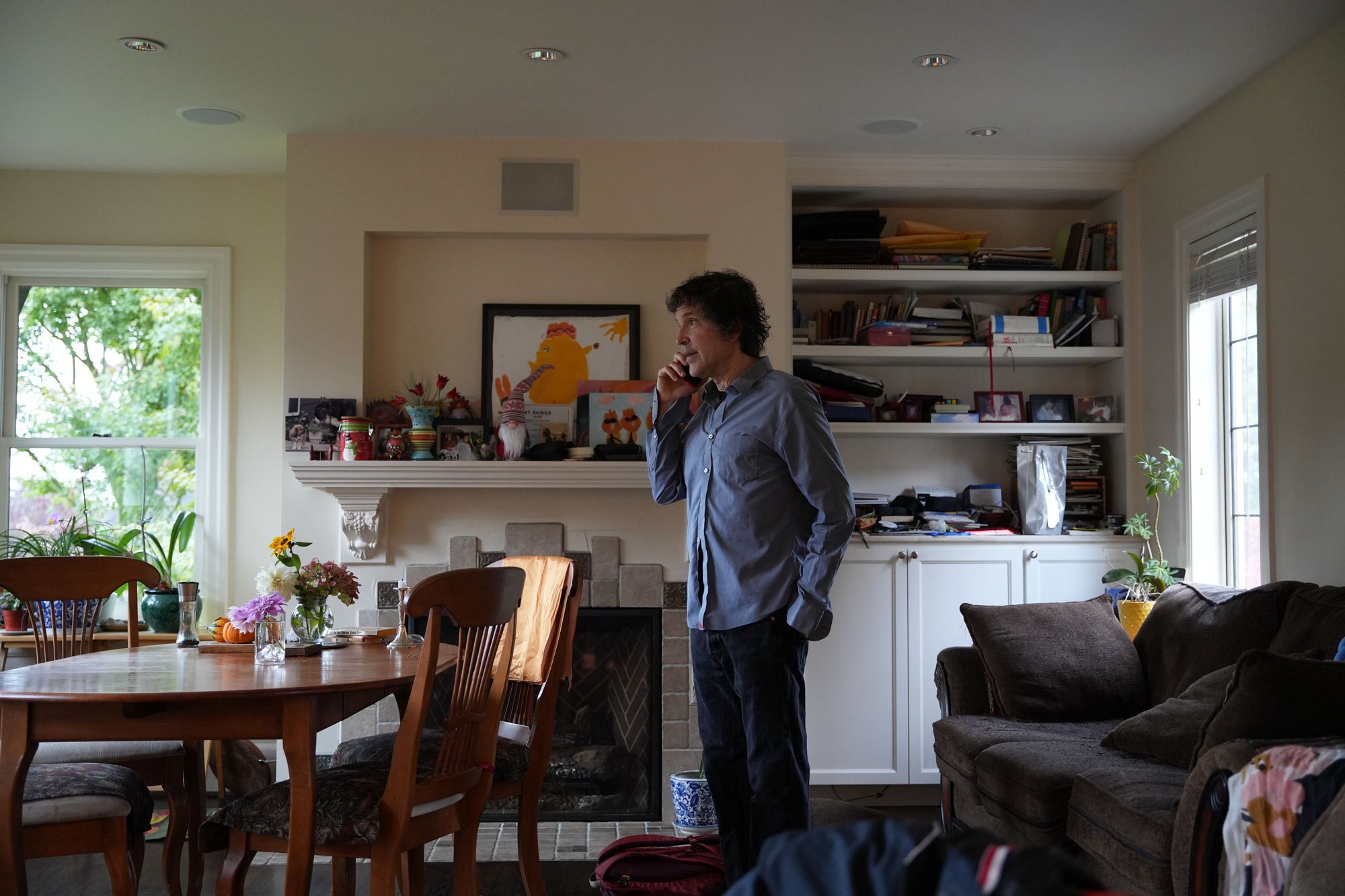
The fringe has a habit of looking less fringe after Stockholm calls. Yet Baker’s story is interesting precisely because the decisive idea did not arrive in one clean flash. There were years of software, failed possibilities, experimental checks, and conversations. He built machines that could reason about the shapes of proteins, then asked a question that made those machines feel new again: if a program could predict a shape from a sequence, could it suggest a sequence for a shape someone wanted? The turn sounds simple enough to fit on a napkin. Working it out took a career.
A circuitous route to the question
Baker grew up in Seattle, where both of his parents taught science at the University of Washington. His father, Marshall, worked in theoretical physics; his mother, Marcia, in geophysics and atmospheric science. He attended Garfield High School. This is the sort of background that invites a tidy childhood destiny, except Baker has described no such tidy beginning. He was not especially drawn to science as a boy. At Harvard he began with philosophy and social studies, then moved toward biology. Even the eventual subject of his Nobel Prize waited. “I didn’t work on proteins until I became a professor here,” he said of Washington.
After graduating from Harvard in 1984, he earned a biochemistry doctorate at the University of California, Berkeley, studying with Randy Schekman, and did postdoctoral work at the University of California, San Francisco, with David Agard. He joined Washington in 1993. In Seattle, his attention settled on the way a protein chain folds. A protein begins as a sequence of amino acids; the chain becomes a three-dimensional object, and that shape matters to what it can do. The sequence is a kind of score. The folded molecule is the performance. Knowing the notes does not, by itself, make it easy to hear the music.
Given an amino acid sequence, estimate the form it will fold into.
Given a desired form, seek a sequence that will reliably make it.
The reversal led from explaining the molecules already known to designing new ones.
Around 1998, Baker and his co-workers developed Rosetta, a computer program for tackling the folding problem. It performed well in blind tests of structure prediction. But its more mischievous promise lay in the reverse direction. If the program could evaluate how a chain might fold, then a scientist could search for a chain that would make a chosen form. The software could become a sketchbook. It could help answer a question that evolution had no obligation to answer: what protein shapes are possible even if no known organism has used them?
A small protein with a large point
In 2003, Baker and colleagues reported Top7, a protein they had designed with a fold unlike those then observed in nature. It was not a gigantic object, and it was not an overnight revolution. It was a proof with unusual philosophical reach. The catalog of proteins found in living things was not the catalog of everything chemistry could make. One could specify a form, write a sequence, produce the protein and see whether it folded as planned. The experiment gave protein design a physical exhibit, something more persuasive than a clever calculation on a screen.
Baker’s lab kept moving between computation and experiment. A design that pleases a model has to face the stubbornness of an actual molecule. It must be made, measured, questioned, and often redesigned. That cycle helps explain the patience behind the field. Each advance in software made the search more capable; each trip to the lab could reveal where the program had been too confident. The work became an exchange between two kinds of imagination: the ability to propose a structure and the willingness to find out if it exists outside a computer.
“That you could make new [proteins] was kind of a crazy idea.”David Baker, October 2024
Top7 also supplied a useful antidote to the myth of the solitary inventor. Its design joined computer work and bench work, and the broader Rosetta project developed into RosettaCommons, a shared research community. Baker’s name is on the prize, but his tools and his institute were built with many hands. He seems unusually comfortable saying so. When asked to explain the atmosphere of his lab, he has reached for a social image: a giant communal brain.
A communal brain, with room for strangers
A 2020 account of the Institute for Protein Design describes Baker moving through a floor of laboratories and desks, greeting people as he goes. “I believe ideas come when you are talking to people,” he said. He described the lab as “a giant communal brain” and added, “I’m connecting people.” The line has a practical meaning. Protein design sits at the meeting point of chemistry, physics, computer science and engineering. Its problems rarely respect departmental borders. Baker holds adjunct appointments across those fields at Washington, but a title alone cannot make them talk. He has made conversation part of the method.
An extension of that method began on a hike. In 2006 Baker and David Salesin, a computer scientist, talked about turning part of protein research into a game. The result was Foldit, which invited people far beyond the lab to puzzle over molecular shapes. Players could bring visual intuition and persistence to problems that computers were working on too. By 2020, the game had attracted more than 750,000 players, and player solutions had contributed to published work. A walk had become a way of giving strangers a seat at the research table.
There is something revealing in that choice. A scientist can protect a difficult problem as a private possession, especially when the field is young. Baker helped turn it outward. Rosetta’s shared software community, Foldit’s public puzzles, and the institute’s dense mix of disciplines all express the same habit: more useful ideas can appear when the circle grows. The 2012 founding of the Institute for Protein Design gave that habit a physical home in Seattle. Its labs could test ideas that would have been awkward to house in a single traditional discipline.
One measure of that place is the people who have left it. The institute says more than 100 of Baker’s trainees have gone on to independent faculty positions. The number is quieter than a prize announcement, but it may say more about how a field reproduces itself. Each new lab can carry a method elsewhere, argue with it, improve it, or teach it to another generation. Science has no final edition. It is a text continually marked up by readers who become authors.
What happens after a field becomes possible?
The tools changed rapidly. Machine learning methods added new ways to generate and refine protein forms, including work from Baker’s group on RFdiffusion. Yet the basic shape of the endeavor remained recognizable: propose a molecule, construct it, test it, learn from it. The Institute for Protein Design now describes its work across technology and sustainability as well as fundamental science. Its director has published more than 650 papers and holds more than 100 patents. By 2024 he had co-founded 21 biotechnology companies, among them Xaira Therapeutics. The list is long enough to make his career look industrial; in conversation he still returns to the exchange of ideas.
Xaira, launched in 2024, is a visible example of how work from a university lab can travel into a company. Baker is a co-founder, and the company identifies his institute’s research as part of its computational foundation. The distinction between the two settings is worth keeping clear. At the university, Baker directs an institute and leads a research group. At Xaira, he is a co-founder and adviser. The connection shows the reach of the methods, while his daily scientific home remains the crowded and talkative Seattle laboratory.
In 2026, the National Academy of Engineering elected Baker to its membership. The honor joined his earlier election to the National Academy of Sciences and the Nobel Prize. Those landmarks make a neat sequence when printed on a page. Baker’s own account of his path is less neat. He has called it “long and circuitous.” The detours matter: from philosophy to biology, from folding to design, from a computer program to a game, from a lab to an institute. Each turn gave the original question more people and better tools.
There is a pleasing tension in the story. The molecule is small enough to disappear into a speck of dust. The ambition required a building full of specialists and, eventually, players at home around the world. Baker’s art has been to see a design problem inside a natural phenomenon, then make space for other people to work on it. The photograph of his Nobel phone call catches a pause, not an ending. In January 2026 he was back explaining recent advances in protein design at a University of Washington lecture. A prize ceremony had fixed a date in history. The question that led to it was still generating work.
“I believe ideas come when you are talking to people.”David Baker
Perhaps that is the useful way to read Baker’s career. The achievement is not merely that scientists can now make a protein with a shape they imagined. It is that a once improbable question became something a graduate student can pursue, a colleague can challenge, a player can explore, and a computer can help test. Nature remains a remarkable inventor. Baker and the community around him have learned to offer a few proposals of their own.