Dave Blake was at a sales kickoff when he was pulled into a customer escalation call. The executive on the other end was angry. There was harsh language. There were complaints. Among them was an accusation with the awkward advantage of being true: nobody had bothered to meet him in person. Blake had never met this executive sponsor either. An organization could be a customer on paper and still contain a stranger with the power to end the relationship.
Blake took the criticism seriously. Over the following years, he worked to understand the executive and what his team needed. The business relationship remained difficult at times, but it survived and eventually produced more revenue. In Blake’s telling, the connection helped both sides through moments when the partnership might otherwise have ended. It was a lesson in the gap between having an account and knowing the people inside it.
That gap runs through his career. The founder and CEO of ClientSuccess has built software for the period after a sale, when promises acquire deadlines and customers begin deciding whether they made a good choice. His subject is a commercial one: retention, renewals, expansion. His preferred unit of observation is smaller and more awkward to automate. A person. Their expectations. The meeting someone should have arranged before the angry phone call.
An accountant takes a different route
Blake graduated from Brigham Young University with an accounting degree, then took a career detour almost immediately. He has said he never practiced accounting afterward. He entered Arthur Andersen’s business consulting group, working on Oracle implementations. It is a useful opening chapter for someone who would later build a software company: he began where a purchased system had to become something people could actually use.
His university years also included playing wide receiver for BYU. He remains a college football fan and enjoys waterskiing at Lake Powell. These are pleasant complications to the picture of a founder surrounded by dashboards. Before there were customer portfolios to manage, there were passes to catch. The accounting diploma, meanwhile, had already demonstrated its versatility by qualifying him for a career elsewhere.
In 2003, he joined Omniture as a customer success manager. He stayed through the company’s growth, its public offering and its acquisition by Adobe, then continued building a global customer success organization. The work gave him a view of both ends of the profession: the individual responsible for an account and the executive responsible for the people responsible for accounts. Software sold once still had to earn its place repeatedly.
The spreadsheet had a very large job
Blake’s responsibilities eventually included a global enterprise operation. In a later account of that work, he described roughly 120 customer success managers handling about $400 million in business. Microsoft, Sony and Apple were among the brands he recalled. Yet the machinery underneath consisted of spreadsheets, custom dashboards and fields in Salesforce. The scale of the customer book had grown considerably faster than the elegance of its management tools.
There is a particular irritation in running a sophisticated operation through makeshift arrangements. Each report may be defensible. Each spreadsheet may have a devoted owner. Together they can become a second job. Blake had lived inside that arrangement long enough to recognize a product opportunity. He wanted a system shaped around the work his team actually performed, with the information and workflows in one place.
ClientSuccess emerged from that experience. Its early financing included investment from Omniture co-founder Josh James and a $1 million seed round led by Peak Ventures. There was a certain continuity in the support: someone connected to the company where Blake had learned the problem was helping him build an answer. The proposition concerned the customers a business already had, and the work required to keep earning their business.
“In a SaaS business, product is king”
Dave Blake
A friendship needs more than one telephone number
Blake gave his thinking a name: relationship ROI. The phrase puts an accountant’s abbreviation beside a human activity that resists tidy accounting. He argued that trust could produce expansion revenue, and could also buy a relationship enough patience to survive a difficult period. His former boss and mentor, Steve Wellen, taught him to build connections across levels of a customer’s organization, rather than depend on a single friendly contact.
It is an unromantic detail in an otherwise warm philosophy. An enthusiastic advocate can leave. An executive who approves the budget may have quite different priorities from a daily user. Blake’s account of the angry sponsor makes the point without requiring a graph. Familiarity with one person is a fragile way to understand a whole company. The useful question is who else needs to be heard.
He has also written about the relationship between salespeople and customer success managers. At Omniture, he remembered a successful salesperson who sent handwritten thanks and substantial gift cards to the customer success colleagues helping him grow accounts. The gesture recognized shared work. Blake’s argument was practical: customers benefit when the people handling daily needs and the people handling commercial discussions understand their roles and cooperate.
Taking the conversation up a mountain
Blake also founded the CS100 Summit. Its mountain setting gives a fairly literal form to his interest in bringing people together. At Sundance, the program has mixed executive discussions with the opportunities for conversation that sit between scheduled sessions. The 2018 agenda offered an optional morning mountain adventure and dinner on the mountain. Even a profession with an acronym can benefit from getting outside.
The gatherings have brought him into conversation with people approaching the customer from different directions. In September 2016, he hosted a fireside chat with Qualtrics co-founder Ryan Smith in Park City. Their discussion explored growth, culture and the place of customer success inside a company. In other sessions, Blake has interviewed investor Stacey Bishop about the business fundamentals investors watch. He keeps returning to the connection between the customer’s experience and the company’s economics.
By 2024, the Sundance program included Dave Jackson on a company-wide approach to customer success, Arit Nsemo on AI capacity modeling, and Brittany Soinski on video-driven onboarding. Those topics show how far the conversation had spread beyond the account manager’s desk. Blake’s gathering offered room for a question his own career had made familiar: how many parts of a company must cooperate to deliver what a customer thought it bought?
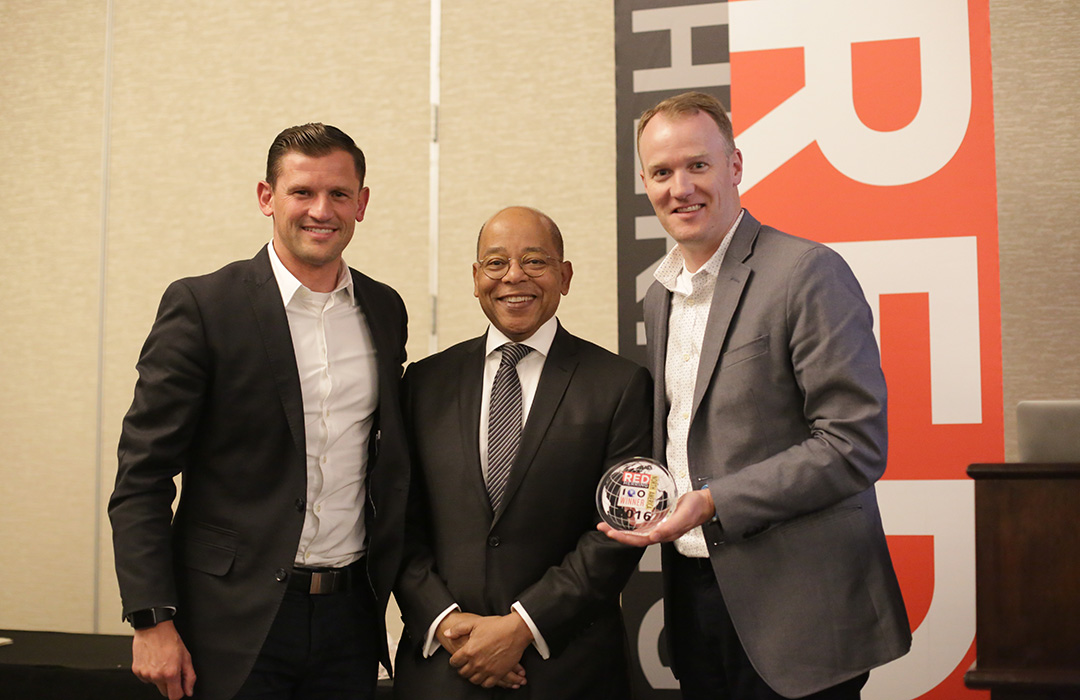
When ClientSuccess received a Red Herring Top 100 North America award in June 2016, Blake’s reaction pointed toward the people around him. “We have an awesome team and customers. This is for them.” Recognition made a public moment out of a business usually occupied with making someone else’s day go better. His response was brief enough to fit comfortably on the back of a thank-you card.
Three purchases, one familiar frustration
As ClientSuccess developed, Blake began buying capabilities as well as building them. In November 2023, the company acquired Status, an onboarding and collaboration product. The announcement addressed the complexity and expense of making teams use multiple tools. Customers could use Status independently or alongside ClientSuccess. The original frustration with fragmented software had acquired a new setting: the early weeks of the customer relationship.
Baton followed in June 2024, adding onboarding, implementation and project management capabilities. Blake said customers wanted a unified way to manage their experience after the sale. A signed contract was only the beginning; getting a customer started introduced its own workflows, deadlines and handoffs. Baton would remain available on its own while its capabilities were integrated into ClientSuccess. The purchase expanded the company’s attention toward that beginning.
In January 2025 came Product Signals, a platform for collecting product feedback and feature requests. It extended the idea toward another difficult conversation: what should the software company build next? Feedback could be connected with customer information, including revenue and renewal considerations. For Blake, whose early advice to founders emphasized strong product leadership, the acquisition put customer requests closer to product decisions. It also made prioritization a more explicit part of his company’s offering.
The seat at the recital
Blake is a father of five. Asked in 2021 about balancing family, community commitments and running a company, he described a principle-based approach rather than the pursuit of a perfectly balanced schedule. He gave a specific example: after long working hours or travel, he tried to be fully present at a child’s game or dance recital. The measure of attention was whether his children knew he was there for them.
That example makes his professional preoccupation more legible. A meeting can appear on a calendar while its supposed participant is mentally elsewhere. A customer can appear in a database while nobody understands what matters to them. Blake’s answers keep coming back to attention made visible through conduct. At work, that might mean meeting an executive. At home, it means attending to the game already in progress.
The next tool still needs a person
His recent work adds AI to the discussion. A January 2025 conversation on Inside the Workflow covered leadership and the changing role of AI in customer success. In a webinar recorded in June 2026, Blake focused on employees already experimenting with it: people learning independently, building useful things and teaching colleagues. His advice to leaders was to recognize that work, give it room and reward the people doing it.
He has kept making a case for physical meetings, too. In a public post about remote work, he suggested hometown coffees, conference visits and joining customers around team offsites. The office might have disappeared from the itinerary; the person had not. After years spent improving the software between a company and its customers, Blake still finds value in arranging a table where two people can sit down.