Dan Tocchini IV had a perfectly serviceable product to sell: diamonds. In the mid-2000s, he carried stones to small jewelers around the Bay Area. Then he needed a website. The expense of commissioning one sent him toward programming, and programming pulled him out of the diamond business. A tool he needed for one trade became his next trade. Eventually, the frustrations of that trade would become the premise of a company.
There is a certain professional inconvenience in becoming good at a task you would rather abolish. Tocchini’s answer was The Grid, a company built around software that would arrange a website from the material its owner supplied. Photographs, words and videos would go in. A designed page would come out. The small business owner could get back to running the small business, a job already rather well supplied with chores.
The question beneath that proposition has outlived the excitement surrounding its launch. How much expertise should someone need to publish a few pictures and an idea? Tocchini approached it as an engineer, a designer and a founder. Those occupations would give him different answers, and different kinds of trouble.
A complaint becomes a specification
The Grid’s origin story contains a line that sounds much more like domestic exasperation than a venture pitch. After a client website was finished, Tocchini recalled his wife asking: “Why can’t we just throw content in and have it design itself?” It is an economical description of a problem. It is also an extremely expensive specification.
By 2010, The Grid was taking shape. Its eventual leadership brought together Tocchini as CEO, Brian Axe as chairman, Leigh Taylor as creative director and Henri Bergius as engineering lead. Daniel Tocchini III was a co-founder and business development executive. The team worked across San Francisco and Berlin. This was a project that needed people who could think about both a computer’s instructions and a reader’s attention.
Tocchini’s distinction was between providing material and arranging it. Most people can decide which photograph they want to publish. Fewer want to become responsible for the relationship between its crop, a headline, a navigation menu and a phone screen. Offering more controls can multiply that responsibility. The Grid proposed to absorb some of it.
Even the company name carried his particular mixture of interests. He connected it to typography books and grid design, while allowing that Tron might have played a subconscious part. A sober publishing principle and a science-fiction film are quite comfortable neighbors in this story.
“Content should dictate form.”
Dan Tocchini IV
The arithmetic behind the taste
Before the public could buy the promise, Tocchini worked on the machinery beneath it. Grid Style Sheets, or GSS, approached browser layout through constraints. The project used Cassowary, a solver also associated with Apple’s native layout system. Instead of individually prescribing every position, a developer could describe relationships that the layout should respect.
Consider two panels that should have equal widths. On a narrow screen, both need to change while preserving that relationship. A constraint expresses the relationship itself. The solver works out values that satisfy it. GSS also allowed priorities, so a preferred relationship could yield when a stronger requirement demanded the space. In a crowded room, some guests get the comfortable chairs.
This is an instructive way to understand Tocchini’s temperament as a builder. He reached below the visible editing interface and reconsidered the mechanism doing the arranging. A nicer control panel would still leave the owner at the controls. A solver offered a way to move decisions into the system.
In March 2014 he presented the work at O’Reilly’s Fluent conference in San Francisco. The talk’s title promised layouts beyond what tomorrow’s CSS could do. Its underlying complaint was more everyday: why should simple relationships between objects be so awkward to express? The ambition was large, but the irritation was familiar to anyone who had spent an afternoon moving a box.
A slider for a feeling
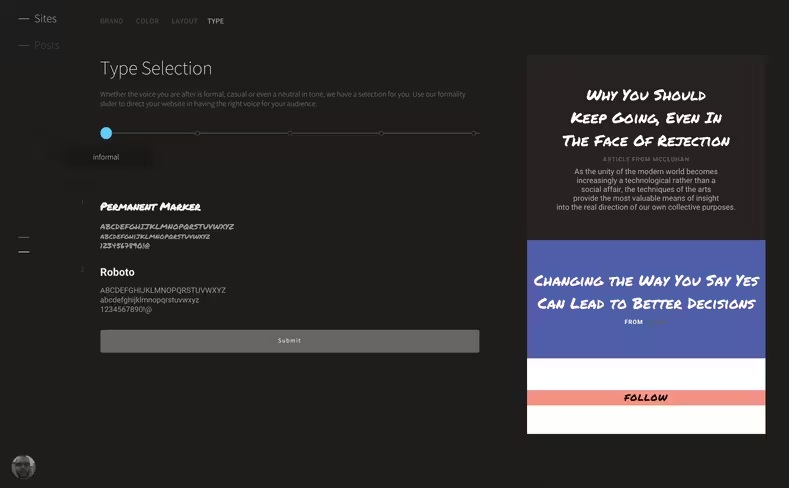
By 2015, the technical ideas had acquired a public interface. Tocchini demonstrated sliders for typography, layout and color. A visitor could move between more informal and more formal font combinations, or steer a page toward a magazine or blog arrangement. Rather than asking people to name every typographic ingredient, the controls asked for a direction.
That choice matters. Someone can recognize that a design feels too formal without knowing which typeface would make it less so. The interface gave that judgment somewhere to go. It still involved selection and revision; the claim of automatic design did not eliminate the question of whether the owner liked the result.
The company also described a color system that extracted five dominant colors from an uploaded image and generated palette variations. Typeface selection and layout generation were separate parts of the design machinery. In practice, the appealing simplicity of a slider sat on top of several distinct problems. A single gesture can conceal a considerable amount of plumbing.
Tocchini was explicit about the role of professionals in this arrangement. In 2015, he described designers as training the AI and directing its behavior. Taylor, who had worked on Medium, helped turn design judgment into a system others could use. The intended division of labor gave designers responsibility for the rules, with software carrying those rules into many individual pages.
The customers arrive before the certainty
The public campaign began in October 2014. In January 2015, Tocchini said The Grid had passed 16,000 pre-orders. A $4.6 million Series A round had been announced the previous month. People were paying for a future in which a persistent administrative annoyance might finally become somebody else’s problem.
The figures captured demand for the proposition. They could not, by themselves, establish how comfortably the finished product would fit into a customer’s working day. A pre-order is a vote made before the whole experience is available. For a founder, it brings money and evidence of interest. It also creates a growing population of people watching the calendar.
Recognition arrived alongside that expectation. The Grid was a finalist in the web design category of the 2015 Innovation by Design awards. Tocchini, Taylor and Bergius received the creator credits. Slack won the category. The distinction placed the project among design experiments receiving serious attention, while leaving the practical business of serving users very much in progress.
There was a revealing brevity to Tocchini’s answers about running the company. Asked about challenges, he singled out email and meetings. Asked how new funding would be spent, he began with salaries. Behind the ambitious language about artificial intelligence were the ordinary demands of employing people and keeping a team working. Even a company dedicated to removing chores had an inbox.
January 2015 · before general availability
Molly gets a larger job description
By January 2017, Tocchini was describing a broader role for Molly, The Grid’s AI designer. In a NamesCon interview, he said she could connect a website with other services, including acquiring a domain through Uniregistry. His aim extended to the services a business needed to reach its customers online.
He also reported 55,000 people paying $5.2 million in the pre-sale campaign and said the product had become generally available three months earlier. These are his figures from that moment. The conference plans included a live website build with audience participation. The pitch had moved from explaining a possible system to showing people an operating one.
The enlarged job description makes the continuity in his thinking easier to see. First the software would arrange the page. Then it might handle more of the work surrounding the page. Buying a domain, publishing material and reaching an audience belong to one business task, even when the internet sells them as separate errands.
It also raises the standard by which such a service must be judged. An owner is handing over work because they want dependable help. The more the system takes on, the more its reliability matters. A compelling demonstration can make delegation imaginable. Repeated, uneventful use is what makes it useful.
- 2014The public pre-sale campaign begins.
- 2017Tocchini reports general availability.
- NowThe live site carries its V2 archive notice.
The promise meets the notice on the door
The Grid’s current website presents a more difficult chapter. Its notice says V2 sites have been placed in an archived state, with a tool promised to let existing users retrieve and back up their content. Registration is to reopen with V3. The notice also acknowledges a lack of responsiveness. It supplies no public launch date for the replacement.
That changes the terms of the story. A website owner who delegates design also depends on the service that keeps the site available and the content accessible. The machinery beneath a page includes hosting, support and continuity as well as layout. The elegant part of the problem cannot stand alone.
Tocchini’s current LinkedIn profile lists Ncarnate Labs, whose public description concerns AI agents working alongside people inside existing tools and channels. The association places him in another effort to move work into software. It does not establish a new release for The Grid, whose own notice remains the relevant statement about its product.
The more playful details of his professional record offer some relief from launch dates and version numbers. His LinkedIn honors include a third-place finish in the 2012 trampoline dodgeball world championships. There are many ways to spend time away from layout algorithms. His apparently involved competitive bouncing.
The arc of his work returns to a stubbornly ordinary desire: someone has something to say, show or sell, and would like to get on with it. Tocchini built tools around that impatience, attracted paying customers and earned design recognition. The archived sites belong in the same account. An ambition to make publishing easier is judged, eventually, by the experience of the person trying to publish.
Follow the work
Projects, profiles and conversations that continue the story.