In healthcare, the shortest distance between a decision and its consequence is often a person nobody invited to the meeting. A payer adjusts a rule. A trial struggles to enroll. A pharmaceutical company publishes a resource. Somewhere downstream, a patient decides whether the message is meant for people like her, whether the institution deserves belief, and whether taking action is worth the risk.
Cullari Communications Global has built a business in that distance. From Hershey, Pennsylvania, the woman-owned consultancy advises pharmaceutical, biotechnology, and medical-device companies on patient advocacy, policy, clinical trials, corporate communications, and digital engagement. Its customers are companies. Its work, when done properly, is shaped by patients, caregivers, clinicians, nonprofit leaders, policymakers, and community organizations.
That distinction explains why CCG is not quite a conventional public-relations agency. Publicity is one tool in the cabinet. The more interesting tools are stakeholder maps, advisory boards, policy briefings, compliant education, social-listening dashboards, community meetings, and one-to-one introductions. CCG calls its basic rhythm “Listen, Measure, Engage.” The order is the point.
The problem arrived as a list
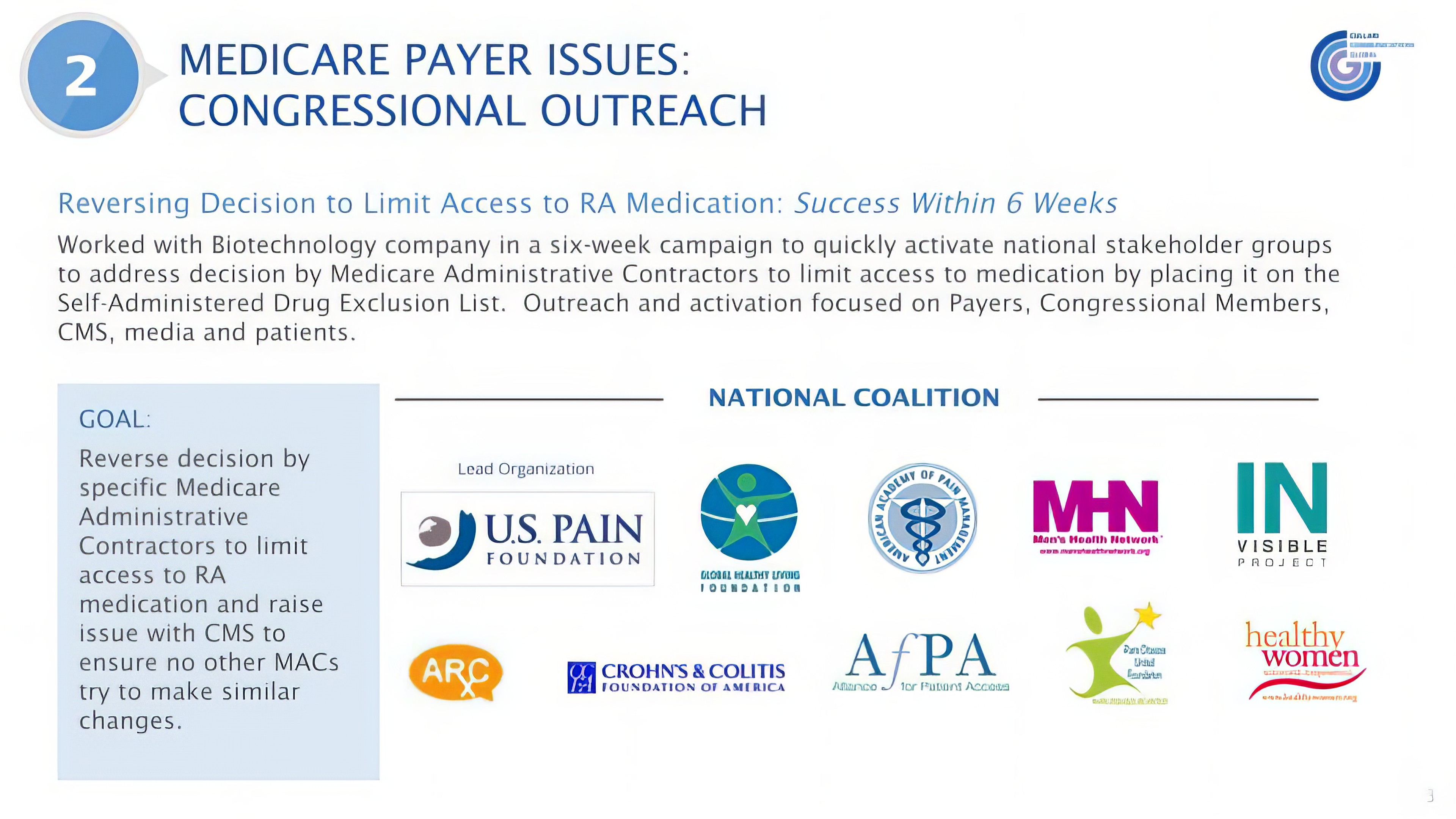
One CCG case begins with an administrative phrase engineered to empty a room: the Self-Administered Drug Exclusion List. Certain Medicare contractors had decided to place rheumatoid-arthritis medicines on it. The practical consequence was less abstract. Patients who relied on treatment in a physician’s office because they could not self-inject risked losing access under Medicare Part B.
The first thing to fail was not the medicine. It was the path to it. CCG’s assignment, performed with a biotechnology company, was to reverse the restriction before similar decisions spread. The firm had six weeks.
The response was a coalition, assembled quickly but not randomly. CCG identified 30 organizations concerned with arthritis, women’s health, seniors, and health disparities. It briefed them, helped them communicate, and created several ways to act: letters, alerts, social posts, conversations with payers, outreach to Congress, and escalation to the Centers for Medicare & Medicaid Services. Patient advocates received media support and training.
According to CCG’s account, pressure from CMS and congressional offices helped force a reversal within the six-week window. The campaign engaged 49 members of Congress in 23 states. What changed the payer’s mind was not a prettier message. It was the sight of the same access problem arriving through multiple credible doors.
Trust is not a media buy
The same premise appears in CCG’s clinical-trial work. A client was struggling to enroll people with sickle cell disease in trials in the United States and United Kingdom. The obstacle was not merely awareness. Historical mistreatment had given Black communities reasons to distrust medical research. More impressions could make the wrong message louder without making it more believable.
CCG began with advocacy landscape assessments, then worked with state chapters of the Sickle Cell Disease Association of America, community opinion leaders, and trial investigators. Patient-friendly materials had to remain compliant with the United Kingdom’s ABPI code. Community patient-engagement meetings made room for questions, and an education congress brought more than 100 patients together. Trial coordinators held one-to-one conversations onsite.
This is the practical lesson another organization can copy: separate “people who can see the message” from “people who can carry it.” Map the latter first. Invite them into the design. Make the request specific. Give them material they can safely adapt. Then measure an outcome that matters to the underlying problem.
The conditions matter. This approach depends on an authentic community need, room for stakeholders to influence the work, compliant information, and enough time to earn participation. If the outcome is fixed in advance, the patient voice is being used as scenery. If the local rules and history are ignored, a global network becomes a distribution list.
A small firm with a wide switchboard
Kathi Cullari founded the company in 1997 after work in government, trade associations, and the private sector. The origin story is modest: one client recognized her ability to build relationships and partnerships. The operating idea scaled better than a slogan. Today CCG presents a senior network spanning advocacy, public affairs, health policy, oncology, rare disease, communications, digital strategy, clinical experience, and facilitation.
For global work, the firm uses a coordinating lead and in-country specialists. That model is a quiet answer to a common corporate problem. A centralized team wants coherence; a local market resists being treated like a translation exercise. CCG’s pitch is that local specialists know the regulation, language, health system, and unwritten etiquette, while one lead keeps the program from becoming a collection of unrelated agencies.
The roster shown in its public work includes Pfizer, Vertex Pharmaceuticals, Abbott, Alexion, Gilead Sciences, Novo Nordisk, Genentech, Jazz Pharmaceuticals, and other life-sciences companies. Acadia Pharmaceuticals’ Ben Chandhok credits CCG with translating complex issues into accessible communications and strengthening public-affairs campaigns. The business model is consulting: clients pay for strategy and execution across projects, programs, and markets. Current fees are private. An older public lobbying record shows hourly billing, but the modern menu is much broader.
The numbers are useful, not innocent
CCG is unusually willing, for a boutique consultancy, to publish outcome figures. Its multinational Embracing Carers work reported more than 916 million in online and print reach, 2,602 pieces of online coverage, 114 broadcast items, more than 12 million social impressions, and engagement with more than 60 patient-advocacy organizations. Those figures reveal scale. They do not all reveal the same thing.
Read the bars as a taxonomy, not a common scale. Reach measures possible exposure. Impressions measure delivery. Coverage counts outputs. Participating organizations indicate coalition breadth. The useful question is which one connects to the decision the campaign needed to change.
A sharper example came from a three-week campaign aimed at metastatic-breast-cancer communities. CCG used 73 audience identifiers and 39 keywords or hashtags to define a potential audience of 4.8 to 5.3 million accounts. The campaign delivered 3.8 million ad impressions and increased the client’s followers by more than 250 percent. The jump is arresting. The method is more portable: define the community precisely, test messages against engagement, and keep the learning after the media spend ends.
Where Cullari fits
The alternatives are easy to name: a large healthcare agency network, a clinical-trial recruitment shop, a public-affairs firm, a digital specialist, or an in-house advocacy team. CCG’s niche is the connective tissue among them. It is large enough to coordinate several markets and specialized enough to keep patient access, policy, compliance, and communication in the same room.
Its services now include advocacy strategy, ambassador programs, patient storytelling, advisory boards, corporate communications, reputation work, policy engagement, social listening, content, podcasts, video, precision oncology, a rare-disease practice called R.A.R.E., and a clinical-trial service called CT Connect. The list is long, but the underlying product is consistent: a relationship architecture for moments when a life-sciences company cannot solve the problem by speaking alone.
Senior strategy plus the fieldwork required to turn advocacy, policy, and communications into one coordinated program.
Patients and caregivers need useful information, genuine influence, or better access for the engagement to hold.
Map trust before channels, build several paths to action, and choose a measure tied to the actual barrier.
Credible local partners, regulatory fluency, honest listening, and permission for stakeholder input to alter the plan.
The six-week reversal remains the cleanest expression of the company. A policy decision met a coalition. The coalition met lawmakers and regulators. The patient’s problem became legible to people with the authority to change it. Communications was not the glossy layer added at the end. It was the mechanism that let the system hear itself.