An invoice is a remarkably discreet place to hide a business opportunity. It arrives without applause, asks to be paid, and generally hopes nobody will make a fuss. Craig Russell made a career of taking a closer look. Before founding Green Mountain in 1999, he worked on software at FedEx, where his team helped move customers from paper billing to electronic data interchange in the 1990s. The package had a destination. The information travelling behind it had possibilities of its own.
That is the useful starting point for Russell’s story: a developer working inside the machinery of shipping, learning how its financial records could become more useful. Green Mountain would eventually combine auditing, analysis, and advice for large shippers. Its beginning was specific and practical. Customers needed a better way to check what they were being charged, process payments, and understand the information attached to their shipments.
A career in the paperwork
Russell’s early experience gave him a view of the problem from the carrier’s side. Electronic billing made information available in a form that software could handle. His next business would serve the customers of carriers including FedEx and UPS, using technology to examine parcel invoices and organize shipping information. There is a certain satisfaction in that progression. The work of making a bill electronic could lead to the work of asking whether the bill was right.
A parcel audit has an unromantic name and a very practical purpose. The charge needs to match the agreement. The records need to be usable. For an enterprise shipping at high volume, those requirements repeat across an enormous number of transactions. The arithmetic may be elementary; organizing it reliably is a business. Russell’s founding idea placed software inside that repetitive work, with a service built around what the records could reveal.
An old friend, a different skill set
Jim Jacobs joined Russell as co-founder. Green Mountain’s account of its beginnings describes Jacobs as Russell’s lifelong friend, bringing more than a decade of experience in sales, marketing, and business development in transportation and logistics. A technical background and a commercial one met around a shared business. The friendship is a welcome human detail in a history otherwise populated by invoices, carrier agreements, and acronyms with very little talent for conversation.
Their education also connected them to Memphis. The university’s alumni photo archive lists Russell with a 1989 BBA and a 1995 MBA, and Jacobs with a 1988 BBA. Years later, they would be building a relationship between their company and the university itself. In the meantime, the work was to develop a service customers would keep using, and a team capable of delivering it.
The name catches up with the work
In April 2015, Green Mountain Consulting announced that it would become Green Mountain Technology. The explanation reached back to Russell’s software experience. Technology had become central enough to the service to belong in its name. A company name is a small sign above a large amount of work; this change made the sign more accurate.
As large shippers became customers, the business extended beyond auditing. The same shipment data could support analysis, network optimization, and carrier contract management. Retail customers facing expanding e-commerce operations had questions about both cost and service. Checking an invoice answered one question. Helping decide what to do next required another kind of work.
Green Mountain combined automated systems with specialists who worked alongside customer logistics teams. The distinction matters to Russell’s business story. Software could organize the information; people still had to interpret the opportunities and help put changes into practice. The service grew around that continuing relationship. An electronic record became the beginning of a discussion about how the shipping operation should run.
- 01CheckAudit the charge
- 02UnderstandAnalyze shipment data
- 03ImproveReview networks & contracts
Five days of fun, twenty years of work
By 2018, Green Mountain had received Memphis Top Workplace recognition five years running. The company celebrated with “5 Days of Fun”: catered meals, hot chocolate bars, and boxes of supplies donated to United Way. Software and shipping data were the daily business. For a few days, the agenda made room for cocoa.
Russell’s comments at the time connected the award to the experience of building a company with his colleagues. He had started the business almost twenty years earlier; serving large brands was an achievement, and building the workplace alongside his team was part of its satisfaction. The celebration supplies a modest but revealing scene. A company that spent its working hours on parcel networks marked a milestone by gathering people and sending useful things into the community.
The recognition continued. By December 2021, Green Mountain had been named a Memphis Top Workplace for eight consecutive years, placing sixteenth in the medium business category that year. The award was based on anonymous employee feedback gathered by Energage. Russell again directed attention toward employees and the difference they made for customers. In his public remarks, the team consistently received a substantial share of the credit.
A desk on campus
In March 2019, Green Mountain opened its first satellite office on the University of Memphis campus as an anchor tenant of the CommuniTech Research Park. The intention was to recruit technology talent and strengthen a relationship that could benefit the university, the company, and the city. A campus office gave that intention a physical address.
The following month, Russell accepted the university’s Innovation Award for Green Mountain at the first Partner ForUM. The photograph captures the formal version of the occasion: people on a stage, a presentation, a university banner. The practical story sits behind it. A business dependent on software and logistics knowledge had moved closer to people learning the skills it needed.
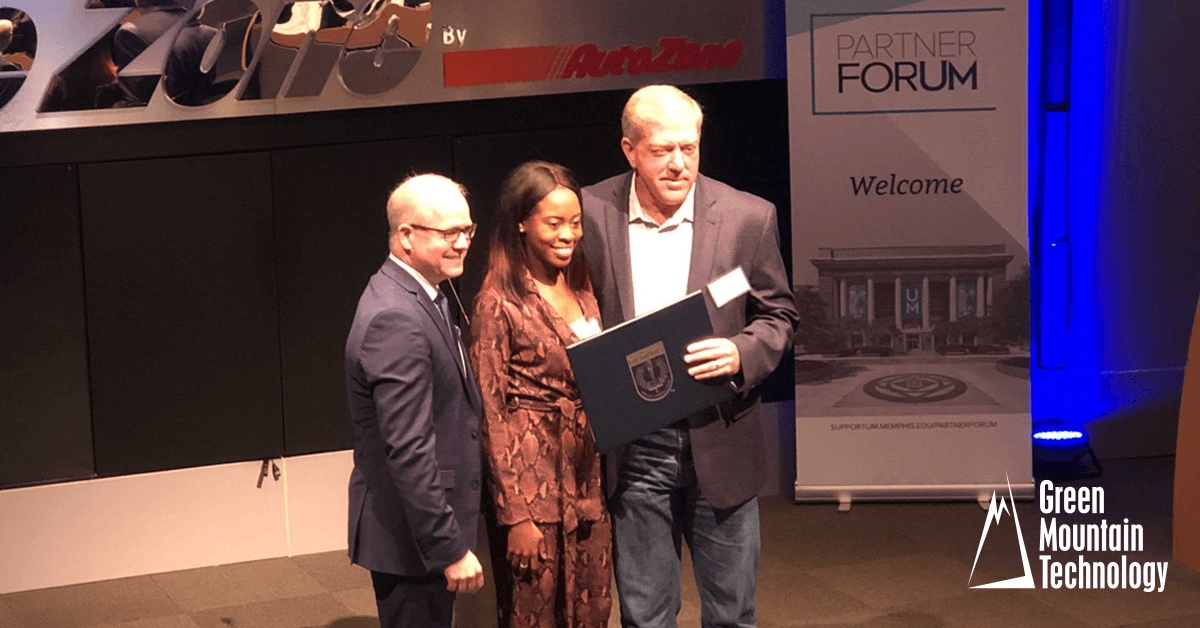
The connection also makes the company’s geography easier to understand. Memphis supplied experience in transportation, but it also offered a university relationship that Russell welcomed as a business opportunity. Recruiting was part of the company’s development, and the campus office put it close to the talent it wanted to meet.
Capital meets a long apprenticeship
In February 2020, Thompson Street Capital Partners announced a growth investment in Green Mountain. Financial terms were undisclosed. The business was twenty-one years old. Russell, then founder and CEO, welcomed the investor’s culture and strategic perspective; Jacobs described the partnership as a way to pursue opportunities and accelerate the company’s development. Growth capital had arrived at a business with a long operating history.
At the time, Green Mountain’s customers represented more than $7 billion in parcel spending. That figure describes customers’ shipping expenditure, rather than the company’s revenue or the founder’s personal wealth. It conveys the scale of the networks the team was helping manage. Even a specialized service could sit close to a considerable amount of economic activity.
Later that year, the company announced its fourth consecutive Inc. 5000 appearance. It reported 64 percent revenue growth and roughly thirty additional jobs. Russell credited the team’s contribution to customer success. The rankings continued into 2021, giving Green Mountain five consecutive appearances from 2017. They offer a dated record of growth during his leadership, alongside the less numerical story of university ties and workplace recognition.
“Our team has been the driving force behind our accomplishments.”
Craig Russell · August 2020
The customers ask another question
October 2020 brought an expansion into less-than-truckload, or LTL, spend management. The company was applying its approach beyond parcels to freight that occupies part of a truck’s capacity. Russell’s explanation was straightforward: customers needed greater visibility and optimization for those shipments. The offering combined analysis with strategic support.
The expansion followed the logic of the earlier business. A customer had information, complexity, and decisions to make. Green Mountain aimed to connect those pieces through technology and expertise. For Russell, the public explanation stayed close to the customers’ needs. There was no need to dress the request in ceremonial language. Understanding a freight network is quite sufficient work for an ordinary Tuesday.
Memphis stays in the picture
Russell also spoke publicly for Memphis as a place to build a logistics technology business. In the city’s business promotion campaign, he credited the region’s concentration of supply chain knowledge and its pool of adaptable problem solvers. The company’s growth, in his telling, depended in part on access to those people. Geography was a resource with names, experience, and skills.
Green Mountain has since continued under other leadership. In September 2025, the company named longtime operator Mike Lambert CEO and appointed Jacobs executive chairman, with Jacobs retaining his commercial role. Russell is identified publicly as founder and former CEO. His part in the story remains concrete: experience with electronic billing, a company founded in 1999, and a service that developed from checking invoices into helping large shippers make decisions.
The company’s present-day description still puts technology alongside specialist advice. It describes building digital twins of customers’ parcel networks to examine opportunities, and working with carriers to address the causes of recurring billing problems. Those services carry the original subject into a different scale of analysis: the record of a shipment can help inform the next operating choice. Seen across the company’s history, Russell’s contribution was to establish a business around that information and the customers who needed help using it.
There is pleasure in an origin story that gives patient, technical work its due. A parcel invoice rarely asks to be admired. Russell found a reason to examine it, then helped build a company around the examination. The fine print had been doing its best to look dull. It had rather more going on.