Craig Harris had a question for the people who had just invested in his company. When could he get back to the job he really wanted? HG Data had raised its Series B, and its chief executive was thinking about research and development. In the usual founder story, more money means a larger stage. Harris was interested in a different part of the building.
He wanted to spend time solving data problems. He had wanted that when he started NOZA, the donation-research company acquired by Blackbaud in 2010. He wanted it again when he and his co-founders started HG Data that same year. Running the company had become one way of keeping the research moving. By 2018, there was room to arrange the work differently.
The decision is a useful entrance into his life. Harris’s career has crossed nonprofit fundraising, commercial technology intelligence and software purchasing. The continuity lies in the questions underneath the businesses. Who might support this cause? Which company uses this product? What can a buyer learn from the software other organizations have chosen? Information becomes interesting when it helps someone decide.
The surfer who got Paraguay
Harris came from San Jose and studied aquatic biology at UC Santa Barbara, graduating in 1995. After university, he joined the Peace Corps. A surfer with an interest in a Spanish-speaking coastal posting, he was assigned to Paraguay. Geography supplied the first joke: Paraguay has no coastline.
He worked on reforestation with rural communities. The work continued beyond his volunteer service through a forestry initiative established with other former volunteers. Back in California, he became a development director at the Santa Barbara County food bank and worked as a fundraising consultant. Asking people to support a mission became part of his working life.
That experience gave his next venture a specific customer and a specific problem. Fundraisers needed to know where to direct their requests. A record of previous giving could help, provided it could be found and understood. Harris’s route toward a data company began with the practical business of asking for money.
A donation leaves a paper trail
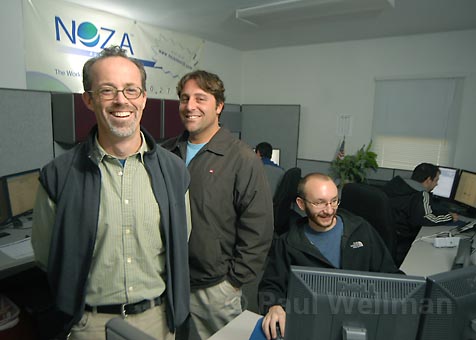
NOZA launched in 2006. Its raw material was publicly available donation information, gathered from the internet and organized for nonprofit research. Giving has a paper trail: organizations acknowledge support, publish records and describe the people and institutions helping their work. Individually, those details serve their original purpose. Together, they can help a fundraiser understand a prospective donor.
On October 4, 2010, Blackbaud announced its acquisition of NOZA. The business had nearly 50 million records of donations to US nonprofits and more than two million Canadian giving records. Blackbaud had already been a partner. The deal brought NOZA’s information into a larger set of fundraising and analytics products.
For Harris, the announcement contained another beginning. He and NOZA’s senior executive team would launch HG Data, concentrating on the commercial market. An acquisition usually invites a full stop. This one arrived with a next paragraph already attached.
HG Data begins its next chapter.
From giving histories to installed software
HG Data changed the subject of the research. Technology companies wanted to understand the technology their prospective customers used. The umbrella term is technographics: information about an organization’s software and hardware environment. A company’s industry and headcount tell a seller something. Its installed products can tell the seller whether an offer is relevant.
Harris’s co-founding circle included Tracy York and David Ruehlman. The business took shape in Santa Barbara, where his earlier nonprofit and company work had also been based. The HG initials referred to the Holy Grail of data. It was an ambitious name for a business whose practical task involved extracting usable details from untidy material.
The attraction is easy to understand. A seller approaching an unfamiliar organization needs a reason for the conversation. Knowing its technology environment can improve the questions. A complementary product may fit what is already installed; a competing product presents another kind of opportunity. Either way, the conversation can begin with some knowledge of the customer’s circumstances.
In April 2014, Gartner named HG Data a Cool Vendor in Information Innovation. The company’s announcement emphasized the commercial uses of installed-technology intelligence, including demand generation, competitive sales and sales-cycle efficiency. This was the territory Harris’s team had chosen: data whose value could be judged through the work it helped customers perform.
Making room at the top
In March 2016, HG Data announced a $12 million Series B led by Updata Partners, alongside existing investors Rincon Venture Partners and Epic Ventures. The company reported total funding of $23 million. The money was intended to support product development, customer acquisition and additional science and engineering expertise.
Funding made the next set of choices concrete. A data business has to maintain the machinery that creates its information while finding better ways for customers to use it. Research, engineering, distribution and product development all compete for attention. An expanding company needs people who can take responsibility for those different tasks.
Harris’s eventual answer was a leadership handover. Elizabeth Cholawsky became chief executive in 2018; he moved into research and development and the chairmanship. He spoke candidly about wanting stronger product experience in the leadership of the business. Her background included Citrix’s GoTo products and leading Support.com.
The handover preserved a working relationship between the incoming chief executive and the founder. It also gave his interest in research an organizational home. A founder’s usefulness does not have to remain attached to the first job title on the business card. Here, the company could gain a different set of executive skills while keeping Harris involved in the work that had led him to start it.
“That’s where I want to spend my time.”Craig Harris, discussing research and development in 2018
The information needs somewhere to go
In the new role, Harris wanted to look more deeply into HG’s accumulated company documents. He described a corpus spanning geographies and industries, with potential information beyond a basic connection between a business and a product. A technology-install record was a starting point. Context could make it more useful.
He also wanted the information to reach customers inside their existing work. Some applications could be built by HG; others could be served through partners with their own customer relationships and delivery expertise. This was an ambition about use as much as coverage. The document collection had to lead somewhere.
That distinction gives his career a recurring shape. Public data can be plentiful without being convenient. A fundraiser, salesperson or software buyer is rarely looking for more material to read for its own sake. The task is to organize evidence around the decision waiting on the desk. Harris’s work repeatedly starts with that person’s question.
The other code in the office
His writing about attracting employees offers another view of the founder. In 2015, Harris connected workplace learning with his experience working with farmers in Paraguay. He emphasized chances to learn, take responsibility and see the effect of one’s work. Leading a project could matter alongside leading a team.
He treated the culture at HG Data as something that required ongoing attention. People and mentors had helped shape it; there remained room to improve. That is a modest description of work that companies often wrap in grand vocabulary. Giving someone a problem to solve, and support while they learn, is a recognizable daily practice.
Harris also took part in a workshop with surfer and author Shaun Tomson. Participants developed personal codes, expressed as short commitments. Harris described leaving with twelve lines that he intended to keep using. The founder of a data company found value in another sort of code, one concerned with how to conduct a life rather than how to process a document.
His colleague Mark Godley later wrote about the appeal of HG’s people and credited Harris with laying groundwork for its values. For a business assembled around information, the relationships were part of the attraction. The data might introduce a customer. The people still had to build a company worth working with.
Back across the purchasing table
Harris now leads BuyerCaddy as CEO and co-founder. Its leadership group includes Pawan Nachnani, whose background includes Salesforce’s Data.com, and John Greathouse, an entrepreneur, investor and UC Santa Barbara teacher. Santa Barbara Venture Partners lists BuyerCaddy in its portfolio, with an original investment in 2024.
In July 2026, Harris signed BuyerCaddy’s securities filing as chief executive officer. The filing also lists him as a director, alongside Greathouse, Nachnani and Mike Tucker. It is a recent view of the team carrying this next business forward.
BuyerCaddy turns attention toward software choices and comparisons across technology stacks. Harris has described a shared view for the stakeholders in purchasing: the budget holder, finance, legal, IT and the people using the software. A contract can look sensible to one participant and incomplete to another. Bringing those perspectives together is part of the product’s purpose.
He has also announced work with PwC Canada using technology-stack benchmarking to inform application modernization. In his own description of BuyerCaddy, the ambition is to help procurement teams contribute more strategically. The familiar installed-product information now supports another audience, asking what belongs in its own organization.
Harris’s story offers no tidy retirement scene after the first acquisition, and no insistence that the founding chief executive must remain in that chair forever. It offers a succession of working questions. A volunteer became a fundraiser. A fundraiser built a database. A founder made room for another leader, then started again. The next useful question seems to have kept his attention longer than any particular title.