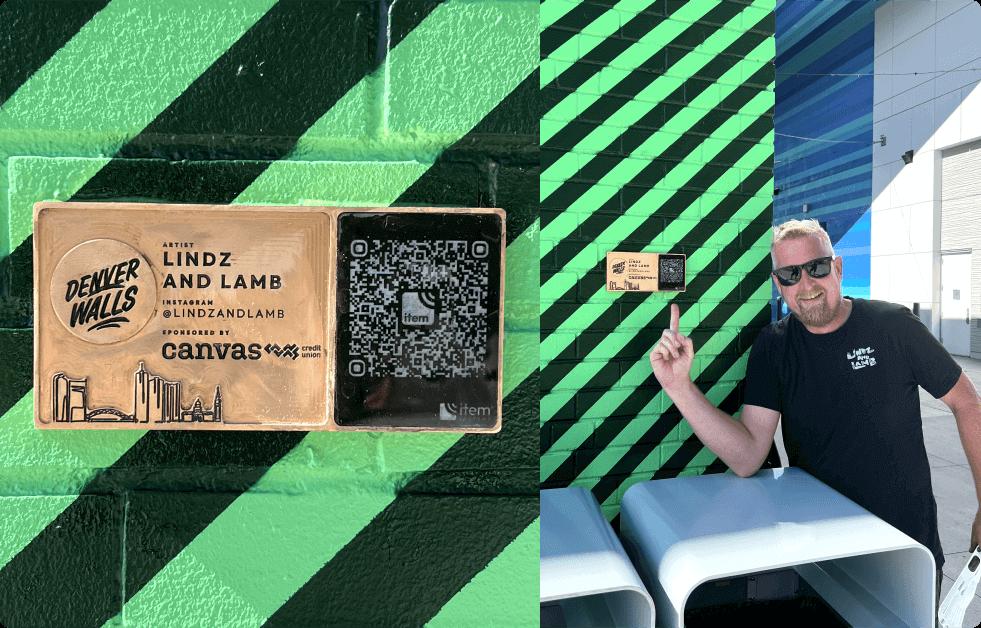
Consider the bronze plaque beside a mural in Denver’s RiNo Art District. It has the things a plaque usually has: an artist’s name, a sponsor, a small claim on permanence. COZ gave it another job. Tap it with a phone, and it becomes a check-in, an introduction to the artist and a stop on a digital trail. Somewhere behind that ordinary gesture, a blockchain is involved. The visitor has a more immediate concern: where is the next mural?
- For users: Neon Wallet manages digital assets under their own control.
- For builders: Python and TypeScript tools make Neo development more approachable.
- For clients: COZ connects software, physical objects and the experience around them.
The plaque is the interface
For DENVER WALLS, COZ built the browser map and visitor experience around plaques containing non-fungible item, or NFI, chips. These link physical objects to digital records. Visitors could collect check-ins without downloading an app. A partnership with Ratio Beerworks added beverage rewards. The trail launched in 2023 and expanded in 2024; the installations could remain while the web experience changed.
That last detail matters. An event normally ends when its scaffolding comes down. Here, the installed object could support another campaign. COZ was selling the design of the interaction as well as the technology underneath it.
A translation problem becomes a product problem
The company’s origin offers a clue to this approach. In 2017, developers interested in Antshares, later renamed Neo, encountered a language barrier. Important material was in Chinese. An international group helped translate it, then began producing the things developers and users needed: wallets, explorers and programming tools. The community became City of Zion, now COZ.
Translation solved access to the idea. Software had to solve access to the system. But community enthusiasm brought a second difficulty. In a December 2021 public discussion, co-founder and CEO Tyler Adams acknowledged that some promising projects had never become useful products. COZ’s formal incorporation in 2019 and subsequent organization accompanied a more deliberate focus on what people could actually use.
“never formalized into a product the ecosystem could benefit from”
Tyler Adams on some early COZ projects, Neo Live, 2021
This is the revealing failure in COZ’s story: ideas getting stranded before delivery. Adams described a need for a cohesive product platform. Read the later portfolio through that lens, and its apparent oddities begin to make sense.
The tools beneath the tap
Neon Wallet is the most visible product. It gives people a self-custodial interface for managing assets and connecting to decentralized applications. COZ’s current product page lists Neo N3, Neo X, Ethereum and other EVM-compatible networks, alongside desktop, mobile and Chrome extension options. Ledger support adds a hardware-wallet connection. COZ advertises more than one million users, a company figure that should not be mistaken for a disclosed monthly active audience.
Underneath sit tools with narrower audiences. Boa compiles Python smart contracts. Mamba helps Python developers interact with Neo. Neon.js and Neon-DappKit serve JavaScript and TypeScript workflows. CPM, the Contract Package Manager, helps integrate contract libraries, generate SDKs and bring existing network state into local testing. Props supplies reusable contracts and examples, including mutable NFTs called Puppets.
The distinction is practical. A developer can borrow a library instead of rebuilding an integration. A wallet user can manage accounts through an interface. An event organizer can commission the complete experience. COZ operates across those layers, with particular depth in Neo.
A ring, a lizard and a line
At Consensus 2023, that combination took the form of OneBand rings supplied by ITEM Systems. Visitors tapped their rings at nine Neo project stations to modify a digital lizard. COZ handled software, booth design and on-site delivery. Its case study reports 795 rings distributed over three days, with waits ranging from 20 to 90 minutes.

Distributed at Consensus 2023, according to COZ’s event account.
The queue is instructive. Removing software friction does not remove physical capacity. A successful interaction still needs enough staff, enough hardware and a tolerable wait. COZ’s own account describes five staff supporting the three-day event. The operating work belongs in the product story.
At Tribeca that year, rings served as invitations and bidding interfaces for a charity auction tied to Shadow Brother Sunday. Physical 35mm film clips sat in bronze holders linked to digital twins. COZ reports 200 rings distributed and 20 collectibles offered. The interaction gave the underlying record a specific purpose: connect this object, this bidder and this transaction.

Who pays for the useful part?
COZ’s commercial offer includes advisory, design, custom development and event activations. Buyers include blockchain organizations and cultural clients. Neo is central; DENVER WALLS and Vanishing Angle show the work reaching other settings. Its open-source history also includes Neo ecosystem support, so the business should not be reduced to a wallet subscription. The customer may be buying technical judgment, a working application, fabrication or the coordination of a live event. Those are different deliverables, even when they share code. A buyer should define which outcome matters before choosing the tools.
Its market position depends on the assignment. AxLabs offers another route into Neo development through Java and Kotlin tooling, while also collaborating with COZ. A client can build internally or hire an agency. COZ’s case rests on bringing engineering and experience design into the same engagement.
The next customer has a budget, too
In September 2026, COZ presented WhisperDark, a browser dungeon crawler in which an AI agent manages funds and buys items. Each optional loot box costs 0.1 xGAS, with a ten-purchase limit per run. The experiment tests constrained spending authority. On October 26, its Proof of Working program announced 369 NEO in rewards for external contributors improving payment monitoring, deployment tooling and token vesting.
The lesson worth copying is to start with a useful action and remove the steps around it. The corresponding judgment is ours: if a simple database already supplies sufficient trust, a blockchain may add unnecessary work. COZ is most interesting when the physical object, the shared record and the person using them all have a reason to be there.