Consider the wine bottle after the wine is gone. Its original assignment has ended. It can go into the recycling bin, or it can remain on a shelf, carrying the date of an anniversary, a company name, a small reminder of who gave it to whom. Corporate Vintages has built its offering around that second possibility. The bottle is a container, certainly. It is also a piece of real estate.
The Pleasant Hill business, which calls itself Corporate Vintage on its website, customizes bottles for corporate gifts and wineries. Its materials are familiar: glass, artwork, paint. Its particular contribution is to join them through a process that involves both a digital file and a pair of hands. A logo leaves Adobe Illustrator and ends up carved into the object somebody brings to dinner.
That journey helps explain why the company fits awkwardly into the broad category of graphic design. It supplies a physical result. The work crosses into wine gifting, bottle decoration and hospitality display. For a buyer, those distinctions matter less than the practical question: can the company turn this occasion, this identity and this budget into a bottle worth presenting?
The file meets the sandblaster
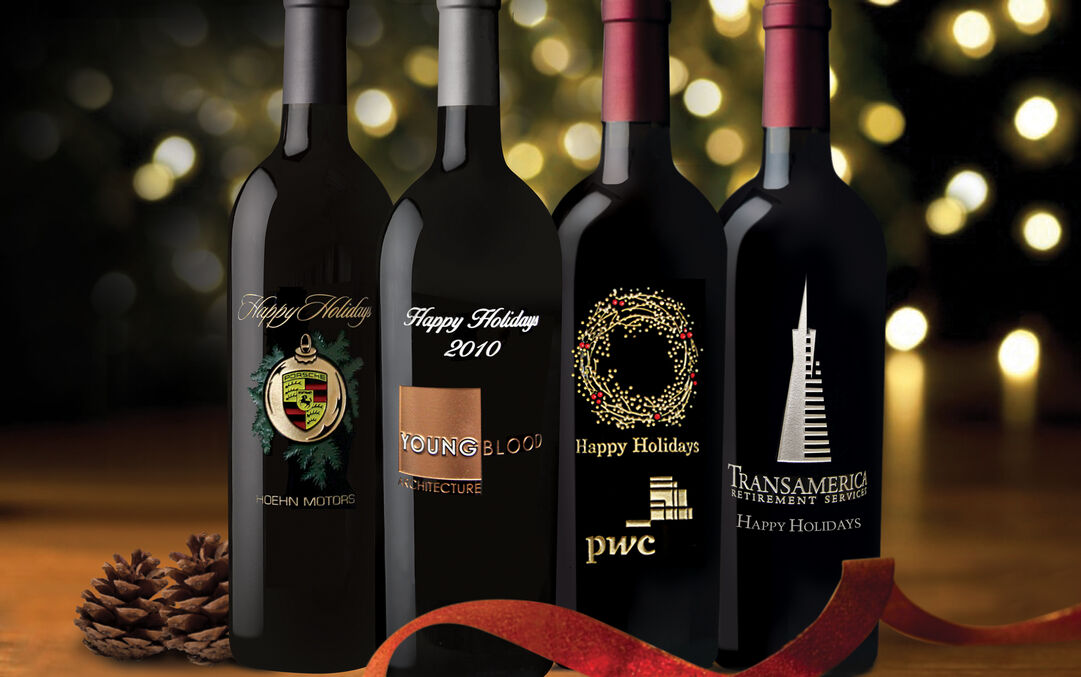
The company describes an unusually legible production sequence. Customers provide Adobe Illustrator vector artwork. That file is converted into stencils, which are attached to individual bottles. An operator then sandblasts the glass to the required design. Finally, artisans paint the bottles by hand, using different techniques to achieve the custom finish.
There is something satisfying about the specificity. “Personalized” can describe anything from a name dropped into a template to a fully commissioned object. Here, the word has a physical meaning. The artwork determines a stencil; the stencil controls where the glass is worked; paint adds another layer of interpretation. The final surface has to make sense on an object that turns in the hand.
The company’s corporate-bottle pitch explicitly imagines recipients touching the etched and painted logo. That is a useful way to understand its expertise. A business identity normally designed to be seen also becomes something to feel. Whether that produces more affection for the giver is a separate question. The immediate, demonstrable difference is the treatment of the bottle itself.
“With each etched wine bottle, our goal is to create a special gift that makes a great impression that remains for years.”Corporate Vintage
A bigger bottle has a different job
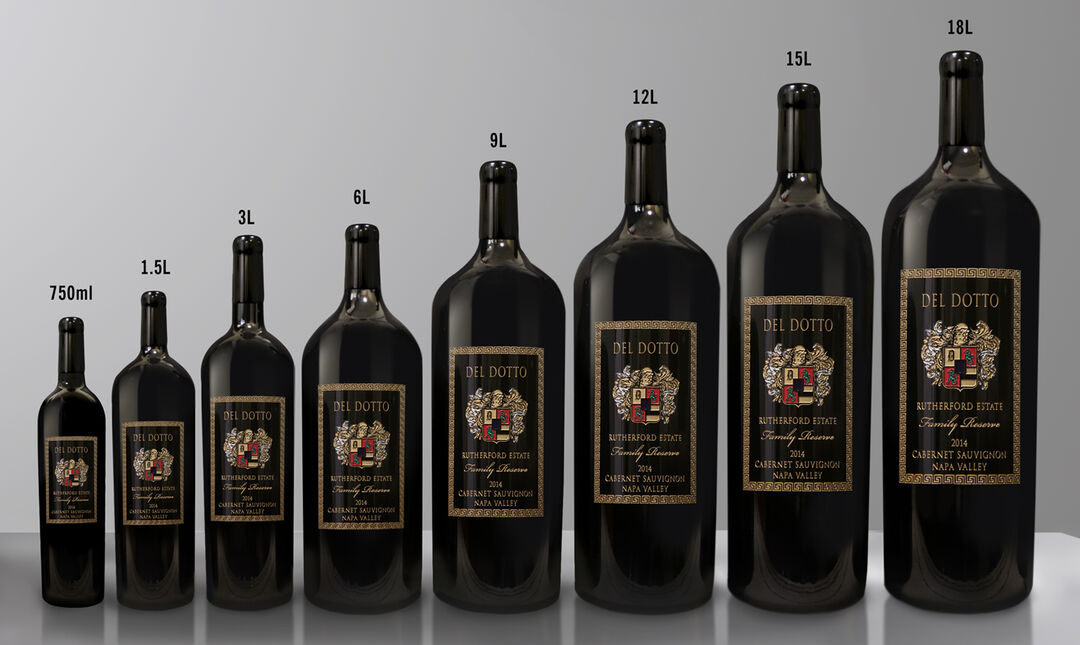
One photograph on the company’s website presents a lineup of Del Dotto bottles. At the left sits a 750-milliliter bottle; at the right, an 18-liter version towers over it. The intermediate sizes turn the picture into an informal lesson in scale. The design remains recognizable while the amount of space it occupies changes dramatically.
The photograph illustrates the large-format side of the business. Corporate Vintage markets etched large bottles as collectible objects that buyers might display at home before opening with friends or family. That is the company’s proposition, rather than a measured claim about how long any particular customer keeps one. Still, the design problem is clear: give the bottle a reason to remain visible.
Then comes the especially revealing product: a three-liter display bottle. For restaurants and country clubs, the company offers to blacken the interior and wax the top. Its stated purpose is visibility among ordinary 750-milliliter bottles. The finish and size are doing the work of a small sign, while preserving the recognizable form of the product being promoted.
A three-liter bottle has four times the nominal capacity of a 750-milliliter bottle. That arithmetic says nothing about sales lift or the amount of attention it will receive. It does explain why the two are different display objects. In this application, the bottle’s job begins before anyone reaches for a corkscrew.
The nominal capacity of a 3 L display bottle compared with 750 ml.A size comparison, not a sales claim.
The gift brief starts with the occasion
The corporate offering names five uses: holiday gifts, events, company anniversaries, customer appreciation and employee appreciation. Each provides a reason to put a particular design on a particular bottle. An anniversary supplies a date. An event supplies a shared memory. Appreciation supplies a recipient and, ideally, something more thoughtful to say than the company name alone.
The business also offers help choosing the wine. It says it works with wineries in Napa and can suggest a selection that fits the client’s company image and budget. That puts two decisions in the same conversation: what goes inside the bottle and what happens to its surface. A buyer need not treat the artwork as an afterthought added once the wine has already been chosen.
The commercial route is a quote request. A useful brief would therefore specify the occasion, recipient group, bottle quantity, artwork, wine preferences, budget and required delivery date. Those are sensible questions for commissioning custom work, rather than a published checklist from the company. The point is to make the desired result concrete enough to discuss and price.
For someone comparing alternatives, the relevant market includes personalized wine sellers, bottle decorators and other corporate-gift suppliers. Personal Wine, for example, markets wine gifts with custom labels or engraving. Corporate Vintage’s own documented emphasis is its stencil-to-sandblasting process, hand painting and large-format display work. Buyers can compare those attributes directly instead of assuming that every use of “custom” means the same thing.
An old business with a very specific lesson
Corporate Vintage dates its beginning to 1984 in Orinda, California, and says it later relocated to Pleasant Hill. Its account singles out an expansion in 2000, connecting that period with confidence in the value of developing its artistic skills for corporate clients and wineries. The thread running through that history is the application of craft to a narrow class of objects.
The lesson another business can borrow is straightforward: consider what happens to the object after the transaction. Corporate Vintage’s stated ambition extends beyond handing over a decorated bottle. It imagines that bottle being touched, displayed and eventually shared. A designer can use that same sequence as a set of questions: where will this live, who will handle it, and what will make it feel particular to the recipient?
The fit depends on the occasion. A wine gift makes sense when the recipient welcomes wine and the giver wants an object connected to a celebration or relationship. A display bottle makes sense when there is somewhere to show it. If the priority is an instantly delivered message, or an audience for whom wine is unsuitable, a different medium would answer the brief more naturally.
There is no need to make the bottle carry a grand theory of loyalty. Its more modest achievement is visible in the process: a familiar package becomes a commissioned object. Somewhere between the vector file and the final brushstroke, the bottle acquires a second assignment.