A hotel room looks like a simple purchase until the person sleeping in it works the night shift. Then checkout time becomes a scheduling problem. Parking becomes an equipment problem. A change of job site becomes a cancellation problem. And somewhere, an office manager inherits a collection of receipts that must explain where everyone went and which project should pay.
Corpay Lodging works in this gap between the reservation and the workday. Formerly CLC Lodging, it combines negotiated hotel rates with booking, payment, reporting and human support. Its natural customer has people scattered across job sites, trucks or repair assignments. The room needs to be affordable. The arrangements need to survive contact with the job.
- Businesses pool hotel demand to access negotiated rates.
- Crews book through an app, online, by phone or with in-network walk-ins.
- Managers get policy controls, audited invoices and consolidated billing.
- No monthly fee still leaves room rates, taxes and applicable nightly fees.
A hotel room has two customers
Barry Downing founded Corporate Lodging Consultants in Wichita in 1977 around pre-negotiated hotel rates. The proposition joined two ordinary needs: businesses wanted affordable rooms, and hotels wanted business travelers. Gather enough demand and the conversation with an individual property changes. A small employer can participate in buying power it would struggle to assemble alone.
That mechanism remains central. Corpay Lodging advertises 20.3 million annual room nights and $540 million in annual member savings. Those are company claims, useful as measures of its stated scale rather than a promise about the next reservation. For a hotel, participation offers another route to workforce bookings. For an employer, it offers rates and administration together.
Annual room nights. One recurring purchase, multiplied across traveling workforces.
The network is also a set of relationships. The company describes negotiating at property level, including stay terms and amenities. That matters because a hotel brand on a map cannot tell a coordinator everything about a particular location. The useful agreement is the one that fits the actual trip.

The midnight test
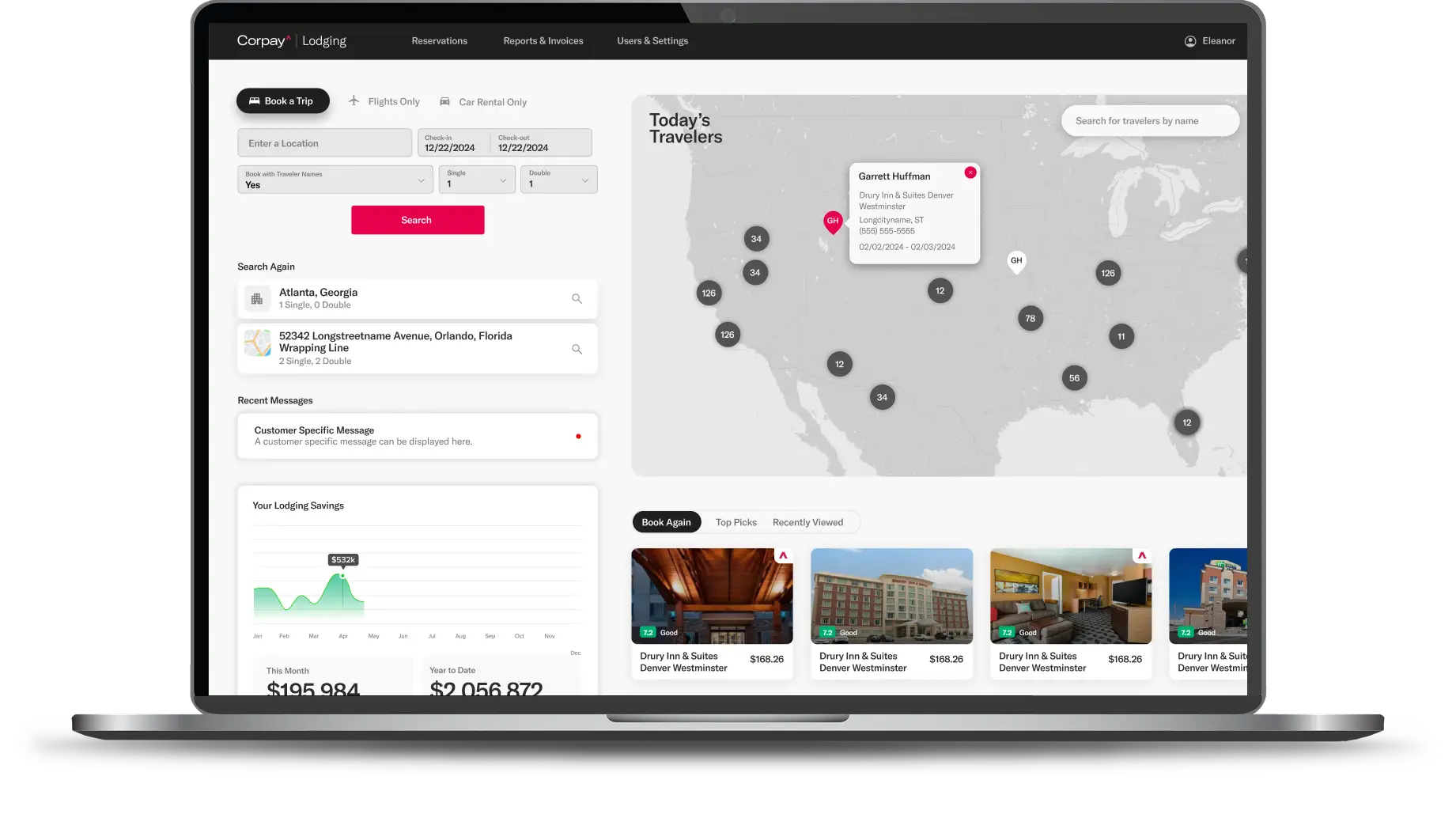
Consider the product details. Corpay Lodging’s redesigned app, launched in July 2025, includes filters for three types of truck parking. It has map search, hotel photographs and eligible loyalty-program integration. Truck parking is a wonderfully specific feature. It suggests that the person making the booking may be responsible for something considerably larger than a carry-on.
The company also promotes 24-hour stays from check-in at in-network hotels. For someone arriving after an irregular shift, that changes what a room buys. Flexible in-network cancellation terms address another workforce reality: the assignment can change before the traveler arrives. These benefits belong to the relevant network arrangements; they should be checked against the booking.
For larger projects, the service adds hotel negotiations, rooming lists, dedicated support and customized invoicing. Emergency lodging extends the coordination to disaster-response and restoration crews, including sourcing outside the normal network. This is where staff availability becomes part of the product. A reservation problem does not politely wait until the accounting department opens.
- 01BeforeNegotiate rates.
Set booking rules. - 02DuringManage changes.
Support check-in. - 03AfterAudit and code.
Consolidate the bill.
The office gets a different set of tools: spending controls, traveler mapping, reports by project and division, and invoice review. Corpay says it audits invoices before billing the customer. Preventing an unauthorized charge is useful. Putting an authorized charge against the right project is useful, too. Both reduce the detective work that can follow an apparently successful trip.
“With Corpay I spend 30 minutes to do what used to take me 10 hours.”
Deanna Irby, WS Construction
Customer testimonial published by Corpay Lodging
That testimonial is one customer’s account, rather than a general productivity forecast. Still, it identifies the purchase neatly. A travel manager is buying fewer separate tasks, fewer loose ends and a way to hand finance a bill it can use.
Free to join. Read the nightly price.
The pricing page advertises no signup, monthly or agent-assist fees. The FAQ also describes a small per-room-night fee for custom solutions and directs members to a logged-in Payment & Pricing Schedule. A buyer should read those statements together. The relevant comparison is the total stay, including taxes and applicable charges, alongside the administrative work saved.
The Best Price Guarantee has a process, too. Published terms describe an eligible lower price for the same hotel and dates, submitted within 48 hours of reservation. An approved difference becomes an account credit after the stay. That is a useful backstop for eligible bookings; it still requires attention to the conditions and paperwork.
A new name for a familiar calculation
FleetCor bought CLC Group in April 2009 for $169.1 million in cash and preferred stock. The filing described an entry into lodging payments. CLC and Creative Lodging Solutions combined in 2019; CLC became Corpay Lodging in April 2025. The brand now makes its relationship with the payments parent much more visible.
In January 2026, Corpay Lodging announced expanded access to a two-million-property global hotel network for U.S.-based companies. Its pricing distinguishes the self-serve U.S. and Canadian offering from customized options. Buyers need to establish which hotels, support and terms their program includes. Global availability and a particular negotiated benefit are different purchasing questions.
A practical trial would start with a real route or project, then compare the complete charges and booking conditions. Ask whether the chosen hotel can accommodate the vehicle, arrival time and expected changes. Savings can shrink if the useful property is unavailable, the required service sits outside the program or employees book elsewhere. Centralized reporting becomes more valuable when the workforce actually uses the booking process.
Engine and direct hotel agreements offer alternatives. Corpay’s case rests on its combination of negotiated lodging, flexible workforce arrangements and payment administration. The lesson a reader can copy is straightforward: measure the whole stay. Compare the rate, the location, the cancellation exposure and the time spent fixing the bill. The cheapest room deserves a second look if it creates an expensive morning.