Cornerstone OnDemand began with three founders, ten employees, one shared cordless phone and a meeting room borrowed from a Santa Monica bowling alley. The product, then called CyberU, was a directory of online courses for adults. Students from UCLA and USC searched the young web and typed classes into a database. It was 1999. Google was barely a company, course discovery was a legitimate problem, and putting training on the internet sounded like a market.
Then the dot-com bubble burst. Consumers stopped being a credible business plan almost overnight. CyberU turned toward companies, initially as a detour. Financial-services prospects liked the training catalog but wanted controls: salespeople should see sales courses, engineers should see engineering courses, and managers needed proof that required learning had happened. Founder Adam Miller flew home sketching requested features on cocktail napkins. The prospects kept saying they could use the product. Miller's team assumed a tiny vendor could not sell to them. The customers had to change their minds.
“Of course you could. You designed it. But you're never going to buy from us. We're too small.”Adam Miller, recalling Cornerstone's reluctant enterprise pivot
The first thing that failed was the customer
Not the technology. Not the idea that adults would learn online. The failed assumption was who would pay. Cornerstone's replacement business was unusually literal: build the features employers described, host the software itself, and charge organizations to use it. This was software as a service before the category had a clean name. Miller remembers IT departments asking Cornerstone to send the installation files. “There is no software. It's over the internet,” he would explain. Many deals ended there.
One company, four definitions of the product
The enterprise turn survived two brutal tests. After September 11, 2001, much of the company's financial-services pipeline appeared to vanish. Advisers told Miller to cut an already small staff. He hired instead, reasoning that the one signed account could not be served by a skeleton crew. Cornerstone ultimately closed three of the four deals in flight. Those customers supplied cash when venture firms would not.
The second test came in 2005. With 45 employees, Cornerstone was $150,000 short of payroll. Miller found $50,000, then borrowed $100,000 from a loan shark at 100 percent interest. Payroll cleared. This answers what survival cost, but it is the least copyable move in the story. The useful lesson came earlier: the company knew paying customers wanted the product and it retained enough staff to deliver. Without repeatable demand, ruinous debt is merely ruinous.

From course counter to skills graph
Cornerstone finally raised a $32 million Series D in 2007 from Bessemer Venture Partners and Bay Partners. It went public in March 2011, pressing ahead as the Fukushima nuclear disaster unsettled global markets. By 2020, annual revenue had reached $740.9 million, up from $537.9 million two years earlier. The company was no longer a scrappy learning app. It was an enterprise suite selling multi-year subscriptions, implementation and content to employers whose training records could be both operationally valuable and legally necessary.
Scale came with consolidation. Cornerstone bought microlearning company Grovo for $24 million in 2018, then agreed to acquire rival Saba in 2020 for about $1.395 billion. That combination brought the network to roughly 75 million users and 7,000 organizations. Clearlake Capital took Cornerstone private the next year for approximately $5.2 billion, or $57.50 a share. Under private ownership, Cornerstone added EdCast's learning experience technology, SumTotal's learning and human-capital software, and SkyHive's labor-market and skills intelligence.
The customer list makes the target market concrete. Cornerstone publicly highlights American Express, Visa, PayPal, Nationwide and SNCF, while its site displays organizations ranging from United Airlines and Samsung to Novartis, UPS, Dell and the American Red Cross. These are employers with multiple countries, languages, worker types and regulators. Their training problem is not finding one good video. It is assigning the right material to the right population, documenting completion, connecting development to performance and keeping the whole system usable after another acquisition rearranges the org chart.
Cornerstone also extends learning beyond employees. A manufacturer can certify dealers, a software company can train customers, and a multinational can apply different compliance programs without building a separate portal for every audience. This extended-enterprise capability is less glamorous than an AI coach, but it exposes the company's durable expertise: administering complicated learning at scale. The new intelligence products are valuable only if that underlying machinery keeps working.
Those acquisitions explain the modern pitch. Cornerstone Galaxy is not one monolithic HR database. It is a learning-and-talent layer designed to connect with the systems a customer already has. Learn handles assigned courses, self-directed development, compliance and external training. Elevate connects performance, career mobility and succession. Transform uses skills and labor-market data for job design and workforce planning. Content supplies and curates material. Extend provides connectors and a marketplace. Galaxy AI sits across them, inferring skills, recommending development and automating HR work.
Learn
Training, compliance and development for employees, customers and partners.
Elevate
Performance, recruiting, succession and internal career movement.
Transform
Skills intelligence, job architecture and workforce planning.
Content
Curated catalogs plus AI-assisted creation and discovery.
Extend
More than 400 partners connecting the suite to the wider stack.
Galaxy AI
Recommendations, agents, immersive practice and workforce signals.
The moat is context, not a chatbot
Cornerstone says more than 140 million people use its products, with a content interaction every three seconds. SkyHive adds daily labor-market signals and a skills knowledge graph. The strategic idea is simple: connect what the market needs, what an organization is trying to do, what each employee appears able to do and what they should learn next. A generic assistant can summarize a policy. A useful workforce system should know who is nearly ready to run a new plant, which capability is missing and whether training or hiring closes the gap faster.
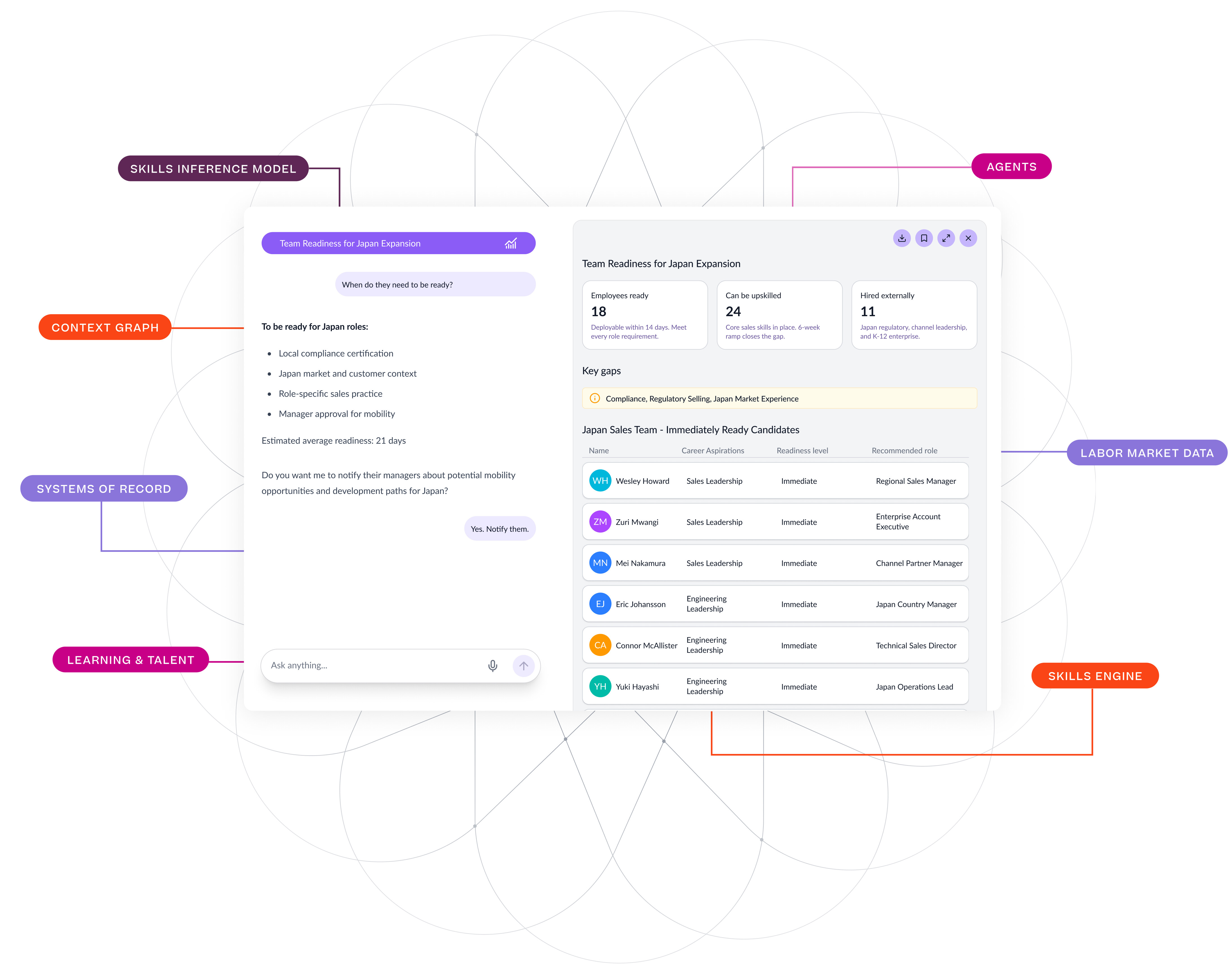
This is also how Cornerstone separates itself from payroll-first suites such as Workday, SAP SuccessFactors and Oracle Cloud HCM, and from narrower learning products such as Docebo or Degreed. Its heritage is deep learning administration, especially at multinational and regulated organizations. Its newer advantage is the attempt to join that history with performance, mobility and external skills data without demanding that customers replace every system of record.
Microsoft and Salesforce partnerships push the model into daily work. Cornerstone agents can surface learning through Microsoft Copilot and Microsoft 365. Its expanded Salesforce relationship carries workforce context into Agentforce, HR and IT service workflows, and Slack. The distribution logic is sound: employees rarely wake up hoping to visit an HR portal. Training is more likely to happen when it appears beside the task that exposed the gap.
What a buyer can actually copy
A company can use Cornerstone to assign safety training, prove compliance, suggest a course, map skills to roles, give employees internal career paths, prepare successors, identify capability gaps and train customers or partners. HR leaders can combine these workflows instead of buying six disconnected point products. Employees get a clearer answer to an old workplace question: what do I need to learn to move from here to there?
Founders can copy a different pattern. First, listen for requests that repeat across prospects; Cornerstone's controls became a product because multiple businesses needed them. Second, let revenue validate the roadmap. Third, preserve the core need while changing the buyer. The consumer directory failed, but adult learning remained the thread. Finally, enter adjacent categories only when shared data improves both sides. Learning plus skills plus mobility can form a useful loop. A random feature pile cannot.
Where the model breaks
- A small company needing only a simple course library may buy far more administration than it needs.
- Poor employee records and stale job architecture will produce polished but weak recommendations.
- Without an owner for integrations, governance and adoption, the platform becomes another tab employees avoid.
- AI skill inference still needs human review where promotion, pay, safety or employment decisions are at stake.
- Customer-led product development fails when one loud buyer's custom request does not generalize.
Cornerstone's current risk is the weight of its own history. Integrating acquired products, maintaining taxonomies and explaining a broad portfolio are harder than making an AI demo. It competes with giant suites that already hold payroll and employee records, while specialist tools can feel lighter. Private ownership also means current revenue and profitability are no longer public. The $740.9 million figure belongs to 2020, not today.
Still, the company's arc contains a satisfying symmetry. CyberU tried to help adults find the education they needed. Cornerstone Workforce AI now tries to infer the education they need before they search. The directory became an LMS, the LMS became a talent suite, and the suite became a graph. The underlying problem barely moved: people know they must keep learning, while organizations remain surprisingly bad at telling them what comes next.
Official channels and demonstrations