A crane makes a persuasive spectacle. It lifts something enormous, swings it across the sky and sets it down with an ease that seems almost rude to gravity. Then everyone waits. The crew must join that piece to the last one, check it and make the frame safe for the next lift. On a multistory job, those little pauses become the calendar.
- ConXtech designs, fabricates and erects prefabricated structural steel frames.
- Its patented connections move precision work into the factory and make field assembly repeatable.
- Data centers and medical buildings are major markets; CoreSite and Kaiser Permanente are named customers.
- The company reports steel erection three to five times faster on many comparable projects, a claim about the frame rather than the whole building.
ConXtech built its business around the pause. A beam can arrive with a carefully made connection; a column can arrive ready to receive it. The crew lowers the piece, locks the geometry and bolts the connection. That is the gist of its ConX system, though the engineering is considerably less simple than the gesture. The company is both a construction technology developer and a turnkey steel subcontractor: it coordinates design, fabricates components, delivers them and erects the frame.
The distinction matters. Plenty of firms sell an ingenious part. ConXtech sells the sequence in which the part earns its keep. BIM, CAD, CNC fabrication and factory welding help make the components accurate; trained field crews make the assembly method real. Its business model is project work for owners, developers and general contractors, supplemented by a network of certified fabricators and erectors. The customer buys a structural frame and the expertise to get it standing.
The joint has a job description
ConXtech's families are tailored to different buildings. ConXR 200 uses smaller columns and shorter bays suited to housing and hotels. ConXL 400 spans more generously for healthcare, offices and data centers. ConXL 300 addresses industrial pipe racks and some manufacturing spaces. Falcon, introduced in the company's 2024 history, is a gravity connection meant to work alongside different lateral systems. There is no claim that one frame fits every plan. The point is to keep a repeatable connection at the center while changing the surrounding structural answer.
Architects and engineers align grid, loads and connection details before steel is cut.
Beams, columns and collars are prepared in a controlled factory process.
Ironworkers place and bolt the designed pieces in a repeatable sequence.
A conventional steel frame may require more field fitting and welding. A concrete structure may carry a different weight and curing schedule. Wood and light-gauge steel have their own economics and height limits. ConXtech competes against those entire workflows, not simply against a cheaper beam. Its case grows stronger when the building has several stories, many repeated connections and a schedule on which an earlier frame has value. It also grows more demanding: the design team must decide enough early enough to let the factory be precise.
Fifteen days is a very specific number
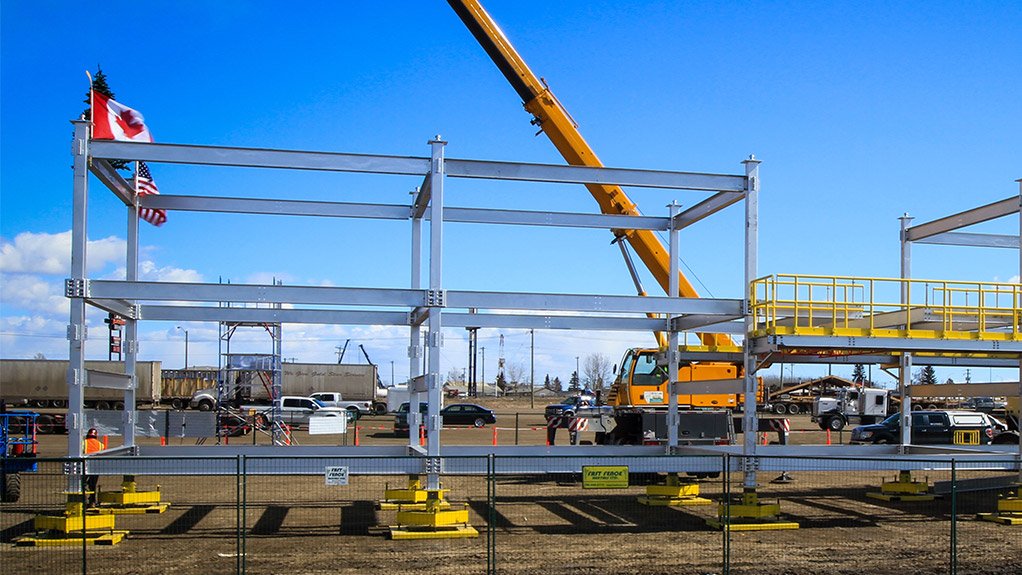
CoreSite's SV-7 data center in Santa Clara offers a clean look at the proposition. ConXtech says its crew erected the 230,000-square-foot steel frame in 15 days. The job used ConXL for the main frame and ConXR on the roof to support cooling towers, as well as at a lobby canopy. Ninety-foot columns arrived and went up at full height. The scope included structural steel, stairs and metal decking. It was the fourth CoreSite data center on that Silicon Valley campus to use the ConX structural frame.
Fifteen days did not finish a data center. Power systems, cooling, envelope and commissioning are different clocks. But a standing frame lets those clocks begin sooner. On earlier CoreSite projects, the company reports 101,250 square feet erected in nine days at SV-5 and 136,000 in nine days at SV-6. Those are company project figures, not a universal rate card. Their value is in showing repeat use by one owner on similar building work.
The building owner's question is usually less romantic than a crane photograph: what did it cost? ConXtech does not publish a general installed price per square foot. Its public material argues that a faster frame can reduce total installed cost and shorten time to occupancy, but the arithmetic belongs to each project. Steel tonnage, transportation, labor, site access, grid choice and financing costs all change the answer. Speed has a price only when it is attached to a particular schedule.
Where the idea had to prove itself
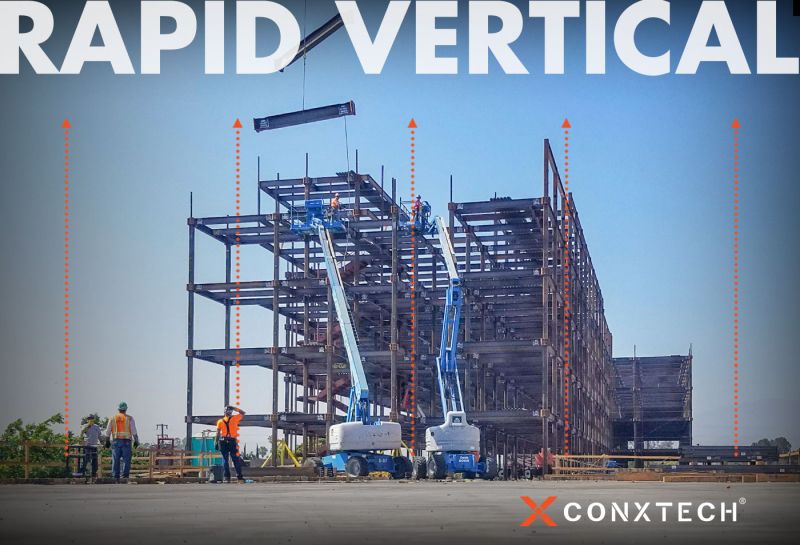
The first point of friction in the usual process is often the handoff between a drawing and the field. If the connection needs improvisation aloft, a tidy schedule unravels. ConXtech's answer was to standardize the detail and control its fabrication. That made structural approval essential. The company's chronology records a full-scale, two-directional connection test frame in 2009, hospital prequalification in California in 2010 and ConXL's inclusion in AISC 358-10 in 2011. Those milestones matter more than a slogan about disruption: engineers and building authorities need evidence before they trust a novel joint with real people above it.
The idea also had to survive buyers changing their minds. At Oakland's Thomas Berkley Square, the project was originally designed for bearing-wall light-gauge steel studs. The Bedford Group chose the ConX system while a four-story parking podium was already under construction. That switch was hardly a casual product substitution. It shows the kind of decision that gives the system a chance: a team must see enough value in speed and layout flexibility to reopen the structural plan.
“The alignment and partnership up front with any trade partner is crucial to the success of any project team.”Boldt Construction testimonial on Sutter Folsom
Healthcare makes the stakes visible. Kaiser Permanente appears throughout ConXtech's project portfolio, and the company says it had erected more than 35 Kaiser medical office buildings by 2024. A newer Sutter Health project in Folsom, announced in December 2025, brings ConXtech's Falcon connection into a 106,500-square-foot care complex with Boldt Construction, Buehler Engineering and Boulder Associates. Boldt's public testimonial stresses early alignment with trade partners. A rapid connection is useful; a coordinated project team lets it become rapid construction.
What the next builder can steal
ConXtech's lesson is available even to builders who never use its steel. Find the repetitive, risky handoff that slows the job. Settle its geometry before workers are suspended above the site. Test it at full scale. Design the factory and the field procedure as one operation. Then measure the claim at the correct boundary: the frame's erection time, the building's completion time and the owner's total cost are three different numbers.
The company has had time to test that discipline. Founded in 2004, it opened a Woodland, California manufacturing hub in 2019 and reported 20 million square feet delivered by 2025. Its 2015 Series D brought in $25 million, with backers including Saudi Aramco Energy Ventures and a fund associated with the George Kaiser Family Foundation; the announced purpose was more fulfillment capacity and reach. In 2022, PIUS announced another $10 million in secured financing. Money bought the means to repeat the detail. The detail, if it works, buys time.
A construction site will never be a watch factory. Weather, permits and thousands of decisions by other trades remain beyond a steel supplier's control. Yet a building is also the sum of small, repeatable meetings between parts. ConXtech chose one meeting - beam to column - and gave it a script. The crane still gets the applause. The joint tells it when to move.