Contract management software has always made a grim promise: put every agreement in one place, then hope everyone remembers to use it. ContractPodAi started there in 2012, founded in London by lawyers Sarvarth Misra and Robert Glennie with Viraj Chaudhary. It built the expected machinery - templates, approvals, repository, search - and added AI when IBM Watson was still the enterprise default. Then the company kept widening the frame. In January 2026, ContractPodAi renamed itself Leah, the name of the AI product it had introduced four years earlier. The old label had become too small for the pitch.
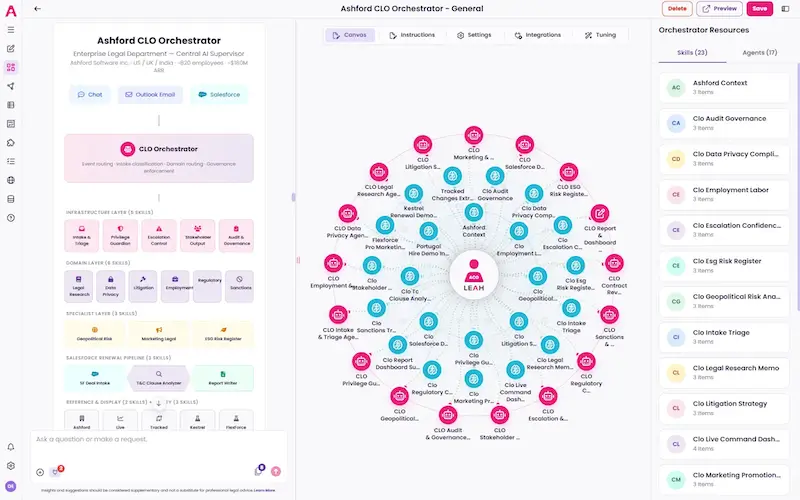
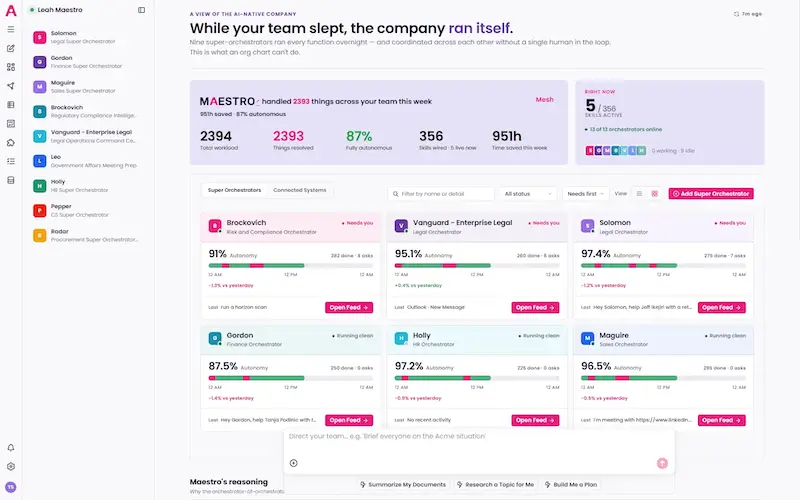
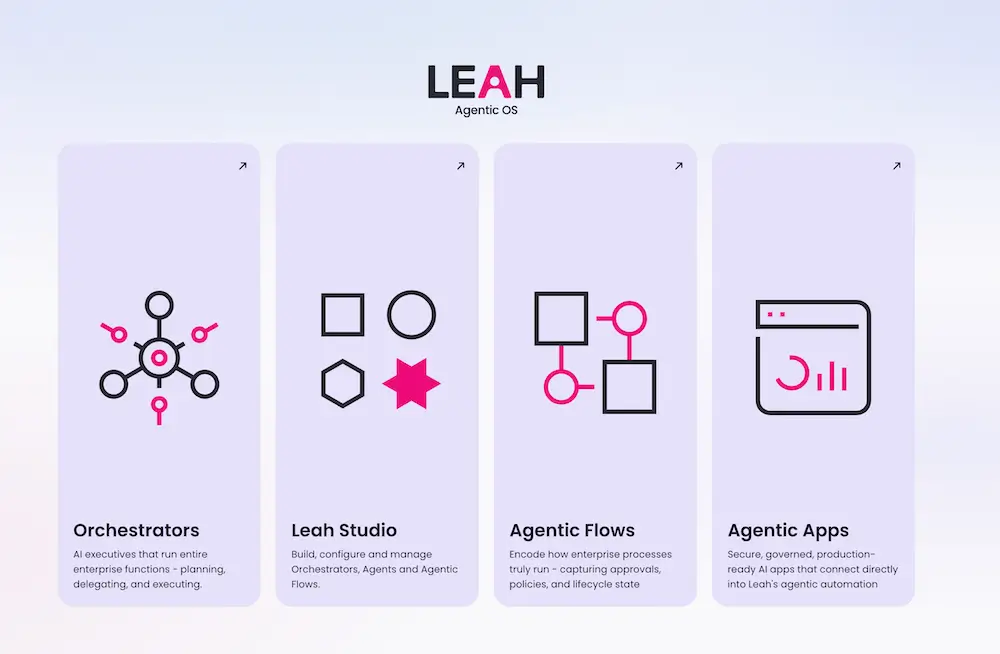
Today, Leah sells two related ideas. Agentic CLM handles the contract from request through renewal. Agentic OS sits above legal, contracting, procurement, finance and shared services, coordinating specialist agents and the systems they need. Maestro, launched in May 2026, is the cockpit above those orchestrators. If ContractPodAi was a very organized contract room, Leah wants the keys to the commercial building.
Why it exists: the PDF is innocent
A contract is rarely the actual bottleneck. The drag appears around it: a sales request arrives without the right details; legal hunts for a fallback clause; procurement forgets a supplier obligation; finance misses a pricing change; an approver is on holiday; a renewal date slips past its notice window. Each team may own a good tool while the transaction itself ricochets through email and spreadsheets.
Leah's useful insight is that the agreement can become structured operating data. Intake fields feed workflows. Clauses become risks, permissions and reminders. A supplier event can pause a linked contract. A signed amendment can update a finance obligation. The product is aimed at organizations where those connections happen often enough, and carry enough risk, to justify turning them into a system.
What people can actually do with it
For contracting teams, the day-to-day product is Agentic CLM. A requester can start from a guided form, upload counterparty paper, or work from Outlook. Leah classifies the document, extracts parties, dates, clauses and obligations, then starts the relevant workflow. Review runs against the company's playbook; proposed redlines arrive in Microsoft Word with tracked changes. Conditional approvals can react to value, jurisdiction or risk, then hand off to DocuSign or Adobe Sign.
After signature, contracts land in a searchable repository. Teams can ask a question in plain language and follow the answer back to a source clause. Portfolio search can surface, for example, every agreement with a GDPR notice requirement or a renewal inside the quarter. Dashboards can show cycle time, obligations and exposure. This is the unglamorous half of CLM that often pays for the glamorous AI demo.
| Job | What Leah does | What the buyer must supply |
|---|---|---|
| Review | Extracts, checks playbooks and proposes redlines | Clean positions, fallbacks and escalation rules |
| Move work | Routes approvals and handles timed escalation | Named owners and honest exception paths |
| Remember | Tracks clauses, obligations, renewals and history | Good migration data and accountable owners |
| Connect | Links CRM, ERP, procurement, signature and storage tools | Integration access, testing and change control |
| Explain | Answers questions with clause references and audit logs | Permissions, evaluation and human review policy |
Agentic OS expands the canvas. Its no-code builders let teams describe an outcome, combine domain agents and connect enterprise data. Human checkpoints can sit where judgment matters. Deployment options include Leah's cloud, private cloud and on-premise environments. The platform advertises support for multiple language models rather than loyalty to one provider, with OpenAI, Anthropic and Azure OpenAI among the named integrations.
The review pattern: capable, with homework
The public review trail is broadly favorable. When researched in September 2026, G2 showed 4.6 out of 5 from 48 reviews; its summary repeatedly noted ease of use, responsive support, automation and classification. Gartner Peer Insights showed 4.7 from 169 ratings, with service and support scoring 4.7. One reviewer reduced the verdict to a useful sentence: “The product is good, but the customer care is excellent.”
The warnings rhyme just as neatly. G2's review summary flags a steep learning curve, initial implementation difficulty, limits in reporting flexibility and gaps in AI or translation capability. Gartner surfaces criticism of an implementation that lacked structure and workflows that could not be overridden without back-end changes. A Leah customer story is unusually frank about “ups and downs during implementation” before the system stabilized. That candor matters more than another badge.
The software can automate a settled process. It cannot settle the politics of who approves what.YesPress verdict
This is the center of the buying decision. Leah can encode a sophisticated operating model, but sophistication multiplies bad assumptions too. A team that has no common clause policy, no owner for historical metadata and six unofficial approval routes will not become orderly because an agent arrives. The platform's flexibility is valuable after the organization agrees on the rules.
Who should shortlist it
Leah makes most sense for a large, contract-heavy business with formal playbooks, multiple legal entities, serious audit needs and enough transaction volume to expose the cost of handoffs. Legal operations leaders, general counsel, procurement heads and finance transformation teams are the natural buyers. A published consumer-goods case says one organization consolidated more than 3,000 scattered contracts and now processes over 1,300 each month. Another account describes a healthcare staffing company moving from 25 active licenses out of 400 to full license utilization after a focused adoption program.
A smaller team that mainly needs signatures, a tidy repository and straightforward templates may be buying a concert hall for a trio. Products such as Juro or LinkSquares may feel lighter; Ironclad emphasizes collaborative workflow and approachable authoring; Icertis and Sirion compete for complex enterprise transformation; Conga and DocuSign CLM can make sense when their surrounding suites already dominate the stack. Workday CLM, powered by Evisort AI, is another serious comparison for organizations in that ecosystem.
| Shortlist when... | Pause when... |
|---|---|
| Contracts affect several departments and systems | You only need storage and e-signature |
| Playbooks and controls are mature enough to encode | Every business unit negotiates the process itself |
| Auditability, sovereignty and deployment choice matter | Public pricing and self-serve setup are mandatory |
| You have an implementation owner and integration budget | Nobody owns taxonomy, migration or adoption |
Pricing: the blank line in the brochure
Leah does not publish list prices. Gartner says pricing depends on the selected package and that the modular product can expand over time. Treat the license quote as only one line of the budget. Data cleanup, migration, integration work, playbook design, testing, training and ongoing administration determine whether the system becomes infrastructure or an expensive shortcut back to email.
The five questions to take into the demo
- Show the source for every extracted term and generated answer. How is confidence represented?
- Change a live approval route. Who can do it, how long does it take, and what appears in the audit log?
- Run our playbook against our counterparty paper in Word, including a clause the system has not seen.
- Price migration, integrations, environments, support, model usage and future expansion separately.
- Define which actions remain human decisions, which can run autonomously, and how an agent stops safely.
Verdict: buy the operating model, not the acronym
ContractPodAi's evolution into Leah is coherent. Contracts already connect revenue, suppliers, risk and obligations; extending intelligence around those connections is more convincing than grafting a generic chatbot onto a repository. Maestro is the boldest part, promising one governed view across an enterprise's agent workforce. In August 2026, Leah selected Oracle Cloud Infrastructure, with PwC leading implementation, for broader regional and regulated-industry deployment. The move underlines where the company wants to compete: high-stakes enterprise operations.
The product earns a shortlist when contract work is genuinely cross-functional and leadership will fund the unphotogenic parts - taxonomy, policy, migration, integration and ownership. Buyers should resist theatrical autonomy and test the boring edges. Can someone override a mistaken route? Can an auditor reconstruct the decision? Can the team improve a playbook without a small consulting expedition? Those answers will matter long after the agent names stop being cute.
Leah's proposition is ultimately practical: stop treating the signed PDF as the finish line. For the right enterprise, it can become the starting signal for everything the business promised to do next.