Connor Jones has a problem with vanishing work. Ask an AI agent a serious question about a business and it may return a sparkling answer, a tidy chart and several minutes of apparent genius. Then the chat scrolls away. The query lives in one place, the code in another, and the reasoning becomes a small archaeological project for whoever asks the same question next Tuesday. Business questions, inconveniently, are fond of sequels.
Jones is building BitBoard for that next Tuesday. The San Francisco company gives AI tools a shared analytics workspace where they can create connected charts, SQL, code and commentary. The output becomes a live dashboard or report that colleagues can inspect, rerun and refine. Sources and logic stay attached. Context gets a longer shelf life than a browser tab.
The idea sounds like software plumbing because it is. Plumbing has the poor manners to be essential without being glamorous. Jones, BitBoard's co-founder and CEO, has spent much of his career around systems where the unglamorous details decide whether the ambitious idea works. He studied engineering at Columbia, worked on BlackRock's Aladdin business, and moved through deployment, revenue, growth and product roles at Forward. In 2025, he and Ambar Choudhury started BitBoard and entered Y Combinator's Spring batch.
First, learn to pull together
There is an earlier line on Jones's résumé that makes the later ones more interesting: rower. At New Trier High School in Illinois, he captained the rowing team. He earned a place in a top United States development eight in 2009 and was invited to the junior national team selection camp the following year. In 2010, he won gold for the US men's eight at the World Rowing Junior Championships.
He went on to Columbia's varsity heavyweight rowing program. Crew is an unusually blunt education in systems. Eight strong athletes can produce a slow boat if they apply power at slightly different moments. The result belongs to the synchronization, not merely the individuals. Jones has not publicly presented rowing as a startup parable, so there is no need to force one into his mouth. The parallel is simply hard to miss: his current product is also about keeping capable actors aligned around one durable piece of work.
After Columbia Engineering, Jones joined BlackRock. His work spanned analyst duties and product roles connected to Aladdin, the firm's investment technology platform. In late 2019, he moved to Forward. Over the next several years, his titles traced a broad operating education: product deployment, revenue strategy and operations, growth, and senior product management. It is a progression through the parts of a company that have to translate an idea into repeatable behavior.
A company changes its surface
BitBoard first appeared publicly in June 2025 as a company automating repetitive back-office workflows. Jones and Choudhury described the operational frustrations they had encountered at Forward: variable inputs, brittle software and important work spread across old interfaces. Their agents used browser automation when necessary, though Jones was emphatic about preferring an API or direct data source when one existed.
His replies during the launch were unusually detailed for a founder introduction. He discussed checking destination data against source data, using the DOM or optical character recognition, caching expected navigation paths and alerting when an agent wandered. He listed TypeScript, Python and Go, with Postgres underneath. He talked about model evaluation and the hope of contributing improvements back to open-source projects when bandwidth allowed. The marketing proposition was automation. The operating obsession was verification.
The BitBoard test for durable analysis
By 2026, BitBoard had changed its public face. It now called itself an agent-first analytics workbook. Connect an AI chat or coding agent, push data into the workspace, and the agent can build a report with charts, transformations and written interpretation. For ongoing work, teams can connect databases, warehouses and business applications. The product caches results, persists logic and gives each step a name.
The shift is substantial. A vertical workflow company and a horizontal analytics product sell to different needs. Yet the connective tissue is visible. Both versions of BitBoard deal with complex work performed across imperfect systems. Both assume that probabilistic software needs firm rails. Both ask what must remain after an agent has acted so a person can check it.
The answer needs receipts
The current BitBoard site uses three words as its standard: accurate, traceable, repeatable. Accuracy means an agent should use a team's definitions, trusted queries and corrections. Traceability keeps the sources, queries, code and context with the result. Repeatability turns a good analysis into a pattern that can run again without returning to zero. The words are corporate copy, but they are also a compact theory of useful AI.
A one-off answer can be impressive and still create no institutional value. The reusable asset is the trail: what data was used, which assumptions shaped it, how the transformation worked, and where a colleague corrected the logic. BitBoard's dashboard becomes less a polished final slide than a workbench with the tools left in sensible order.
This also changes the handoff between humans and agents. BitBoard has introduced collaborative presence indicators, activity states and locking for blocks while someone edits. The mundane language of collaboration software becomes revealing here. An agent is not treated as an oracle behind a curtain. It appears as another participant touching shared material. People can see what is running, what is stale and where a conflict might occur.
Jones's public comments suggest a taste for the strongest available constraint. Use the API before the browser. Use deterministic checks when a claim can be checked. Let a person inspect the output. Prefer a robust data type to a clever workaround. The pattern is practical rather than doctrinaire. In a field addicted to saying what machines may soon do, Jones keeps returning to what a team can verify today.
BitBoard's architecture makes that preference visible. An agent can push a data file for a quick investigation, then move toward live connections when the question becomes recurring. Small queries can run locally. Results remain cached until underlying data changes. A warehouse returns only the rows a query needs. None of this makes for a thrilling movie trailer, but it answers the questions that arrive after the demo: How much will another run cost? What changed? Can we avoid doing all the work again?
There is a design argument hiding inside those mechanics. Most AI interfaces begin with an empty box, as if every question were the first question anyone at the company had ever asked. BitBoard begins with accumulated material. A trusted query, a correction from a colleague and the definition of a company metric can remain available to the next analysis. The agent gets context without hauling an entire chat transcript through every new request. The human gets an artifact rather than a memory of an agreeable conversation.
That may be Jones's most transferable product instinct. When a process matters, do not depend on someone remembering the clever thing that happened last time. Name it. Save it. Expose its inputs. Make the rerun cheaper than the reinvention. In rowing, the useful stroke is the one the crew can repeat together. In analytics, the useful answer is the one a team can revisit without calling a séance for last month's prompt.
Small team, long memory
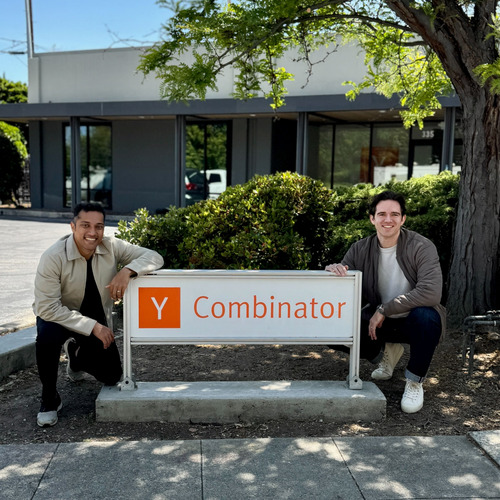
BitBoard remains a two-founder company in Y Combinator's directory. Choudhury, its CTO, was an early engineer at Forward and previously worked at Palantir. Jones brings the span across finance technology, operations, growth and product. Their photographs beside the Y Combinator sign have the familiar grammar of startup beginnings: two people, a sidewalk, a logo heavy with expectations.
What distinguishes the company is not the size of its promise but the shape of its complaint. The AI agent did some useful work, and now nobody can find the reasoning. The business question returned, and the answer had expired. The analyst sent a number, but its lineage took the afternoon to reconstruct. These are modest irritations until they happen every week across a team. Then they become a market.
Jones appears interested in AI that earns a role through reliability. During BitBoard's first launch, he openly invited other builders to trade notes and wrote, “We're happy to share everything we've learned so far.” The sentence carries a founder's optimism without pretending the problem has been conquered. It also fits the product he is now selling: useful knowledge should be shareable, inspectable and available to the next person who needs it.
The long arc from an eight-person boat to an agent-filled workbook does not need a grand moral. It offers a small, sturdy one. Coordinated work beats isolated brilliance. A dashboard that remembers how it was made may be less theatrical than a chatbot producing an instant revelation. It is also much more likely to be useful on Tuesday.