A lawyer walks into a business school and comes out wanting to change banks. The expensive part of the joke takes the next quarter-century. Coenraad Jonker, usually called Coen, had already become chief executive of Edward Nathan when he joined the first MBA cohort at the Gordon Institute of Business Science in 2000. He had a profession, a title and a respectable trajectory. Then a book made that trajectory considerably less tidy.
Hernando de Soto’s The Mystery of Capital prompted him to think about the machinery beneath prosperity: who gets access to finance, who remains outside it, and what a private company might do about the difference. This became an interest, then a subject he taught, then a reason to leave legal practice. Reading is generally considered a harmless occupation. In Jonker’s case, it proved occupationally disruptive.
Today he is the founder and group CEO at GoTyme, the banking business that grew from the original Tyme venture. He is based in Singapore. Its banks operate in South Africa and the Philippines, with separate country chief executives. His story runs through corporate law, community banking, an Australian bank and a supermarket kiosk. The kiosk may be the most revealing stop.
The respectable career he interrupted
Jonker entered the legal profession in 1994 and was admitted as an attorney the following year. He joined Edward Nathan & Friedland in 1996, became a partner and head of its labour department in 1998, and rose to chief executive in August 2000. These are the sorts of dates that make a conventional executive biography look pleasingly inevitable. Nothing about them required a detour into building a bank.
His choice of business school was itself a small wager. GIBS was new. Nick Binedell, its founding dean, was selling an institution whose reputation still lay ahead of it. Looking back, Jonker credited the experience with changing his career: new ideas, teachers and classmates supplied the conditions; he supplied an open mind. The degree did more than improve the credentials on an existing path. It helped him choose another.
In 2005 he joined Standard Bank as director of community banking. There he worked on extending services to underserved consumers, using digital channels and adding more than a million customers. The question that had interested him in class now had budgets, customers and operating constraints attached. In 2011 he moved to Deloitte’s strategy and innovation practice. Tyme emerged as a separate venture in June 2012, co-founded with Tjaart van der Walt.
An app still needs an introduction
Jonker has described his early position as digital maximalism. The appeal is easy to understand: put banking on a phone, remove expensive premises, reach people whom traditional economics have excluded. The difficulty arrives when a customer who lives in a cash economy is asked to entrust their money to a screen. A functioning product and a believable proposition are two separate pieces of work.
Tyme experimented with human assistance alongside its technology. The model evolved into ambassadors standing beside kiosks in retail stores, helping customers open accounts and receive debit cards. The encounter matters. A person can answer a question that an interface has failed to anticipate. A familiar shop gives an unfamiliar financial service an address in the customer’s daily life.
By September 2022, Jonker was explaining a hybrid system with more than 1,000 South African retail kiosks. Digital banking, in his formulation, was a means of widening access. Physical locations had a useful place in that effort. The purist might object that a digital bank ought to be entirely digital. The shopper has other things to do, and is unlikely to award points for ideological consistency.
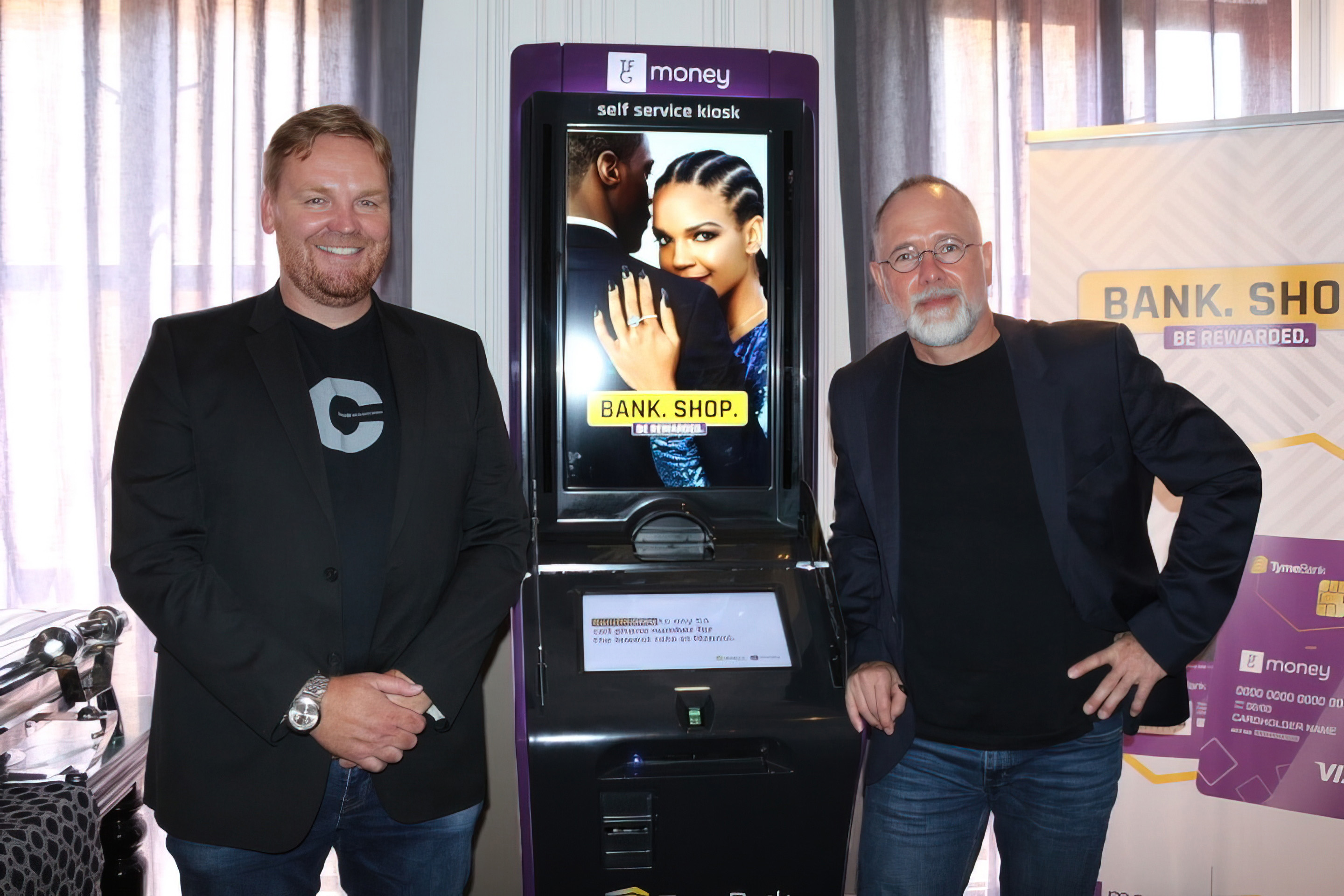
At TymeBank’s public launch in February 2019, the proposition was already concrete. Customers could open an account at a kiosk and receive a personalised Visa debit card in under five minutes. Pick n Pay and Boxer supplied the retail setting. Jonker reported 80,000 customers following the earlier soft launch. An idea about economic participation had acquired a very ordinary place to happen: the weekly shopping trip.
First, learn the institution. Then build one.
Tyme’s ownership history makes the familiar image of a founder steadily building a single independent company look rather inadequate. Commonwealth Bank of Australia acquired the technology business in 2015. Jonker went into the group, working on digital banking across its international markets. In 2017, CBA appointed him group executive for international financial services, effective that July.
The appointment put him inside a large institution with responsibilities extending across Asia. CBA’s announcement described a lawyer and fintech entrepreneur with more than 23 years in legal, financial and professional services. It also credited him with helping design and operate a new retail banking model for emerging markets. The would-be challenger had become a senior incumbent executive.
At the end of 2018, Jonker partnered with African Rainbow Capital to buy the Tyme business from CBA. The following February brought the South African public launch. Institutional experience and entrepreneurial ambition had travelled together, even when the ownership changed. For this particular founder, learning how banks worked was part of the route to changing their economics.
A founder takes the local controls
In 2022 Jonker moved into the South African CEO role. Tauriq Keraan, who had led the bank’s build and growth, shifted toward international expansion; David Pfaff took the group CEO position. Jonker described leadership assignments in terms of the business’s particular phase and the strengths of the people involved. A founder’s title was less useful than the work that needed doing.
Profitability in South Africa was the immediate priority. Partnerships and acquisitions were part of his remit. His preferred image was a fleet of smaller, faster boats, coordinated to compete with established institutions. The metaphor suited a company assembling capabilities through partners: the retailer, the technology team, the bank and the specialist business each had something different to contribute.
TymeBank recorded its first profitable month in December 2023. That milestone deserves its exact wording. A profitable month marks progress toward a sustainable bank; it does not make every subsequent reporting period profitable. The 2024 annual report records both Jonker’s tenure, beginning in July 2022, and his departure from the local CEO role on 30 September 2024 to concentrate on international growth.
TymeBank’s first profitable month, during Jonker’s tenure as South African CEO.
Recognition followed. In March 2024, TymeBank won News24’s Bank of the Year award. The judging included a survey of 4,100 readers and subscribers alongside scrutiny of the banks’ strategies. The award put customer experience and execution beside growth. For a venture built around access, the distinction is useful: opening accounts is one test; giving account holders a reason to value the service is another.
The lift ride with consequences
Late in 2023, at an Endeavor black-tie event, Jonker shared a lift with David Vélez, Nubank’s founder. A conversation began. Months later Vélez called: Nubank had been researching attractive countries for digital banking, and Tyme operated in several of them. A brief encounter had become a reason for a longer discussion. Even in financial technology, the lift occasionally remains competitive with the algorithm.
In December 2024, Nubank invested $150 million in Tyme’s $250 million Series D round. M&G’s Catalyst Fund supplied $50 million, and existing shareholders supplied another $50 million. The round valued the group at $1.5 billion. Those were company financing figures, a measure of the business and its investors’ expectations.
“Valuation is an outcome, like happiness. It’s not the mission.”
Coen Jonker, in conversation with Vincent Fong
The partnership also offered a practical exchange of experience. In his public announcement, Jonker singled out data analytics, credit risk management, product development and marketing as areas where Tyme could learn from Nubank. The attention-grabbing number was the valuation. His list of desired lessons was more workmanlike, and more revealing about what he expected an investor to contribute.
The customer may edit the founder
Jonker’s account of leadership includes an awkward obligation: accepting that the customer may understand the product’s shortcomings sooner than its creator. In his 2024 reflections, he said he would hold his ideas less tightly and correct mistakes faster. He also described the business as a team project that should be able to continue when his own role ends. That is a demanding ambition for someone whose career has become so closely associated with it.
The same attention to economics appears in his more recent thinking. In an August 2026 interview, he explained that inclusive banking needs automation, a broader customer base and lending capabilities. Serving lower-income consumers sustainably requires a bank whose entire model works. The moral argument has to survive the operating statement.
In September 2026, he was discussing a group serving roughly 22 million banking customers across South Africa and the Philippines. The distance from the law office is considerable. Yet the original question remains recognisable: how do you change the arrangements that decide who can participate? Jonker’s answer has required a business school, several employers, co-founders, investors and a great many retail conversations. For all the software involved, somebody still has to make the introduction.