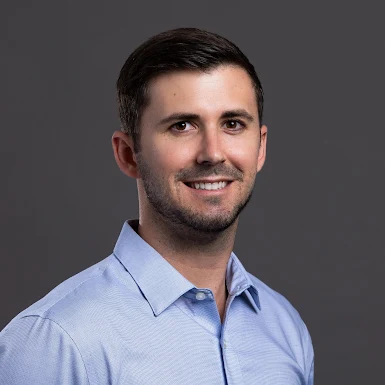
Co-Founder & CEO / DermaSensor
Cody Simmons
He didn't invent the device. He got the call in 2016, said yes, and refused to put it down until the FDA said yes too.
He didn't invent the device. He got the call in 2016, said yes, and refused to put it down until the FDA said yes too.
The thing in the doctor's hand is the size of a TV remote. You press it against a suspicious mole, it pulses light into the skin, and a few seconds later it returns a number. No scalpel. No two-week wait for a biopsy. No three-month line for a dermatologist who lives an hour away. That device is DermaSensor, and Cody Simmons has spent nearly a decade making it ordinary.
Ordinary is the whole point. Skin cancer is the most common cancer in the United States, and most people who have it walk into a primary care office first, not a dermatology clinic. The general practitioner is the front line and, historically, the weakest link in detection - eyeballing lesions with judgment that varies wildly from doctor to doctor. Simmons built a tool that hands that doctor a second opinion drawn from machine learning and a physics technique called elastic scattering spectroscopy.
In early 2024 the device became the first of its kind to win FDA clearance: an AI-powered tool authorized to evaluate all three common skin cancers - melanoma, basal cell carcinoma, and squamous cell carcinoma - for frontline providers. That sentence sounds like a footnote. It is closer to a decade of regulatory trench warfare compressed into a press release.
"Get a sense of your regulatory path and whether there is some way to align that with reimbursement."
Here is the detail that explains him. Simmons is not the original inventor of DermaSensor. In 2016 the serial healthcare entrepreneur Maurice Ferre approached him to take over a young company and turn a research curiosity into a product physicians would actually buy. Simmons was a 20-something at the time - a Brown graduate, a Stanford master's holder, four years deep into Genentech. He took a thing other people had dreamed up and made it his life's work. There is a particular kind of founder who builds the idea, and a rarer kind who adopts one and carries it across the finish line. Simmons is the second kind.
By mid-2024 DermaSensor was commercially live in the US. By the autumn of 2025 it had scanned more than 20,000 lesions and was compounding at roughly 117% a quarter, and Simmons had closed a $16 million Series B that pushed total funding toward $43 million. The investors were not betting on a prototype anymore. They were betting on distribution.
The device uses elastic scattering spectroscopy - a way of reading cellular-level structure by how tissue scatters light. The skin is never broken. The signal is fed to an algorithm trained to spot the patterns that matter.
The physician presses the handheld tip to a lesion during a routine visit. No referral, no surgery, no preparation.
Pulses of light enter the skin and bounce back. How they scatter encodes the structure of the cells beneath the surface.
An AI model reads the spectral data in seconds and returns a risk readout to help the doctor decide: watch, or refer.
Four years inside one of biotech's giants - a leadership development program, then US pricing and contracting strategy for oncology drugs. He learned how the money and the medicine actually move.
Entrepreneur Maurice Ferre recruits him to run DermaSensor and commercialize a handheld skin cancer tool. He says yes.
Named to the healthcare list - recognition for a founder still years away from a product on shelves.
Completes the first FDA pivotal study for primary care-focused skin cancer detection. Along the way the team survives two near-fatal crises: a technical design flaw and a manufacturing breakdown.
DermaSensor wins FDA De Novo clearance - the first AI device cleared to evaluate all three common skin cancers. Commercial launch follows mid-year.
New institutional backers join existing investors; total funding nears $43M, aimed squarely at putting the device in more exam rooms.
Get a sense of your regulatory path and whether there is some way to align that with reimbursement.
Demonstrating manufacturing capability and scalability signals competency to investors and reduces perceived risk.
Find believers willing to advocate for the company during difficult periods.
Early on, Simmons admits, he underestimated networking. He thought a good device and a clean clinical story would carry the room. They did not, not entirely. Capital in medtech moves on trust built over months, and the founders who win the hard rounds are usually the ones investors already knew before the term sheet was on the table.
So he changed his habit. He now advocates for proactive, monthly outreach - keeping relationships warm long before he needs anything from them. And he draws a sharp distinction between an investor with a checkbook and an investor who is a believer. The believer, he argues, is worth an equity discount, because the believer is the one who shows up during the bad quarter and argues for the company in the room you are not in.
The device that catches cancer was the easy story. The eight years of regulatory and manufacturing survival was the hard one.
Two setbacks nearly ended the company. One was a technical design problem. The other was a manufacturing crisis - the unglamorous, fatal kind of problem that kills medtech startups in the gap between a working prototype and a product you can build ten thousand of, reliably, to the standard a regulator demands. Most companies do not cross that gap. DermaSensor crossed it twice.
There is a tidy irony in Simmons's resume. He spent his Genentech years on the pricing side of oncology - figuring out what cancer treatment should cost. Then he walked to the other end of the timeline, to the moment before treatment is even needed, and bet his career on catching the disease early enough that the expensive drugs and the surgeries and the fear might never enter the picture at all.
His ambition is unfashionably plain. Not a moonshot, not a manifesto. He wants a skin cancer check to become a routine, point-of-care moment - something your family doctor does in the same visit they take your blood pressure. The cancer caught in a strip-mall clinic in seconds instead of a specialist's office in months. If he is right, the most radical thing about DermaSensor will eventually be how boring it feels.
He studied entrepreneurship with a bioengineering focus and economics at Brown - one foot in the lab, one in the spreadsheet.
His Genentech years were spent in oncology pricing and contracting strategy - selling the treatment before he built the detector.
Elastic scattering spectroscopy reads cellular-level tissue information without ever breaking the skin.