A steel pipe is a rather conspicuous thing to lose. At Womble, the Houston pipe-coating business, the difficulty was keeping track of customer inventory across an outdoor operation covering 165 acres. Trucks, trains and barges brought material in. Paper tried to keep up. Somewhere between the yard and the office, a physical fact had to become an administrative one.
- Cloud Inventory connects physical inventory work with enterprise records.
- Its customers manage stock in factories, warehouses, yards and the field.
- Mobile capture, inventory execution and label printing are separate product jobs.
- The useful test: can a worker record a movement correctly, where it happens?
Cloud Inventory’s account of the Womble deployment describes serialization and barcoding linked to Oracle JD Edwards EnterpriseOne. The resulting record followed customer-owned pipe from receipt to shipment. Womble says it subsequently coated and tracked more than 57,000 miles of pipe without losing a piece. That is a customer result published by the vendor, rather than a universal promise.
Womble’s inventory problem had room to wander.
The interesting detail is the boundary. Inventory could be physically present and operationally elusive. A worker needed to know which pipe belonged to whom, where it was, and what happened next. Cloud Inventory makes software for that moment: when an object changes location, status or custody, and the business needs a dependable record of the change.

A whiteboard with a waiting list
At Yalumba, the Australian winery, enterprise software already tracked stock by warehouse location. The awkward part came afterwards. Workers manually recorded inventory transactions, which were processed in batches. The system consequently lagged behind the stock. Picking instructions lived on a whiteboard; warehouse personnel waited in line to consult it.
A queue in front of a whiteboard is a wonderfully literal picture of an information bottleneck. Yalumba adopted mobile supply-chain applications that exchanged data with its enterprise system. It later extended the approach to barrel management, recording receipts, fills and blends, and generating labels. The cellar applications could operate without a connection. Staff received training and configuration help, then developed the skills to support and expand their use.
Offline operation deserves careful reading. Cloud Inventory’s Mobile Enterprise Platform captures data locally and updates the system when connectivity returns. A worker can continue collecting transactions, but colleagues elsewhere still need the synchronization before they have those new facts. The distinction matters when two people make decisions about the same stock.
- 01 / CaptureScan where the work happens
- 02 / ValidateCheck the item and workflow
- 03 / ConnectUpdate the system of record
The warehouse in the middle
Domtar’s pulp business had manufacturing software and a sales-and-invoicing system. Its trouble sat between them: inventory distributed through third-party warehouses. Those facilities had their own software, and Domtar’s internal network was absent for security reasons. Spreadsheets and handwritten shipment information compounded the separation.
“We did not have an inventory system in between.”
Rob Tice, Senior Logistics Coordinator, Domtar
Domtar selected Cloud Inventory for cloud access, customization and ERP integration. It began implementation in late 2019. During 2020, equipment could be mailed to warehouses and scanners set up with remote assistance and training. The shared system let locations remain independent while making inventory data available to the people planning shipments and replenishment.
That choice suggests a useful purchasing principle: define the organizational boundary before drawing the software diagram. A supplier’s warehouse, a contractor’s truck and your own plant may all hold inventory relevant to the same order. They do not necessarily share a network, an ERP or an employer. A practical inventory layer has to accommodate those differences.
Three products, three jobs
Cloud Inventory’s current offering separates problems that often get bundled under “warehouse software.” Its Mobile Enterprise Platform, or MEP, extends data capture to workers through ready-made applications and a low-code toolset. The published application library covers receiving, inventory inquiries, cycle counts, transfers and manufacturing transactions across ERP environments including Oracle Fusion, JD Edwards, Oracle EBS, SAP and IFS.
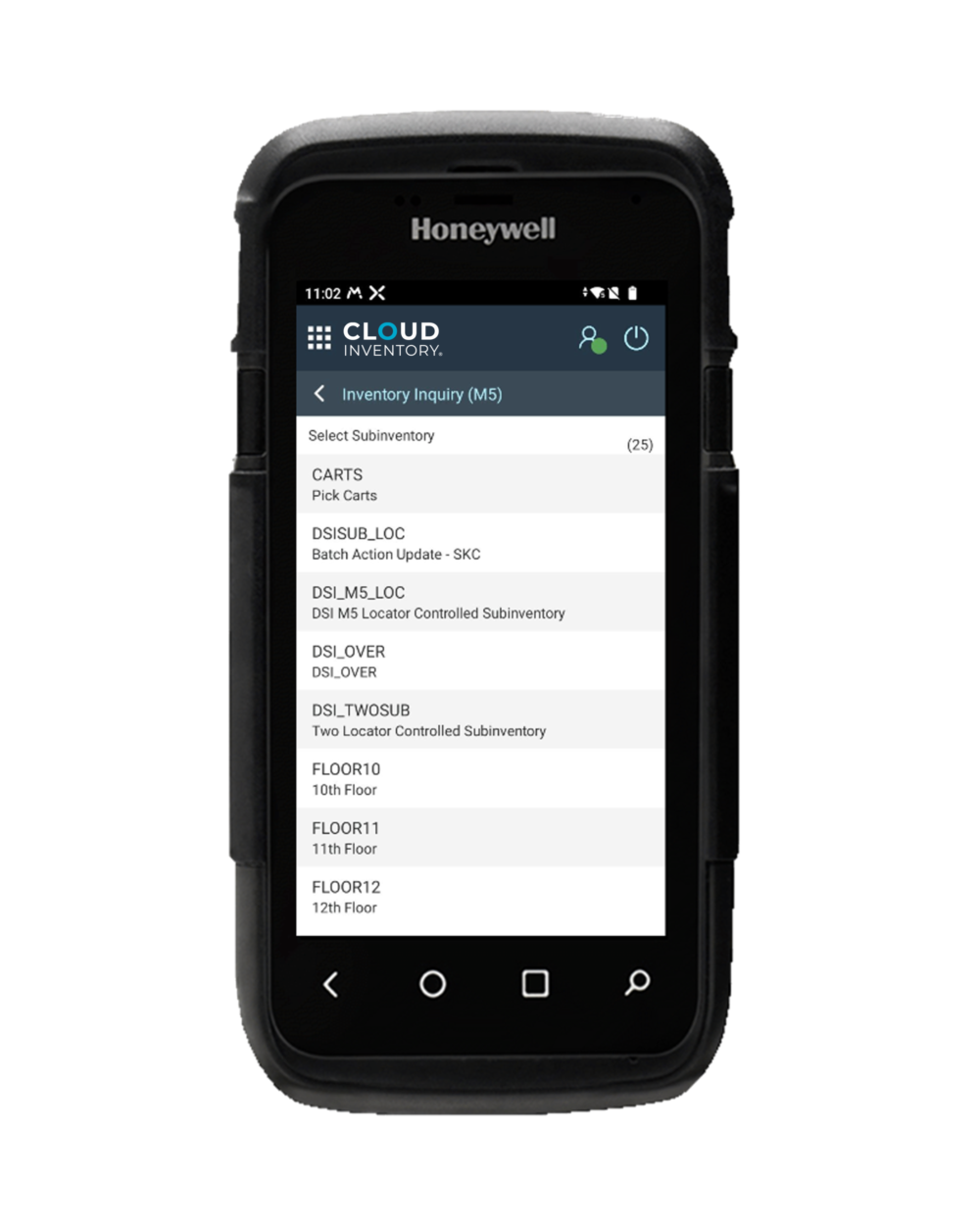
The Cloud Inventory Platform occupies a different position. Its pitch is an execution layer between the ERP and warehouse floor, with controls beyond a mobile extension. The feature list includes lot and serial traceability, license-plate numbers for identifying handling units, scan-verified receiving, directed putaway, inspections, quality holds and wave-based outbound work. A wave groups work for release, rather than leaving every order to compete independently for attention.
Capture the work
Mobile transactions and configurable apps.
Control the movement
Validation, traceability and execution.
Print the identity
Labels and distributed output management.
Enterprise Printing Platform, or EPP, handles the labels that make scanning possible. Users create, manage and print them in a browser. Business rules can alter label requests; output management provides printer monitoring and redirection. Its remit extends to partner locations, third-party logistics providers and contract manufacturers. A pallet’s label has a surprisingly demanding social life.
The expertise here combines enterprise integration with the details of physical operations. Field Inventory addresses stock outside warehouse walls. Manufacturing Materials covers production inventory. ScanWorkX serves Microsoft Dynamics environments. The company also offers implementation and technical services; its IFS consulting work through eNSYNC reflects how much of this business depends on understanding the system already installed.
The price lives in the workflow
This is a business-to-business software purchase involving deployment, configuration and support. Cloud Inventory routes prospects through demos and sales discussions. For a buyer, the useful unit of evaluation is a working transaction: receiving a delivery, moving a pallet, counting a location or completing a manufacturing order. Each reveals different integration and training requirements.
Gold Eagle’s customer account is instructive here. The automotive-chemical manufacturer used mobile transactions in warehouse and production operations, with real-time updates to JD Edwards. Its account also credits a move to better-performing ruggedized handheld devices with faster picking and packing. Cloud Inventory supplied training, hardware support, application building and troubleshooting. The scanner’s response time belonged in the software conversation.
A sensible evaluation therefore includes devices, network conditions, ERP connections, workflow configuration, labels and staff time. Test an actual exception as well as a clean transaction. What happens after the wrong item is scanned? Who approves an adjustment? What happens to a queued offline transaction? These are editorial recommendations drawn from the operational demands described in the customer stories.
Cloud Inventory positions its platform for companies that need warehouse discipline without the scope of a full warehouse-management system. That is a purchasing distinction, not a claim that the products are interchangeable. Blue Yonder, for example, advertises warehouse labor, robotics integration and advanced slotting alongside execution. Facilities seeking that breadth should evaluate it directly. At the other end, a simple stock operation may have little reason to undertake a substantial enterprise-integration project.
An old company’s new AI brief
The name sounds recent; the business began as Data Systems International in 1979, founded by Mike McGraw. Nextworld announced its acquisition in January 2022. The combination joined mobile inventory products to Nextworld’s ERP and no-code platform. The announcement also maintained the company’s ERP-agnostic position. Selling useful extensions to customers with other systems remained part of the proposition.
The surrounding partner network matters for the same reason. Denovo’s June 2025 partnership combines MEP with Oracle infrastructure and application services. Cloud Inventory also expanded its Boomi integration partnership in 2022. These relationships address the connective work between applications, rather than requiring every inventory customer to start again with the same stack.
In May 2026, Cloud Inventory announced an AI-Native platform. Its stated applications are concrete: an AI agent, connected through an MCP server, can help create picking waves using order volumes, staffing and carrier arrival times. Image analysis can help assess and record the condition and authenticity of assets. These are announced capabilities; the older customer stories do not establish their measured performance.
The other releases are less theatrical and equally revealing. May’s EPP update supports multiple servers with load balancing, allowing traffic to be redirected when a server fails. July’s MEP release adds programmable gateway restarts, a login screen focused on single sign-on and saved transaction filters. Each addresses a small interruption that can become a large operational nuisance.
The common thread runs back to the pipe yard. Record the movement while someone still knows what happened. Make that record available to the next person who needs it. Keep the scanner, connection and printer useful enough that people actually use them. Inventory software earns its place in the business through those ordinary moments, repeated across a shift.
Follow the transaction
Explore the applications, watch the company’s introductory video, or follow its product updates.