The most revealing thing about Janam Technologies may be its slogan. “The right features. The right price.” No moonshot. No promise to reinvent work. It sounds like a procurement manager wrote it on a yellow legal pad - which is precisely the point. Janam makes computers for people whose shifts can be ruined by a dead battery, a missed barcode or a five-foot fall onto concrete. The glamour is in what does not happen: the warehouse lane does not stop, the blood sample does not get lost and the stadium queue does not become a small civic emergency.
Founded on Long Island in 2006 and led by co-founder Harry Lerner, Janam built rugged handheld computers for retail, healthcare, manufacturing, logistics, government and field service. The products sit in the gap between a consumer phone wearing an optimistic rubber case and the most expensive industrial terminals from Zebra, Honeywell, Datalogic and Panasonic. They scan quickly, survive rough handling, stay connected and last through a shift. They are sold through distributors and resellers, with accessories, repair plans, connectivity and custom engineering around them.
01 / The useful middleA computer for the moment the workflow gets physical
Janam's range is less a gadget shelf than a taxonomy of repetitive work. The XT line resembles a thick smartphone and handles barcode, NFC and credential jobs. XG devices add the familiar pistol grip for workers scanning cartons all day. XM models retain physical keypads for input-heavy operations. XR2 sweeps UHF RFID tags across a warehouse. The GT family docks a handheld into a battery-powered pedestal so a guest can scan a ticket without a staff member holding the reader.
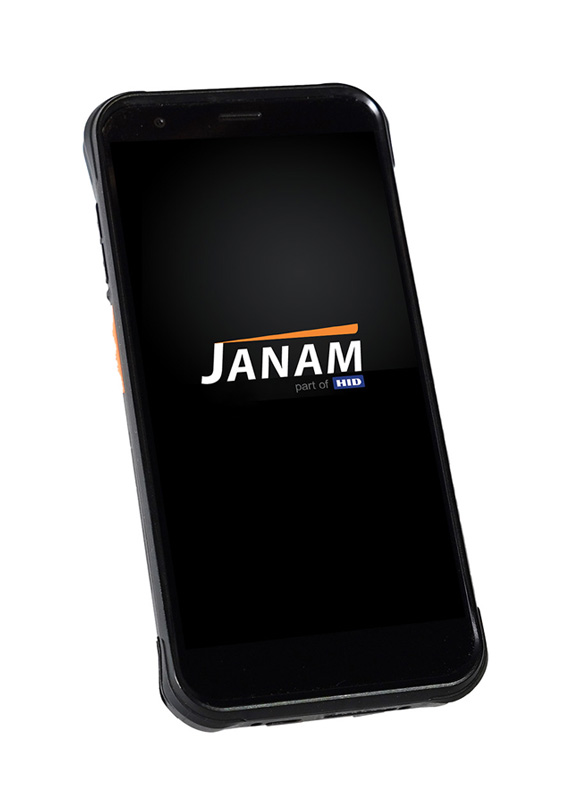
The current XT4 makes the strategy visible. It runs Android 14, supports 5G and Wi-Fi 6E, carries a hot-swappable 5,200mAh battery and is sealed to IP67. A Honeywell imager reads conventional barcodes. Janam's HaloSense system places active NFC antennas on the front and back, reducing the awkward choreography of finding the exact tap spot. An HID OMNIKEY secure element ties the device into its parent's identity ecosystem. The latest software roadmap extends to Android 18.
Survive
Sealing, drop ratings and batteries built for a full shift turn reliability into the first feature.
Capture
Barcode, UHF RFID, NFC and cameras give one fleet several ways to identify an item or person.
Connect
Wi-Fi 6E, 5G, private LTE and JanamConnect move field data into enterprise systems in real time.
Reuse
Backward-compatible cradles and pedestals lower the pain of upgrading the computer inside.
02 / The first thing to failBefore the hardware broke, the old process did
Janam's customer stories follow a dependable pattern. The original problem is rarely “we need a nicer scanner.” It is a process fraying under volume. Paper records introduce errors. Manual counts hide inventory. An old mobile operating system blocks new applications. A battery expires before the shift. A fixed gate costs too much to install where crowds move. The device enters as a repair for that operational failure.
The published results are specific enough to explain the sale. Coastal Pipco said an XM5 improved productivity by about 60 percent. Stone Oak Property Owners Association reported a 40 percent decrease in water-meter reading time with an XT2. American Nutrition reported a 20 percent productivity lift from an XG3-ER. The Dentists Supply Company said its XM75 deployment cut automation costs by 50 percent while improving scanning and processing. Those are separate cases with different baselines, not a controlled comparison, but they show what Janam actually sells: fewer labor minutes per reliable transaction.
Reported field outcomes / separate customer cases
Measures differ: productivity gain, time reduction, automation-cost reduction and productivity gain. Janam-reported case-study figures; they should not be added together.
What did it cost? Janam does not publish a universal price list, and enterprise configurations vary by scanner, radio, accessories and service. In 2026, one public reseller listed XG5 configurations around $1,530 to $1,997, against manufacturer suggested prices up to $2,995. Another listed the XR2 near $1,833. That is expensive beside a mass-market phone and ordinary beside specialized industrial gear. The economic argument only works when a failed scan, broken screen or interrupted shift costs more than the rugged premium.
“Their existing Janam scanners are half the solution; GTX completes it for them.”Harry B. Lerner, on the mobile entry pedestal
03 / The mind-changerDigital tickets made the scanner strategic
The company did not abandon industrial computing for entertainment. It noticed that venue access had become another high-volume data-capture problem. Printed tickets became phone screens. Phone screens became Apple Wallet and Google Wallet credentials. The pandemic made contactless entry urgent. A warehouse scanner already knew how to read quickly, roam on crowded networks and survive a bad day; Janam taught it NFC and placed it in a pedestal.
GT1 and later GTX offered a neat bit of hardware judo. Instead of installing a permanent turnstile for every lane, a venue could slide an existing Janam handheld into a mobile, battery-powered stand. The same software and network connection came along. Wheels let operators change the gate plan. The GTX could be adjusted for ADA access. A magnetic placard handled sponsorship without commandeering the validation screen. In 2022, Janam hardware supported access at the FIFA World Cup in Qatar, according to HID.
That changed HID's calculation. HID already had RFID and NFC tickets, wallet credentials and identity infrastructure. Janam brought the moving endpoint - handheld readers and portable pedestals that stood where people entered. HID acquired the company in December 2022 for an undisclosed amount and folded it into the Events & Mobility Solutions business. The deal gave Janam global sales support and gave HID a more complete path from issuing a credential to reading it at the door.
Weak scanning and lifecycle controls
Value-priced ruggedness
Higher cost and complexity
04 / More jobs, same objectTickets became faces and payments
After the acquisition, the handheld accumulated jobs. The 2024 XR2 brought long-range UHF RFID into an all-in-one reader; Janam publishes a rate above 1,300 tags per second and a range around 60 feet under suitable conditions. The 2025 XT4 added dual-sided NFC, faster connectivity and HID security hardware while remaining compatible with XT3 accessories. The XG5 refreshed the pistol-grip line with Wi-Fi 6E, a hot-swappable battery and optional scanning out to 66 feet.
Software partners stretched the endpoint further. Wicket's opt-in facial authentication runs on XT4 and the GTX family, with biometric data handled by Wicket rather than stored on the Janam device. Ingenico's SoftPOS turns XT4 and XT40 into PCI-compliant contactless payment terminals for cards, wallets and QR codes. In July 2026, Janam introduced GTX+, a taller pedestal designed to place the camera at a useful height for face verification while still reading tickets and wallet passes.
This is where the company differs from a device maker shipping a new rectangle every year. Janam keeps widening the transaction around the rectangle: identify the asset, validate the person, admit the guest, take the payment. Its revenue comes from B2B hardware sold through distributors and solution partners, plus accessories, JanamCare support, JanamConnect cellular service and Janam Edge custom engineering. A supplied company estimate puts annual revenue near $21 million and headcount near 22, though neither figure appears in public filings.
05 / The stealable partBuild the boring core, then rent it new jobs
The Janam playbook, without buying a barcode factory
- Start where failure is expensive. A warehouse lane or stadium gate has a visible cost per minute.
- Measure the repair. Sell time saved, errors removed and hardware eliminated - not a pile of specifications.
- Preserve yesterday's purchase. Compatible cradles, batteries and pedestals make the next upgrade easier to approve.
- Add adjacent transactions. The trusted scanner can become the credential reader, identity check and payment endpoint.
- Use partners for the layers above. Wicket supplies biometrics, Ingenico payments, HID identity and TD SYNNEX channel reach.
There is a useful restraint here. Janam did not need to own the ticketing system, the biometric model, the card network and the cellular carrier. It needed to be the dependable object in the worker's hand or at the guest's shoulder. Partnership made the hardware more capable without forcing a small team to become five different companies.
The approach has limits. It does not work when the environment is gentle, the workflow is occasional or the buyer only compares upfront handset prices. It weakens when an organization wants software without managed hardware, when a permanently installed gate is operationally simpler, or when specialized sensing lies outside Janam's integrations. Biometrics also brings privacy, consent and regulatory obligations that no clever pedestal can erase. And backward compatibility can become a design constraint if maintaining old accessories prevents a necessary leap.
But under the right conditions - repetitive frontline work, measurable downtime, many credentials and a fleet expected to last - Janam's logic is hard to dismiss. The company made the scanner survive. Then it made the scanner useful in more places. By the time HID arrived, Janam was no longer selling a barcode box. It was selling the last three feet between a digital system and the physical world.
Correction-sized context: HID and Janam did not disclose the acquisition price. Device prices shown here are public reseller snapshots, not guaranteed quotes. Customer percentages are company-published case results from different deployments and measure different outcomes.