The first thing a new user sees is often the part a founder least wants to build. Sign-up needs to recognize a returning user, recover a forgotten password, accept a social account, keep bots out, satisfy an enterprise IT department and still look as if it belongs to the product. It is a door with a surprising number of locks. Clerk's business began with a simple offer to developers: take the door off their hands.
Brothers Colin and Braden Sidoti founded the San Francisco company in 2019. Colin became chief executive; Braden, chief technology officer. Their early product put working sign-up, sign-in and profile screens into React applications as components. Developers could style them, configure authentication methods and use APIs for custom flows. The distinction was visible. An authentication API can verify a user; a component also gives that user something to click.
- Clerk supplies ready-made authentication UI, SDKs and APIs, then extends that identity layer into organizations and billing.
- Its October 2025 count was more than 200 million managed end users across over 15,000 applications, according to the company.
- Its current free tier includes 50,000 monthly retained users per app; paid plans add features and usage charges.
- Two major outages in early 2026 made reliability a declared engineering priority.
A button became the argument
Clerk's 2022 formulation was blunt: “The Component is the new API.” It said that more than 95% of its customers used all three core components - sign-up, sign-in and user profile. The statistic matters because it describes a developer buying a finished experience, not merely a credential store. A good sign-in screen absorbs a catalogue of small, consequential decisions: error messages, password rules, email verification, device sessions, passkeys and recovery. Each one is easy to underestimate in a sprint plan.
That placed Clerk among services such as Auth0, WorkOS, Supabase Auth and Firebase Authentication, plus the durable temptation to build auth in-house. Clerk's angle was the combination of polished interface, modern framework integration and managed backend. Its SDKs and documentation made the initial implementation quick; the company then kept adding the cases that surface after launch, from enterprise single sign-on to team accounts. The convenience is real, though the developer still needs to design permissions and decide what data belongs in the application itself.
Those are company-reported end-user counts, not a tally of businesses paying Clerk. They still reveal the stakes. When a service sits in front of millions of applications' sessions, the login page stops being a small piece of UI. It becomes infrastructure. Clerk said its footprint reached more than 15,000 applications by the time it announced a $50 million Series C in October 2025.
What happens after the door opens?
A person signs in, then immediately presents a second problem: what may they do? A team product needs workspaces, invitations, administrators, members and perhaps a different role in every organization. Clerk's Organizations product holds those memberships and places the active organization's context in the session. A builder can offer an organization switcher and check a user's role or permission without assembling every membership screen from scratch.
Billing was the next adjacent problem. Clerk Billing, introduced in 2025, connects to the customer's Stripe account. Stripe takes the payment; Clerk supplies pricing and account-management UI, associates plans with users or organizations and exposes entitlements for feature checks. A paid feature can be gated against the same session used for authentication. The appeal is fewer webhooks and fewer custom joins between identity and subscription records. The trade-off is a deeper dependency: changing the auth provider now touches the checkout and access model too.
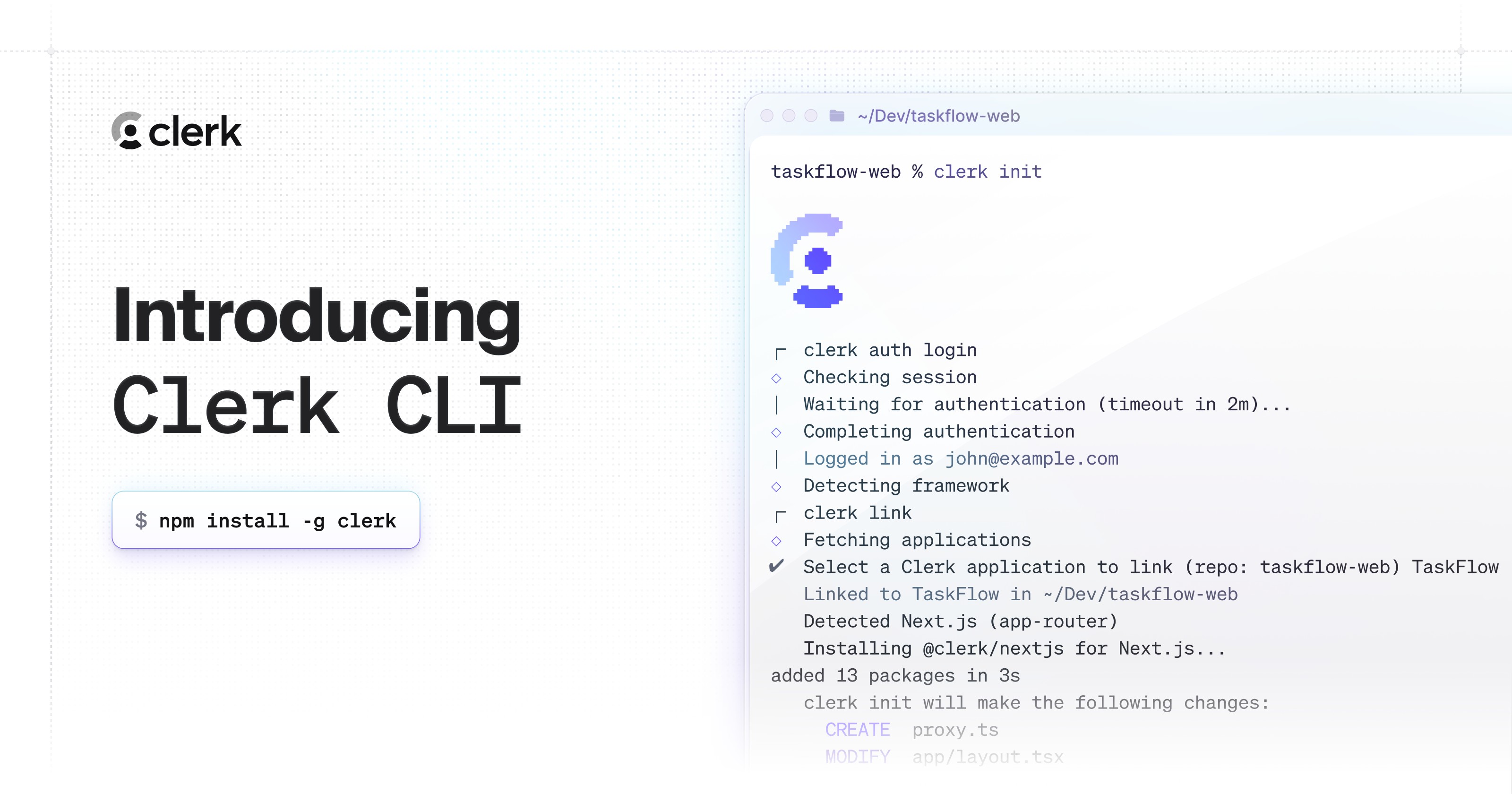
The April 2026 CLI extends the same idea to setup. Run clerk init in a new or existing project and it can identify the framework, add sign-in and sign-up and set up route protection. It also exposes configuration and API work from the terminal. This is a practical response to how software is made now: developers and coding agents often work in the editor, not a dashboard. It is also distribution. The simpler the first ten minutes, the more likely a team is to build around the service.
The bill is attached to the returning user
Clerk sells a free entry point, paid software subscriptions and usage. Its Hobby plan currently includes 50,000 monthly retained users per application. “Retained” has a precise meaning here: a person who signs up and never returns after the first 24 hours does not count toward that measure. Pro starts at $20 a month when billed annually, with published rates for users beyond the included allowance; Business starts at $250 a month on annual billing. Enterprise terms are negotiated. Clerk Billing adds 0.7% of billing volume on top of Stripe's fees.
What did it cost? A small qualifying app can begin at $0. On Pro, 100,000 monthly retained users would mean the base fee plus usage above 50,000; at the first published $0.02 rate, that is roughly $1,020 a month with annual billing, before other add-ons. Model returning users, organizations, enterprise connections and payment volume before choosing a provider.
That pricing makes the product attractive to teams that earn money from repeat users. It can look different for a very large free audience. Huntr's account offers a more human illustration of the buying decision. The job-search company said a pending $50,000 increase from its previous authentication provider prompted a search. It migrated 250,000 accounts to Clerk, citing pricing clarity and support. The number is Huntr's reported migration, not a universal promise about how painless migrations will be.
The incident report is part of the product
In February 2026, Clerk's service suffered a roughly 90-minute outage after PostgreSQL chose an inefficient query plan. The company said more than 95% of traffic returned 429 responses at the peak. Investigators first suspected a customer's traffic spike; the spike was a reaction to Clerk's own failures. Re-running a database analysis restored the earlier plan. Clerk also acknowledged that its status updates were too sparse and its first severity label understated the impact.
A March outage had a different cause: a failed live migration of its Google Cloud SQL database. Clerk said it moved most of its engineering team to reliability work, delaying new features. The repeated failures test its central bargain. A company can save months by buying authentication, but it inherits the provider's operational risk. The lesson a buyer can copy is prosaic and useful: examine incident histories and failover behavior alongside screenshots and setup time.
Clerk has published detailed explanations and planned fixes. That transparency does not refund lost uptime, but it lets customers ask better questions. How do sessions behave if the origin is degraded? Are status messages frequent enough for a support team to use? Can a customer export users if the economics or reliability stop working? These are not edge cases for a login provider; they are part of the purchasing decision.
The next user may be an agent
The 2025 Series C, led by Menlo Ventures and Anthropic's Anthology Fund, backed a new question: how should software agents act for human users? A bot needs a traceable identity, limited authority and a way for the human or application administrator to see what it did. Clerk says it intends to build around emerging standards rather than pretend the problem is settled. It is a natural extension of sign-in, though the hard work lies in permission boundaries, audit trails and interoperability.
The company has spent seven years moving outward from one familiar screen. A developer can copy the product logic without copying the business: find the task customers must perform but dread implementing, package the whole experience, and follow the next problem the customer encounters. Clerk's progress shows how far that path can lead. Its outages show the price of becoming essential to someone else's product. Both facts belong in the same story.