A factory called Nuevo Día ought to come with a warning about endings. Its name means New Day, an optimistic choice for a business born from a labor dispute. In January 2010, Jerzees Nuevo Día began operating in Honduras. The agreement behind it had brought together a clothing company, workers’ representatives and a labor watchdog. Claude G.B. Fontheim had represented the company in the negotiations. The new day would need considerably more than a name.
There were jobs to restore, payments to make and a relationship to build between people with excellent reasons to distrust one another. Fontheim’s part in this story is unusually revealing because it extends beyond helping secure signatures. He also took a role in the machinery designed to keep the parties talking afterward. In corporate responsibility, the afterlife of an agreement is where much of the actual work resides.
A telephone call before the handshake
In 2009, Russell Athletic was facing a dispute over labor rights at its Honduran operations. Fontheim, acting as its outside attorney, contacted the Worker Rights Consortium about possible remedies. The organization already knew him from other cases. Familiarity did not settle the matter, but it gave the proposed conversation somewhere to begin.
The watchdog insisted that the company speak directly with the CGT, the federation representing the affected workers. Phone calls and emails led to meetings in Washington in late July and further discussions in August. This was a negotiation with several centers of authority. A company lawyer could speak for his client; he could not supply the workers’ consent.
That distinction matters to understanding Fontheim’s contribution. His assignment was on the corporate side of the table. The union had its own representatives, interests and bargaining power. Any account that turns the episode into a solo rescue would erase the people whose organizing made a remedy necessary.
Pressure came from far beyond Honduras. More than 100 universities cut business ties with Russell during the campaign. Students, unionists and university officials helped turn a factory dispute into a commercial problem. A college sweatshirt had acquired a rather demanding second syllabus: who made it, under what conditions, and who was responsible when those conditions broke the rules?
Universities cut business ties with Russell during the labor-rights campaign.
The promise gets an address
On November 14, 2009, Russell/Fruit of the Loom and the workers’ representatives reached an accord. A separate agreement with the Worker Rights Consortium reinforced the commitments. The plan included a unionized factory near the closed Jerzees de Honduras plant, employment offers for its former workforce, financial assistance and protections for organizing across the company’s Honduran operations.
These were obligations with practical tests. A factory could be opened or remain shut. A former worker could receive an offer or keep waiting. Union representatives could enter a workplace or be kept outside. Such details give a promise edges. They also make it possible for the people affected to challenge an employer’s account of progress.
Jerzees Nuevo Día opened on January 4, 2010, making basic T-shirts in Choloma. By mid-February it had hired 116 workers. The numbers were modest beside the task ahead, but they described something concrete: production had begun, and former employees were returning to work. The negotiation had acquired a street-level existence.
There was also an oversight structure. Fontheim served as the company’s chief representative in the talks and participated in the body overseeing implementation. That is a less photogenic achievement than a signing ceremony. Oversight committees rarely attract admirers for their tailoring. Their value lies in whether a complaint has somewhere useful to go.
A contract is allowed to be difficult
The factory’s opening did not produce an immediate collective agreement. Bargaining continued for more than a year. In May 2011, the company and union signed a contract that brought a pay increase, further hiring and investment in the facility. By August, the plant employed 820 former Jerzees de Honduras workers. The process had a pace quite different from a press release.
Progress also had limits. Other parts of the broader agreement still required testing, including organizing protections at additional factories. A negotiated right becomes meaningful through repeated use. The first contract mattered; so did the next disagreement, the next request for access and the next group of workers deciding whether to organize.
At Jerzees Buena Vista, workers organized in 2012 and reached a collective agreement in October 2013. Their contract included higher production bonuses, a free lunchtime meal and additional vacation days. Those benefits offer a useful translation of institutional language. Freedom of association can sound remote until it changes an ordinary Tuesday.
Looking back in a 2022 interview, Fontheim put one lesson plainly:
“You can survive and be very productive with a union.”
Claude Fontheim, March 2022
The sentence is striking for its lack of ornament. It places worker representation inside the operating life of a factory. Productivity and bargaining have to occupy the same building. The people on either side remain capable of disagreeing, which is precisely why a continuing process matters.
The ending that complicates the achievement
Then came another closure. In 2025, Fruit of the Loom decided to close Jerzees Nuevo Día and its other remaining unionized garment factory in Honduras, Confecciones Dos Caminos. The factory created by the 2009 remedy would not keep operating indefinitely. Any assessment of the agreement has to carry that fact alongside the years of employment and bargaining.
The closure does not make those intervening years imaginary. It does make a tidy ending impossible. An agreement can change how people work together without protecting a factory forever. For Fontheim’s story, that is a necessary complication: helping construct a remedy is a real accomplishment, and the remedy remains exposed to decisions made long afterward.
There is a temptation in business profiles to stop the clock at the handshake. Here, the clock needs to keep running. The useful question is how long an arrangement works, whom it serves while it does, and what survives when the commercial circumstances change.
Three degrees, several kinds of argument
Fontheim’s education joined three disciplines at the University of Michigan: a bachelor’s degree, a master’s in public policy and a law degree. The combination fits a career spent crossing between corporate decisions and public rules. A business problem can require all three vocabularies before anyone agrees on what the problem actually is.
His government advisory service has included the President’s Advisory Committee on Trade Policy and Negotiations, the U.S. trade representative’s Africa advisory committee and the State Department’s international economic policy advisory committee. He also chaired the Democratic Leadership Council’s project on the global economy and international trade. These roles placed him close to arguments about how commerce should be governed.
His Washington consultancy, Fontheim International, carries that work into advice for businesses. Its team draws experience from government, companies and civil society. The geographical range includes Asia, Latin America and Sub-Saharan Africa. Fontheim’s professional world is populated by institutions with different mandates, rather than a single constituency that can conveniently agree with itself.
Who gets a seat, who gets a say
Through GlobalWorks Foundation, which he co-founded and chairs, Fontheim has also worked on business and human rights outside the consultancy. The foundation supports arrangements in which companies and worker representatives share responsibility for protecting rights in supply chains. Shared authority introduces friction. It also gives participants a reason to keep bringing problems into the process.
In October 2018, GoodWeave elected him board chair. The organization works to eliminate child labor in supply chains through its relationships with businesses, certification and work with affected communities. Fontheim subsequently became chair of its advisory council. The institutional setting changes, but the practical question remains recognizable: how does a buyer’s commitment reach the people doing the work?
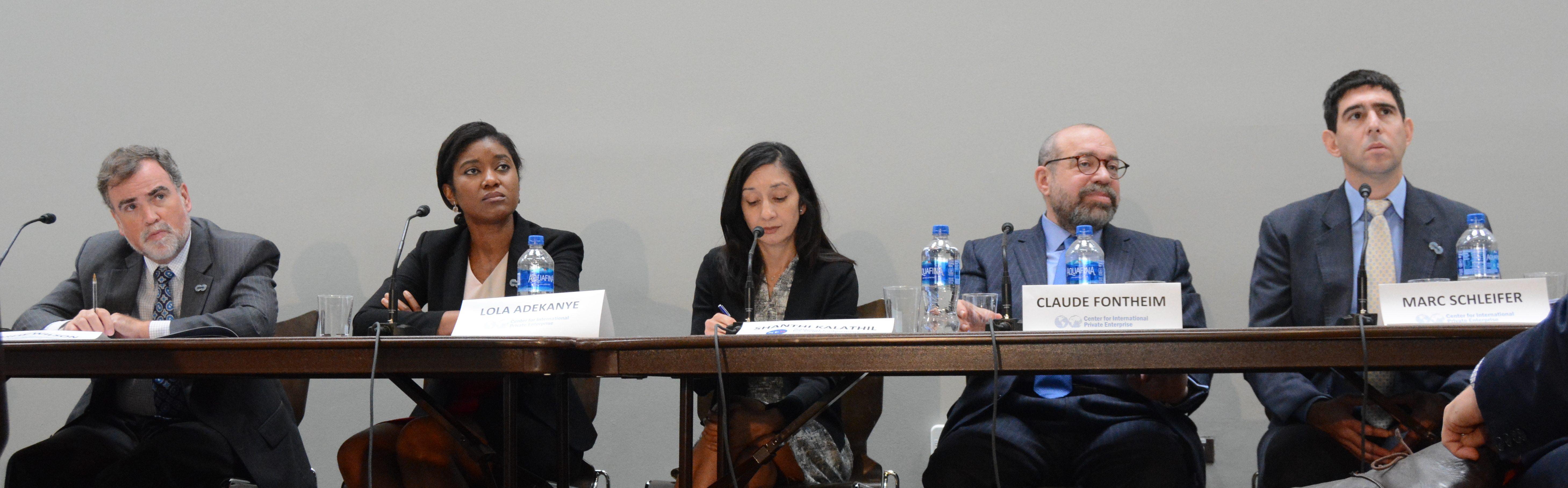
At a 2018 CIPE discussion, he joined a panel examining how investment from authoritarian countries could affect democratic institutions. He returned to CIPE’s board in December 2025, a move announced in April 2026. Trade, investment and corporate conduct meet here in another form: the rules surrounding a transaction can matter as much as the transaction itself.
A conversation moves offshore
In May 2025, Fontheim moderated a discussion on fishers’ rights and fair competition in global seafood supply chains. Participants included researchers and leaders from Global Labor Justice and Verité. The agenda connected worker organizing, responsible purchasing and government policy. A fishing vessel is a different workplace from a garment factory, with its own obstacles to representation and accountability.
He is also co-founder and senior advisor to the American Leadership Initiative, which brings policy participants together around trade, technology and American global engagement. His work there keeps the domestic side of international commerce in view. Decisions about markets abroad are also decisions about jobs, skills and political support at home.
There is a quieter example of access in his Michigan connection. Fontheim serves on the Michigan in Washington advisory board, and his family endowed a scholarship for students who could otherwise struggle to participate. The scale is smaller than an international labor agreement. The underlying decision is tangible: help someone get into a room where opportunities are distributed.
That is a fitting place to leave him. His career runs through committees, contracts, foundations and negotiations, the unglamorous furniture of public life. Nuevo Día gives that work both an achievement and a limit. For years, an agreement became employment and bargaining. Then the factory closed. A serious account can hold both facts, and keep asking what the next promise will require.