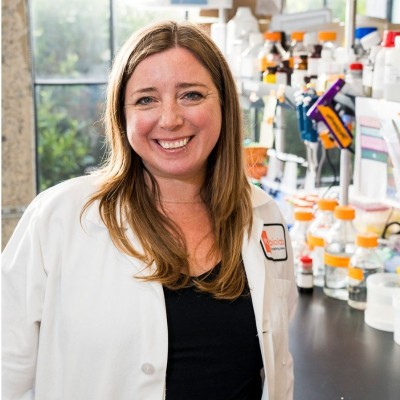
NeuroAge trains brain-aging model on data from 500,000+ peopleXPRIZE — Glorioso's team ranks #1 in the US, beating 103 othersNIA Startup Challenge 2022 — winner52 RNA genes read from a drop of blood20 years of brain-aging research, now a companyTop 10 company to watch, Life Science Nation 2023
Profile · Brain · Longevity
Christin Glorioso
She builds a clock for the brain — one that starts ticking in your mid-20s and, she insists, can be wound back.
CHRISTIN GLORIOSO, MD/PhD · CEO, NeuroAge Therapeutics · San Francisco
FILED FROM SAN FRANCISCO · NEUROAGE THERAPEUTICS · THE LONGEVITY DESK
The Lede
She measures how fast a brain gets old
Most people think aging is something that happens to skin and knees. Christin Glorioso thinks it happens to neurons first, quietly, decades before anyone notices. Her company is built to catch it in the act.
At NeuroAge Therapeutics, the question on the table is deceptively simple: how old is your brain, really? Not your birth certificate age - your biological one. Glorioso, a physician and neuroscientist who spent two decades at the lab bench, runs the company as CEO and co-founder. The product is an "aging clock" for the human brain, stitched together from MRI brain-volume scans, cognitive tests, and proprietary RNA biomarkers pulled from a single blood draw. The model behind it was trained on data from more than half a million people.
The pitch isn't vanity metrics. Measurable shrinkage in the hippocampus, the brain's memory hub, begins in the mid-20s and accelerates from there. That sounds like a sentence. Glorioso treats it as a starting line. Her read of the research is that brain aging is modifiable, and that a large share of dementia cases may be headed off well before symptoms ever surface. The job, as she frames it, is to make the invisible measurable - and then to give people something to do about it.
Her method has a certain elegance. Rather than chase the single molecule the field has obsessed over for years, NeuroAge studies people whose brains age unusually well - the "successful brain agers" - and works backward. Find what their cells are doing differently. Then design drugs to copy it. It is reverse-engineering applied to the most complicated organ we own.
500K+
People in training data
52
RNA genes in the test
#1
US XPRIZE COVID model
20+
Years of brain research
I want to be as mentally sharp when I'm 100 as I am today.
— Christin Glorioso
The Origin
A family, a kitchen table, and a seven-year wait
The clock metaphor isn't abstract for Glorioso. She watched both her grandmother and great-grandmother live with Alzheimer's. Her grandmother developed it in her late 60s, and her grandfather became the caretaker for seven years. That arrangement shaped a household, and it shaped a career. The thing she keeps returning to in interviews isn't the science of it - it's the wanting to spare other families the same long stretch of watching.
So she went and got the credentials to do something about it. A degree in cell and molecular biology from the University of Michigan. Then the long haul of an MD/PhD through the Carnegie Mellon and University of Pittsburgh Medical Scientist Training Program, with a doctoral thesis on the genetics and molecular pathways of how the central nervous system ages. Then a postdoc and a research-scientist post at MIT, where she pioneered the brain aging clocks that would later become the spine of a company.
Twenty years in, she hit a wall that wasn't scientific. It was structural. Academic papers, she noticed, tended to end the same way: a single hopeful sentence about how, someday, this finding might become a drug. Someday rarely arrived. Climbing the faculty ladder took a decade, with time split between teaching and grant-writing and the actual work. The translation from insight to medicine kept getting deferred.
We write papers and there is one little sentence at the end that says 'someday this could be a drug.'
ON LEAVING ACADEMIA
How to stay sharper, longer - the new science of brain aging.
NeuroAge fuses three established measures with AI to estimate a brain's biological age - and how its trajectory might bend.
🧠
Brain MRI
Volume measurements, including the hippocampus, the memory hub.
🧪
RNA Blood Test
52 gene-expression levels read from a single blood draw.
🎮
Cognitive Testing
Processing speed, memory and attention, scored over time.
⏱
Brain Age
An AI-fused estimate of how fast a brain is aging.
The Arc
From bench to boardroom
2002
Earns a BS in cell and molecular biology at the University of Michigan.
2011
Completes her MD/PhD through the CMU/Pitt Medical Scientist Training Program, thesis on CNS aging.
2012-2017
Postdoctoral associate in computational biology at MIT.
2013
Co-founds the nonprofit Academics for the Future of Science.
2017
Becomes an MIT research scientist, building aging clocks for the human brain.
2021
Chief Strategist at UCSF's Bakar Aging Research Institute; Head of AI at TeachAids; leads the #1 US XPRIZE COVID forecasting model.
2022
Founds NeuroAge Therapeutics; wins the US National Institute on Aging Startup Challenge.
2023
NeuroAge named a top-10 company to watch by Life Science Nation.
The Receipts
What's on the wall
PREDICTION
Beat 103 teams
Her global collective's model ranked #1 in the US in the XPRIZE Pandemic Response Challenge, with a 7% error rate across 104 international teams.
RECOGNITION
NIA Startup Champion
NeuroAge won the US National Institute on Aging Startup Challenge in 2022 and an Illumina sequencing grant.
HONORS
A drawer of fellowships
MIT Infinite Mile Award, AFAR Postdoctoral Fellowship, Glenn Foundation Fellowship, and an NIA F30 training award.
In Her Words
The thesis, stated plainly
We identify people who are successful brain agers and then design drugs that can reproduce the cellular changes that those people have.
We examine data from human brains to find patterns in our biology that change as people age.
I realized that there may be a more direct path to starting NeuroAge - which is to jump off the academic train and begin.
There is a lot of misinformation out there, so my advice would be to be very diligent in who you source information from.
The Margins
Things that don't fit the CV
01
Before the lab coat there was a swim cap. She was a state-champion swimmer, her high school tennis captain, and went on to play Division I tennis in college. The competitive streak never left.
02
She's a serial founder in the truest sense: a biotech, a science nonprofit, and a global research collective spanning seven countries - sometimes all at once.
03
Her XPRIZE team was a volunteer collective of about 20 people from seven countries. They beat funded labs and published six papers along the way.
04
The whole company rests on a number most people never think about: not how old you are, but how old your brain is. The mismatch between the two is the entire point.
I saw my grandmother suffer with Alzheimer's, and I want to prevent other families from going through the same thing.