Torrance, California · The workshop problem
A life raft has one unforgiving flaw: it may be somewhere else. In the tidy diagrams of emergency planning, equipment waits where it was stowed and the survivor arrives in good order. Water edits the diagram. Distance appears. Hands are occupied. Energy becomes scarce. A device designed for rescue can turn into an object that must itself be reached, released, opened, and entered.
Chris Hugh built Crusoe Survival around this awkward interval. His premise is compact enough to say before an aircraft briefing: put the raft on the person. Make it wearable. Make the package pocket-sized. Make deployment direct. Then confront the least glamorous and perhaps crucial part of the job - getting aboard.
Hugh is not the founder of the Denver artificial-intelligence company that shares the shorter name Crusoe. His Crusoe is a small marine-safety manufacturer in Torrance, near his home base in Redondo Beach. Its public trail begins in 2013 and is recorded less in conference stages than in government contracts, patent drawings, prototype objectives, and the patient vocabulary of qualification.
Eleven percent changes the question
In 2016, Crusoe Survival received a $149,876 Phase I Small Business Innovation Research award from the U.S. Navy. The project concerned a pocket-sized surface flotation device for over-water aviation survival. Its supporting record cited thirteen years of Naval Safety Center data: only 11 percent of survivors had been able to deploy their life rafts.
That figure does more than make a case for a smaller package. It changes the standard by which the object should be judged. Buoyancy is necessary, but buoyancy waiting in the wrong place is a technical success with a practical alibi. Hugh's task was to collapse a sequence of separate actions. The survivor should not have to find the raft because the raft should already be attached to the survivor.
Interviews with helicopter pilots, aircrew, and trainees sharpened the brief. Existing surface-flotation devices were described as cumbersome, hard to deploy, and difficult to board. Crusoe Survival proposed a lightweight wearable raft with a boarding system intended to lift a person clear of the water. Early float testing had already established enough promise for the Navy to fund further feasibility work.
Emergency gear is judged in the least cooperative minute of its life.
The resulting product idea lives between familiar categories. A vest is wearable but leaves most of the body in the water. A conventional raft provides separation and shelter but occupies more space and may be stored apart from the person who needs it. Hugh's work tries to borrow the availability of the first and the protective geometry of the second. It is the sort of compromise that sounds obvious only after someone has volunteered to make it work.
The problem is boarding
Products intended for calm demonstrations often enjoy calm users. Survival equipment has no such luxury. Hugh's 2019 patent for a buoyant inflatable device puts unusual emphasis on boarding by people who may be injured, weak, or exhausted. The design is compact enough to be carried before it is needed, then expands into a structure intended to support the whole person above the water.
This is where a pocket raft stops being a miniature and becomes a piece of human-factors engineering. The opening must be reachable. The edges must have the right give. Buoyancy must be distributed so that the device remains useful during entry, not merely after it. A person approaching from the water does not behave like a neat weight placed at the center of a test rig.
Crusoe's development notes are full of practical nouns: configuration, material, packaged size, buoyancy distribution, boarding. Together they form an unromantic portrait of invention. The work is not a single flash of cleverness. It is a long negotiation among volume, weight, force, fabric, and an exhausted user who will not read the instructions twice.
A raft that recruits the atmosphere
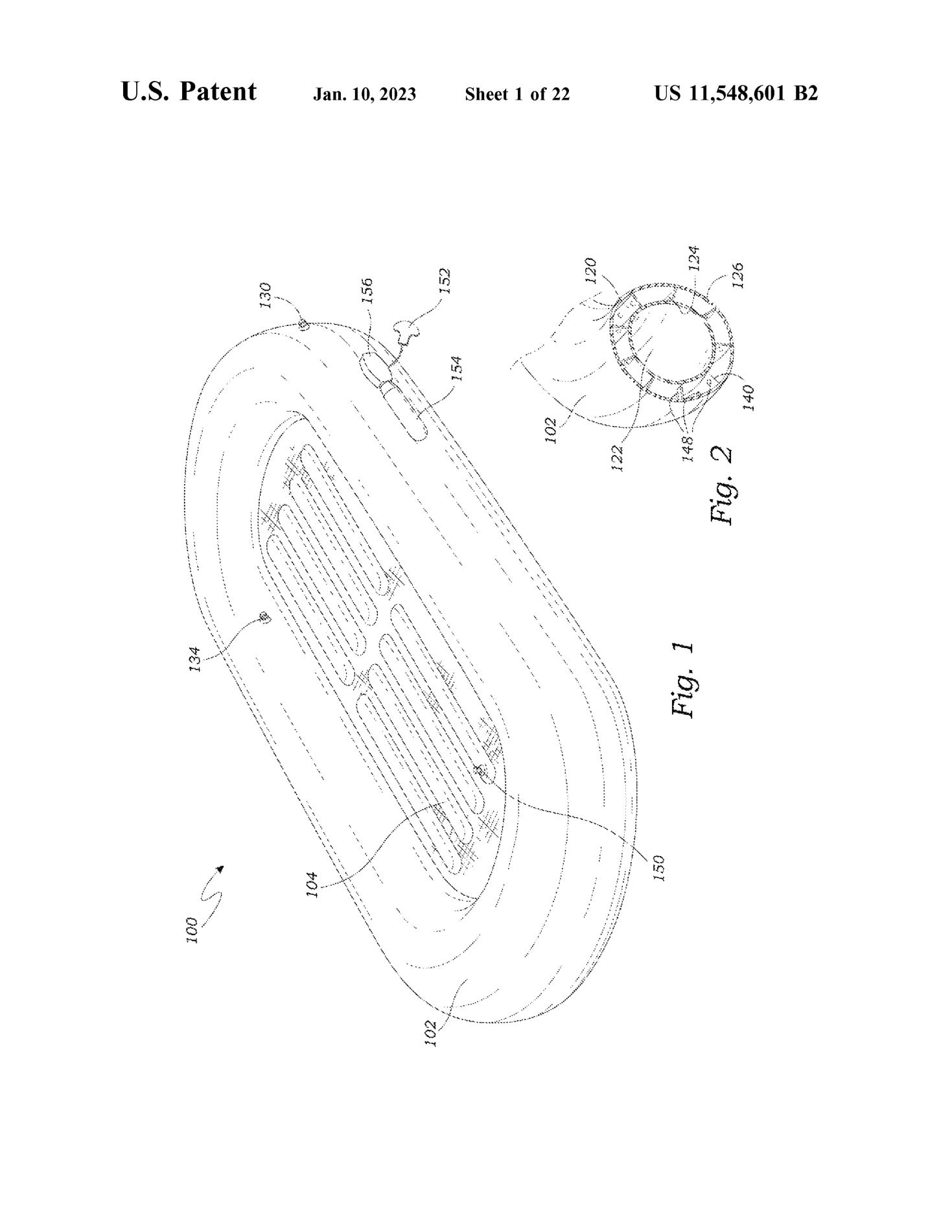
The next patent family reveals the elegant part. A very small raft faces a discouraging arithmetic problem: it needs a useful amount of air, yet the gas supply must also fit into the package. Hugh's multi-chamber design divides the labor. One chamber is actively inflated from a source such as compressed gas. As it expands, it opens a second chamber, which draws in ambient air.
The atmosphere becomes part of the packing strategy. The device carries the means to begin inflation, but not every molecule required to finish it. Patent claims describe versions in which a large majority of the expanded volume comes from ambient air. Another claim describes supporting a 175-pound person using 45 grams of carbon dioxide while allowing outside air into the second chamber.
The patent granted in January 2023 describes active and passive inflation chambers, separate fluid paths, and geometry that lets one expanding section pull open another. A continuation patent issued in May 2026 develops the same family of ideas. The charm is mechanical rather than theatrical. Hugh is using a small, controlled action to invite a larger, free resource into the device.
This is thrift in unusually literal form. Carry less gas. Borrow more air. Keep the package small enough that a person might actually wear it. The physics are ordinary; the arrangement is the invention.
The long middle
Crusoe Survival's timeline resists the familiar startup habit of pretending that development is a montage. The company dates to April 2013. The first Navy award arrived in September 2016 and ran into early 2018. The buoyant-device application matured into a patent in May 2019. The multi-chamber application followed in 2020 and became a patent in 2023.
Crusoe Survival is founded in Southern California.
Navy Phase I funds feasibility work on the pocket-sized raft.
The buoyant inflatable device receives U.S. Patent 10,286,986.
The multi-chamber design receives U.S. Patent 11,548,601.
A Phase II.5 award moves the work toward qualification prototypes.
A continuation patent, U.S. 12,623,758, is granted.
Then came the larger step. In July 2024, the Navy awarded Crusoe Survival $999,876 for Phase II.5 work scheduled through August 2026. The plan was to combine a new inflation approach with refined design and advanced materials, produce qualification prototypes, and prepare the groundwork for eventual military and private-sector commercialization.
From feasibility to qualification
The second award is about 6.7 times the first. More important, its verbs are different. Phase I asked whether the concept could work. Phase II.5 concerned refinement, demonstration, and qualification. The romance of the napkin sketch had long since given way to the administrative poetry of repeatable performance.
Hardware earns this slowness honestly. Software may be updated after release. A survival device gets one opening night, frequently in terrible weather. Its failures cannot be converted into an onboarding lesson. Fabric seams, valves, packed dimensions, and boarding mechanics must agree before the user ever sees the water.
A résumé written in objects
Hugh's public biography is spare. LinkedIn places him at the University of San Diego from 1984 to 1988, then at Crusoe in Torrance, with Redondo Beach as home base. Public company records identify Crusoe Survival as a small California manufacturer and research business. The patents supply his full name - Christopher Ian Roxburgh Hugh - and a more revealing curriculum vitae.
In those documents, one can follow the questions that kept returning. How much of a person's body can the device support clear of the water? How can boarding be made less demanding? How can compressed gas be used more efficiently? How does one chamber cause another to unfold? The questions are connected by a consistent preference for proximity and economy: keep the equipment close, keep its packed form small, ask every gram to do more.
There are no verified public interviews in which Hugh supplies a grand philosophy, and the work does not require one. The design brief has its own moral clarity. A good emergency object should be present. It should be legible under pressure. It should not demand athletic grace from someone who has just survived an accident.
The raft does not wait in the aircraft. It waits on the person.
After proof comes trust
The stated horizon is commercialization for military and private users. That is less a finish line than another set of tests. Qualification must turn prototypes into dependable articles. Manufacturing must reproduce what the drawings promise. A wearable package must remain wearable, and the boarding method must remain forgiving outside the workshop.
Hugh's long project offers a useful correction to the mythology of invention. Some ideas do not sweep across the world because they are loudly announced. They move by surviving a sequence of increasingly serious questions. First: could it float? Then: could it pack? Could it open? Could a tired person climb in? Could it do these things again, and again, closely enough to be trusted?
Crusoe Survival has spent more than a decade in that sequence. Its founder chose a problem whose ideal outcome is almost invisible: a compact bundle stays with its wearer, opens when required, borrows the surrounding air, and becomes enough raft at exactly the right moment. Nobody in that moment will care whether the mechanism was poetic. Still, there is something rather fine about carrying a pocketful of engineering that is waiting to become room.