At nine each morning, Chloe Samaha sent a question to more than 80 people on WhatsApp. At nine each evening, she sent the answers back. There was no gleaming dashboard and no clever agent arranging the work. There was a college student, a phone and a ritual repeated for 206 days.
The questions were designed to make colleagues know one another: a prompt, a quiz, perhaps a small challenge. The first BOND was interested in what hybrid work had thinned out, those casual encounters in which people become more than names in a grid. Samaha had been reading about quiet quitting and the Great Resignation. Her question was plain enough to sting: if people do not feel useful, known or connected at work, what keeps them there?
Her prototype looked almost comically manual. It was also unusually intimate customer research. Every send exposed the friction. Every reply disclosed what people would actually do, as distinct from what they might praise in a survey. By Day 150, Samaha says, the experiment had reached 89 percent daily active use. Only then did she consider turning the routine into a technical product.
There is a delicious reversal here. Samaha now sells automation, yet her apprenticeship consisted of refusing it. Before asking software to recognize important work, she learned the cadence of the work herself. The unscalable version was not a crude prelude to the real company. It was the part that taught the company how to see.
A founder house and a useful kind of peer pressure
Samaha built the early version while studying entrepreneurship at Babson College. She had moved into eTower, the school's living community for student founders, during her first year. She later became its youngest president, led 21 founders, hosted more than 50 events and helped raise $20,000, according to her personal site.
The house gave entrepreneurship a domestic life. Ideas followed residents past classrooms. Advice arrived over ordinary evenings. A dubious plan could not hide for long when the next bedroom contained someone building a company, too. Samaha has described the environment as a place where ambition came with enough humility to ask for help. It also supplied an early connection to a developer for BOND.
“Business is really the science of people.”Chloe Samaha, describing what she learned at Babson
That line fits both her education and the product's first form. The app generated daily activities for teams, added friendly competition through leaderboards and engagement measures, and tried to recreate a little of what eTower provided naturally: repeated contact, useful friction and the feeling that another person's progress had become visible.
In 2024, BOND won Babson's undergraduate B.E.T.A. Challenge and associated awards totaling $35,000. Samaha also made BostInno's 25 Under 25 list. By early 2025, she said the company had won more than $150,000 in equity-free grants and pitch prizes. She paired the wins with a less decorative figure: more than $3 million in potential funding opportunities lost.
Asked about her largest accomplishment, she did not choose the prize money. She chose “learning how to fail well.” The remark lands because she had once been frightened enough of rejection to delay a launch for six months. She wanted perfection before asking anybody to pay. Eventually she understood that a polished product could be a handsome way to postpone an uncomfortable conversation.
Her later advice was bracingly short: understand the customer, build quickly, charge sooner than feels comfortable. “The feedback you're scared to hear is often exactly what you need to hear,” she wrote. It is the sort of sentence founders pin above their desks and then spend six months avoiding. Samaha had already supplied the evidence against herself.
The product changed. The irritation stayed.
BOND did not proceed in a tidy line from WhatsApp to a bigger WhatsApp. The company moved from team bonding to leadership development, then toward an AI chief of staff that assembles company context for executives. The surface area changed considerably. The stubborn concern underneath was wasted potential.
Samaha has traced that concern to a phrase she heard growing up: poor Chloe, she is wasting her potential. A private-equity internship during her first year of college sharpened the feeling. Prestigious work could still feel hollow when effort and meaning failed to meet. Her mother, who started a venture at 17, supplied the counterexample and an enduring instruction: get back on the horse.
The current BOND plugs into the places where an organization leaves its crumbs: Slack, Jira, Notion, GitHub, Salesforce and other tools. It offers a conversational interface for questions, a morning brief, a live view of projects and metrics, and alerts for stalled work or overloaded teams. The company says it interviewed more than 2,000 CEOs, chiefs of staff and executives and found the same nuisance repeating: before leaders could decide, they had to gather.
This is the dreary tax of modern work. The status update has migrated into several applications, each excellent at storing its own piece and cheerfully ignorant of the others. A leader opens five tabs to answer one question. A meeting is convened because the tools cannot introduce their data. By lunch, the day has become a search party.
The first BOND tried to help colleagues notice one another. The current BOND tries to help leaders notice what the company is already saying.
The continuity is more interesting than the pivot. Team culture, leadership coaching and executive intelligence all concern attention: who receives it, what earns it and how much is lost in transit. Samaha's product grew less playful and more operational, but it kept asking how work might make better use of a finite life.
An AI chief of staff, built by people with different maps
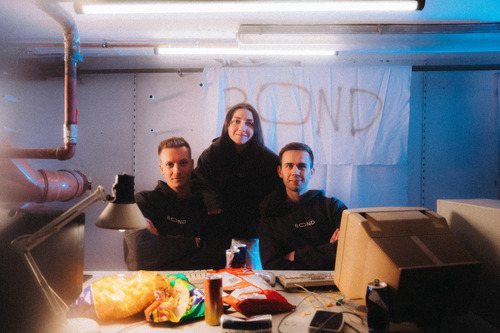
In 2025, Samaha joined forces with Flor Sanders and Tibo Wiels. Sanders brought quantum-computing research experience from Fermilab; Wiels had worked on machine-learning systems at Solv. The team took BOND through Y Combinator's 2025 program in San Francisco. Their YC company photograph has all the ceremony of a basement newspaper office: three founders squeezed behind aging monitors beneath a BOND banner made by hand.
The company found its first customer within two weeks of the new team forming, according to Sanders. Its ambitions grew with its inputs. Forbes reported in April 2026 that BOND had raised roughly $3 million from investors including Y Combinator and MIT-linked E14. That month, the three co-founders appeared on the Forbes 30 Under 30 Europe list for AI.
Awards can make a young story look preordained. Samaha's version is more usefully untidy. The company was once a social app, then a coaching assistant, then something else again. A co-founder changed. The customer changed. The pitch changed. What persisted was her willingness to perform the service manually, submit the work to rooms full of peers and let rejection revise it.
Watch BOND explain the executive information problemProduct demo / YouTube / opens in a new tabOutside the company description, a more elastic person appears. Samaha lists skydiving, tennis and guitar among her interests. In 2026 she wrote about spending 10 days at a silent meditation retreat, 140 hours without speaking, beginning at four each morning. For a founder preoccupied with time and information, the experiment feels almost too perfectly cast: remove every incoming message and see what the mind does with the vacancy.
Her public writing often returns to the same ledger. She advocates sleep, planned work, candid weekly conversations with a co-founder and consistency over bursts of intensity. She has also said she prefers minimizing regret to optimizing for happiness. The skydiving begins to look less like trivia and more like punctuation.
Give the morning back
BOND's immediate promise is concrete: save executives more than 10 hours each week. Its morning brief is meant to arrive with changes, blockers and priorities already organized. Samaha has described the desired experience as waking up to find the to-do list already done. The phrasing is sly. The tasks remain, but the expensive prelude of reconstructing them has disappeared.
There are legitimate complications hidden inside such a product. Organizational context is sensitive. Priority is political. A useful system must distinguish urgency from noise without becoming another noisy authority. BOND says it emphasizes secure deployment and enterprise controls. The more profound challenge will be judgment: knowing which missing follow-up matters and which flurry can be left to expire with dignity.
Samaha's own history offers a credible method for approaching that challenge. Stay close enough to the work to notice its texture. Begin before the system is elegant. Treat a no as information, provided it is specific enough to be useful. Keep people nearby who can challenge the story without draining the nerve required to tell it again.
The founder who once spent her mornings sending prompts now wants software to prepare everyone else's. It would be easy to call that irony. It is closer to earned compression. BOND's intelligence began as Samaha's repetition: twice a day, 206 days, until a pattern emerged from the replies.
Software people like to say that code is leverage. Samaha's story adds a necessary footnote. Before leverage comes intimacy with the stubborn, ordinary task. You do it long enough to become bored, and then longer still, until boredom gives way to structure. Only after that can the machine inherit anything worth saving.