Government regulations are an unusual place to go looking for a business idea. The prose discourages casual visitors. The footnotes offer little relief. Cherrill Farnsworth kept reading. In the small print, the Houston entrepreneur saw openings for companies - places where a change in the rules could make a new arrangement possible. It is a wonderfully unglamorous origin for a career that would eventually include seven businesses.
Her professional life has included a bus franchise, equipment leasing, HealthHelp, and a later move into private equity as an operating partner. The variety is striking. So is the continuity: permissions, capital, contracts, and the work of assembling an organization. Those are subjects that rarely improve a dinner party. They can, however, make a company.
Farnsworth’s career is especially interesting at the points where experience offers no exemption from difficulty. A founder can have previous exits, established investors, audited accounts, and growing sales, then discover that raising money still consumes most of a year. Her story has room for the transaction announcement and the months before anybody is ready to sign it.
First, get the buses moving
In 1977, Farnsworth persuaded the Texas Railroad Commission to grant Suburban Transportation Co. a Houston bus franchise. The company was later sold to the City of Houston. Afterward, she examined which parts of the work she had enjoyed and could do well. Leasing and assembling deals stood out. She went on to establish leasing businesses that took advantage of investment tax credits and other tax provisions.
That sequence gives the early career a practical logic. A sale supplied an occasion to take stock. Her next ventures drew on a skill she had already used. The products changed; the ability to arrange a transaction remained useful. By 2000, her record included six founded companies. Subsequent professional biographies put the career total at seven.
There is a quiet pleasure in the bus-company beginning. It puts something tangible beside the later language of operating partnerships and investment returns. Before the board appointments came a business that needed permission to run. The episode also offers a compact introduction to Farnsworth’s appetite for regulated markets: she was willing to learn the machinery surrounding the business as well as the business itself.
- 1977A Houston bus franchise
- 2001A fourth financing round
- 2017The HealthHelp acquisition
- 2020An operating partnership
A good record meets a closed wallet
By 2000, HealthHelp had reached $27 million in annual sales. It also placed at number 213 on that year’s Inc. 500. Then came the difficult financing market of 2001. Farnsworth was pursuing a fourth round, with three earlier rounds behind her. She expected the record to help. Instead, some investment firms would not even consider the opportunity.
The round eventually raised $14 million and took nine months. Her usual advice to entrepreneurs had been to allow at least six. Investors demanded another accounting firm examine work already audited by a Big Five firm. Marc Sandroff, of existing backer Essex Woodlands, pointed to Farnsworth and the experienced team she had assembled as reasons to invest.
The bureaucratic comedy almost writes itself: the audited company needed its audit checked. For the person raising the money, it meant more meetings and more time. The comparison between six months and nine is a useful correction to tidy founder narratives. Knowing the process can help a chief executive prepare. The people on the other side of the table still get to move the finish line.
Farnsworth’s account preserves the irritation of the experience. Previous companies and useful contacts had not made her immune to a market-wide retreat. That detail gives the later sale more weight. A company’s history includes periods when even a capable team must work hard to persuade someone to keep looking at the numbers.
When the customer changes the company
HealthHelp later encountered another kind of business problem: a customer large enough to change its scale. A 2011 account described the company tripling in size after landing Humana. The accompanying profile framed the sudden expansion as a dream that nearly became a nightmare. Growth had arrived with demands of its own.
The distinction matters in a career so often summarized by company counts. Founding seven enterprises tells us something about appetite. Managing a business that has suddenly become much larger asks a different question: can the organization keep up with the opportunity it has won? A contract is an agreement on paper; fulfilling it is work distributed across people.
This is where Farnsworth’s later title, operating partner, begins to make sense. The word “operating” earns its place. Her background includes raising capital when investors are wary and leading a company through abrupt expansion. Those experiences concern the daily capacity of a business, beyond the attractiveness of the original idea. They are also precisely the kinds of experiences another founder might want nearby when a promising opportunity becomes a complicated week.
The number on the announcement
WNS announced its acquisition of HealthHelp in March 2017. The stated consideration was $95 million, excluding adjustments for cash, debt, and working capital. The business employed approximately 400 people in the United States. WNS financed the acquisition primarily through long-term debt and expected it to add to adjusted earnings immediately.
The transaction brings two scales into view. One is the purchase price, a figure suited to a headline. The other is the organization of roughly 400 people, an accumulation of hiring, management, and working relationships. Farnsworth was HealthHelp’s chief executive at the announcement. The buyer’s chief executive, Keshav Murugesh, emphasized the company’s expertise, approach, technology, and analytics.
An acquisition announcement makes the result look wonderfully orderly. Here is the buyer, here is the price, here are the advisers. Earlier chapters tend to be less obliging. Farnsworth’s record gives the announcement a longer prehistory: the financing negotiations, the expanding organization, and the repeated effort to keep a business moving as its circumstances changed.
After the acquisition, her work continued through a different set of responsibilities. A 2020 WNS corporate factsheet listed her as non-executive chairman of WNS-HealthHelp and head of strategy. The founder’s relationship with the company had acquired another form. A business can change ownership before the experience accumulated around it stops being useful.
Acquisition consideration, before cash, debt, and working-capital adjustments.
The investor who already knew her
WindRose’s connection with Farnsworth preceded her arrival on its team. The firm made a majority equity investment in HealthHelp in 2008. When it appointed her an operating partner in November 2020, it reported having earned a return of more than five times its investment. Oliver Moses, WindRose’s managing partner, had already worked with her through an extended company-building chapter.
The new role involved evaluating investments and helping portfolio businesses improve operations and grow. It brought the former chief executive into the work surrounding other chief executives. That is a consequential change in perspective: she could apply experience across companies rather than carry responsibility for a single organization.
Her explanation for accepting the role was personal and direct. “It is definitely time for me to give back,” she said. She acknowledged the experienced businesspeople who had helped her along the way. That statement gives the appointment a motive beyond the conventional language of a personnel announcement. She wanted to make some of the assistance she had received available to others.
The choice also kept established working relationships in the picture. In August 2020, she had joined One Homecare Solutions’ strategic advisory board, where the announcement noted a previous professional connection with executive Chris Sullivan. By November, she was joining a firm that had been her company’s investor. Her later career contains several such continuations: people who had worked together finding a new reason to do so.
“It is definitely time for me to give back.”
Cherrill Farnsworth · on joining WindRose, 2020
What carries forward
Farnsworth graduated magna cum laude from Butler University and later served on its board of trustees. Houston recognized her as a Woman on the Move in 1986. Her professional honors include entrepreneur awards from Ernst & Young and KPMG Peat Marwick. In 2015, she was elected to the Committee of 200, an organization of women entrepreneurs and corporate leaders.
These affiliations add a civic and institutional dimension to the succession of businesses. University governance, professional networks, and advisory work all create places where experience can travel beyond the company in which it was earned. On her public LinkedIn profile, former colleague Lori Baerenstecher credits Farnsworth with teaching her business development and recalls their time together at TME and early HealthHelp with affection.
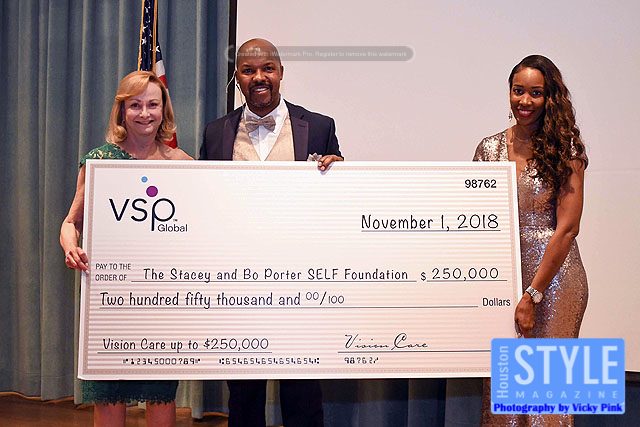
There is also a photograph from the 2018 Stacey and Bo Porter SELF Foundation Legacy Gala. Farnsworth appears at a check presentation, holding an oversized piece of financial paperwork in rather more festive surroundings than an investment meeting. It is a pleasing visual footnote to a career with so many transactions. The occasion was a charitable evening, with community figures and honorees gathered around the foundation.
Her current professional listings include the WindRose operating partnership and a Healthmap Solutions board seat. In April 2025, she was also announced as a participant in a RadSite twentieth-anniversary roundtable with Garry Carneal and moderator Mark Hiatt. The invitation brought an early organizational figure back into conversation with its later leadership, two decades into its existence.
Taken together, the later chapters have a recognizably Farnsworth shape: another organization, another set of working relationships, another use for accumulated knowledge. The buses are long gone from the foreground. The ability to read an arrangement carefully, understand its possibilities, and help people make it work has remained useful. For a career that began with such forbidding reading material, that is a rather sociable ending.
Continue the conversation
- WindRose · current team
- LinkedIn · Cherrill Farnsworth
- LinkedIn · additional public profile
- Healthmap · board biography
- The 2017 acquisition announcement
- The operating-partner appointment
- The early ventures · Red Tape Brainstorms
- The financing story · More Strings Attached
- The 2018 gala photographs
- Explore HealthHelp