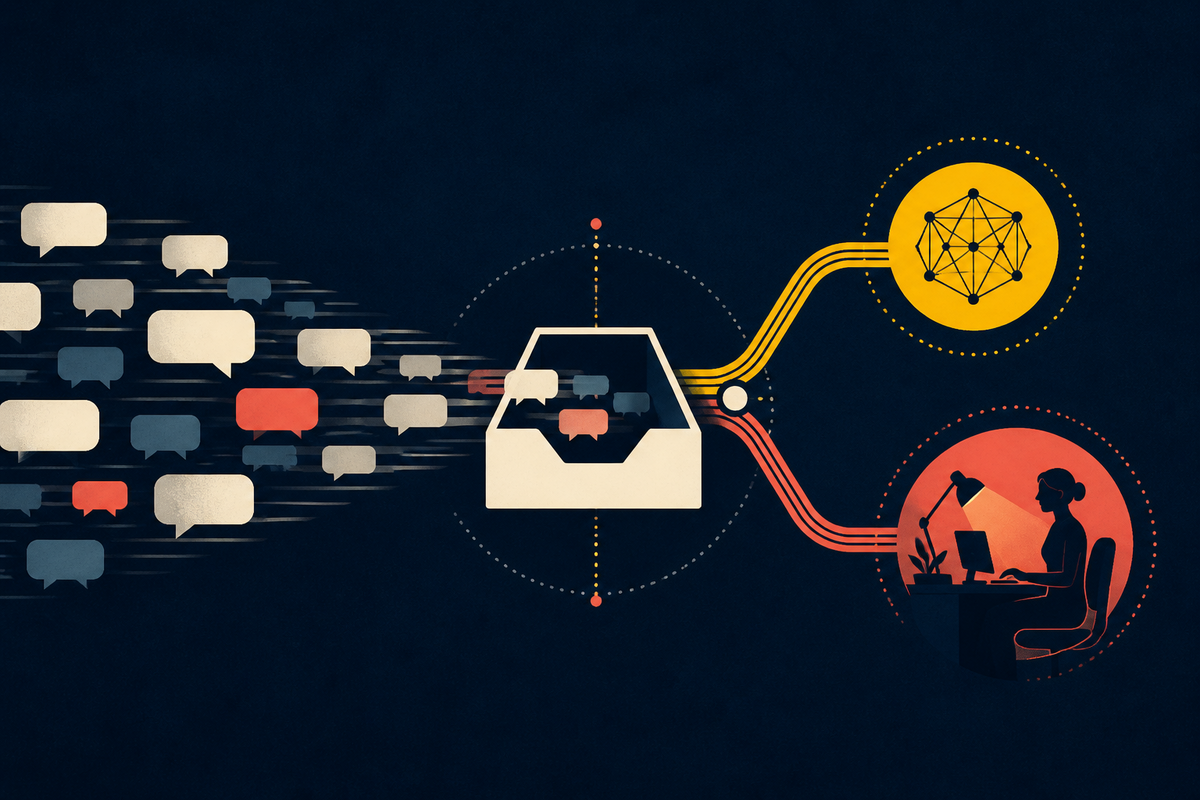
The modern customer-service demo is a small act of theater. A visitor asks a clean question. The chatbot replies before the presenter can blink. Everyone admires the speed. Missing from the stage are the expired return policy, the duplicated product page, the angry customer who refuses to choose a department and the administrator who will spend Friday afternoon working out why the bot invented a confident answer.
That backstage work is the useful way to compare SleekFlow with tawk.to. Both can put a chat surface on a website, help agents answer, preserve conversation history and pass work around a team. Both now sell AI that can draw from a company knowledge base. But they make different bets about how much operating machinery a buyer wants behind the bubble.
tawk.to begins with abundance: its core live chat, shared inbox, tickets and knowledge base are free. SleekFlow begins with orchestration: multiple messaging channels, contact records, flows, team ownership and configurable AI agents are treated as parts of one revenue and support system. The first is easier to try. The second gives a serious operator more places to inspect and tune what the AI did.
The price is the first clue
At the time of publication, tawk.to's AI Assist offers a free Hobby tier with 100 monthly message credits. Its paid Growth plan is listed at $29 a month, adding 1,000 credits, three AI agents and human escalation. Business and Enterprise increase credits, crawl limits, integrations and support. The crucial detail is that the free core remains useful even if the AI is turned off.
SleekFlow lists a free environment for testing core features, then Pro from $149 a month and Premium from $349. Pro includes three user accounts, an inbox, Flow Builder and an AI agent; Premium adds analytics, webhooks, API calls, role-based access and more advanced agents. Contact limits and channel economics still matter, especially for WhatsApp and SMS. The sticker price is not an apples-to-apples measure because SleekFlow is selling more of the customer-operations stack.
For a small website with modest volume, tawk.to can answer the first question cheaply: will visitors use chat at all? For a retailer already juggling WhatsApp, Instagram, website leads and an e-commerce system, SleekFlow's higher price buys a more coherent place to route, assign, automate and audit those conversations. Paying for unused orchestration is waste. Trying to bolt governance onto a cheap widget after volume arrives can also be waste.
The best chatbot feature is the quality of its exit door.
A reply is only as good as its source
tawk.to's setup is legible. A business creates an AI agent, shapes its persona and Base Prompt, adds documents or crawled web pages, tests the agent and assigns it to channels. Shortcuts serve as controlled, reusable answers and can include actions such as tagging or transferring a conversation. Triggers can greet a visitor or rescue an unanswered chat. Departments can be offered in a pre-chat form so a customer chooses sales, support or billing before the queue forms.
SleekFlow asks for more configuration because its agents can do more. An AgentFlow setup can combine files, indexed URLs, custom answers, global knowledge, web search, contact properties and a written Playbook. The operator sets response style, pacing, actions, audience, timing and exit conditions, then tests individual conversations or batches before deployment. A Smart Reply tool also drafts answers for human agents using recent conversation context and the global knowledge base.
There is an important warning in SleekFlow's own documentation: when no relevant trained source is available, Smart Reply may rely only on recent conversation history, and accuracy may be limited. That sentence should be taped beside every AI support dashboard. Fluency can hide missing ground truth. The correct response to a source gap is often a question or a handoff, not a prettier guess.
Explainability changes the labor
SleekFlow has the more developed public story about answer inspection. In its testing panel, an operator can open relevant source excerpts beneath an AI response. For a historical message in the inbox, an execution trace shows detected intent, referenced knowledge and which Playbook steps executed or failed. If a teammate finds a bad message, the person can report it into an Optimization queue.
That queue is not autonomous self-healing. An administrator reviews the complaint, conversation context and trace, inspects a suggested Playbook or knowledge change, tests scenarios and decides whether to apply it. SleekFlow explicitly says suggestions require human review. It also warns that an applied Playbook update changes the live agent immediately and currently has no undo. This is responsible friction, but it is still friction someone must own.
tawk.to documents a simpler operating loop: adjust the Base Prompt, curate data sources and shortcuts, test the setup, then watch conversations and refine escalation. Its inbox keeps past chats and tickets, while a visitor history view preserves earlier conversations. Human agents who take over an AI chat remain in the same thread, and the AI leaves when a person joins. This is enough for many teams, although buyers who need forensic review should test exactly how they will trace a questionable answer before committing.
In other words, the AI does not abolish support work. It moves some work upstream. Repeated typing becomes source editing. Queue triage becomes routing design. Coaching an agent becomes prompt and Playbook revision. Quality assurance becomes transcript sampling and edge-case testing. A team can still come out ahead, especially when routine questions dominate, but only if the upstream work is smaller and more valuable than the labor it replaces.

Safety lives in the handoff
Neither product can infer a company's risk appetite. SleekFlow provides guardrails for topics the agent should watch, language it should use and cases it should avoid or escalate. Its guidance tells teams not to place personal information in prompts and recommends testing sensitive cases such as passwords, payments, medical history and legal issues. Enterprise pricing also lists PII masking. These are useful controls, but SleekFlow is direct about responsibility: the business decides what the AI may answer.
tawk.to's paid AI plans allow escalation when a visitor asks for a person or the answer cannot be found. The transfer runs through a Shortcut that can carry a message, form and action to a person or department. Clear instructions still matter. A bot told vaguely to escalate “when necessary” will make a different judgment than a team that names refund disputes, account security and uncertain inventory as explicit exits.
Conversation history completes the safety mechanism. A transfer without context forces a customer to repeat the problem and invites the human agent to contradict the bot. tawk.to keeps the visitor in one thread during AI escalation. SleekFlow supports owners, collaborators, mentions, team inboxes and round-robin assignment, with conversation visibility shaped by permissions. In both systems, good routing is less about moving a bubble and more about transferring responsibility without losing the evidence.
The buyer's shortest useful test
Do not begin with a feature checklist. Choose 20 real conversations: five easy FAQs, five ambiguous requests, five sensitive cases and five that require another team. Load only the material you would trust a new employee to use. Then measure four things: whether the answer is correct, whether a reviewer can see why, whether the handoff reaches the right owner, and how many minutes the cleanup takes.
Run the test again after changing a policy. This reveals the maintenance path. In tawk.to, does updating the page, shortcut or Base Prompt reliably change the answer? In SleekFlow, can the team locate the excerpt, inspect the trace, propose a fix and test it without turning one administrator into a full-time bot mechanic? Count the human minutes. They are part of the price.
Who should choose what?
Choose tawk.to when website live chat is the center of gravity, budget matters, the team wants a fast experiment and the escalation model is straightforward. Its free core is unusually capable, and paid AI can be added per property when volume earns it.
Choose SleekFlow when conversations span social and messaging channels, ownership must follow teams and contact records, and the organization will use deeper testing, traces and controlled improvement. The extra machinery is valuable only if someone operates it.
The honest promise of customer-service AI is not that the inbox will run itself. It is that routine work can shrink while important exceptions become clearer. tawk.to offers the cheaper doorway. SleekFlow offers the richer control room. The winning choice is the one that reduces total effort without making accountability harder to find.
Questions buyers keep asking
Which is cheaper to start?
tawk.to. Its core platform is free and AI Assist includes a limited free tier. SleekFlow offers a testing tier, but its published Pro starting price is much higher.
Which offers more AI explainability?
SleekFlow documents source excerpts, historical execution traces and a human-approved Optimization workflow. Those features provide a clearer route from a bad answer to a controlled fix.
Can both products hand a chat to a person?
Yes. tawk.to supports paid AI escalation through Shortcuts and keeps the same thread. SleekFlow uses exit conditions, flows and team assignment to transfer ownership.
Does automation remove knowledge-base work?
No. Policies, prices and procedures still need an owner. Both products depend on current sources, explicit instructions and repeated testing.
What should a team test first?
Test outdated information, unknown answers, refund or security cases, requests for a person and cross-team routing. Track accuracy, review time and handoff quality.