Charles Kantor introduced H to a wide audience with a single letter and $220 million. H was a wonderfully economical name for an expensive proposition: artificial intelligence that could navigate software and carry out work. By June 2025, barely a year after that funding announcement, the founding chief executive had handed the job to someone else. A founder’s story usually acquires its complications after the introductory paragraph. Kantor’s arrived while the ink was still drying.
Now there is another name, Blackfuel, and another large number. In September 2026, the inference infrastructure company he co-founded announced more than $250 million in contracted revenue under multi-year customer agreements. The two figures belong to different chapters and measure different things. H’s was seed financing. Blackfuel’s is a statement about future customer business. Put them together carelessly and you get a flattering muddle. Read them separately and a more interesting career appears.
Across these ventures, Kantor has kept returning to the distance between an impressive AI demonstration and something a business can actually use. At H, the question concerned software that could act. At Blackfuel, it concerns the computing capacity required to keep models running. The ambition has travelled down into the machinery.
A mathematician finds the business end
Kantor’s education took him through Centrale in France and Stanford in California. Stanford’s public profile associates him with computational mathematics and a venture residency. It is a fitting combination for the career that followed: equations on one side, the business of getting an idea financed on the other. His public interests include fundamental mathematics and artificial general intelligence, a pairing with very little room for modest conversation.
He co-founded H towards the end of 2023. Around him were Laurent Sifre, Karl Tuyls, Daan Wierstra and Julien Perolat, researchers with experience at DeepMind. Kantor took the chief executive role; Sifre became chief technology officer. The distinction matters. The scientific credentials of the team were a collective asset, and Kantor’s particular task was to turn that assembly of people and ideas into a company with a strategy.
H’s founding proposition involved models that could reason, plan and collaborate while performing sequences of actions. Its investors described a future in which specialised agents could work together within particular sectors. That was a demanding brief for a young organisation. A fluent answer in a chat window is easy to admire. A system trusted to advance through a business process has to survive contact with the actual process.
H’s announced seed round, with Kantor as founding CEO.
The invitation list becomes the headline
When H announced its seed round in May 2024, its backers included Accel, Amazon, Samsung and UiPath, alongside Eric Schmidt, Xavier Niel, Yuri Milner and Bernard Arnault’s Aglaé Ventures. It was an investor list capable of becoming a story all by itself. The difficulty for any founder enjoying such company is that the list cannot do the work of the product.
The financing announcement set out fairly material uses for the money: research talent, computing resources and data. H also envisaged commercial and computing partnerships with strategic investors. Behind the glamorous roll call sat the less decorative requirements of an AI laboratory. Researchers must be hired. Models must be trained. Someone must pay for the machines while everyone else discusses the future.
Kantor’s position also had a geographical argument behind it. He wanted H to attract talent to France. His case drew on the country’s mathematical education and AI researchers, coupled with the need for ambitious employers able to bring those people together. The ambition was international, but the choice of a French base was deliberate. It gave the venture a location as well as a slogan.
Five founders, then two at the helm
By August 2024, three co-founders were leaving. Tuyls, Wierstra and Perolat departed over what H called operational differences. The company said Kantor and Sifre would continue leading it, with a team of almost 40 engineers and researchers. A venture introduced through the strength of its founding group was suddenly being discussed through the departure of much of that group.
The announcement was restrained about the disagreement. That restraint deserves to survive the retelling. Operational differences establish a split; they do not provide a transcript of the room in which it happened. What is clear is that Kantor continued as CEO and that the company kept working towards releases. The change in personnel became part of H’s history without supplying a complete explanation of it.
There is an awkward interval in a founder’s life when the public has already formed an opinion and the product is still being built. H occupied that interval under unusually bright lighting. Its funding had made it conspicuous. The departures made the organisation itself a subject of attention. Kantor’s next public task was to explain what all that capital and research were intended to produce.
Teaching the computer to do the clicking
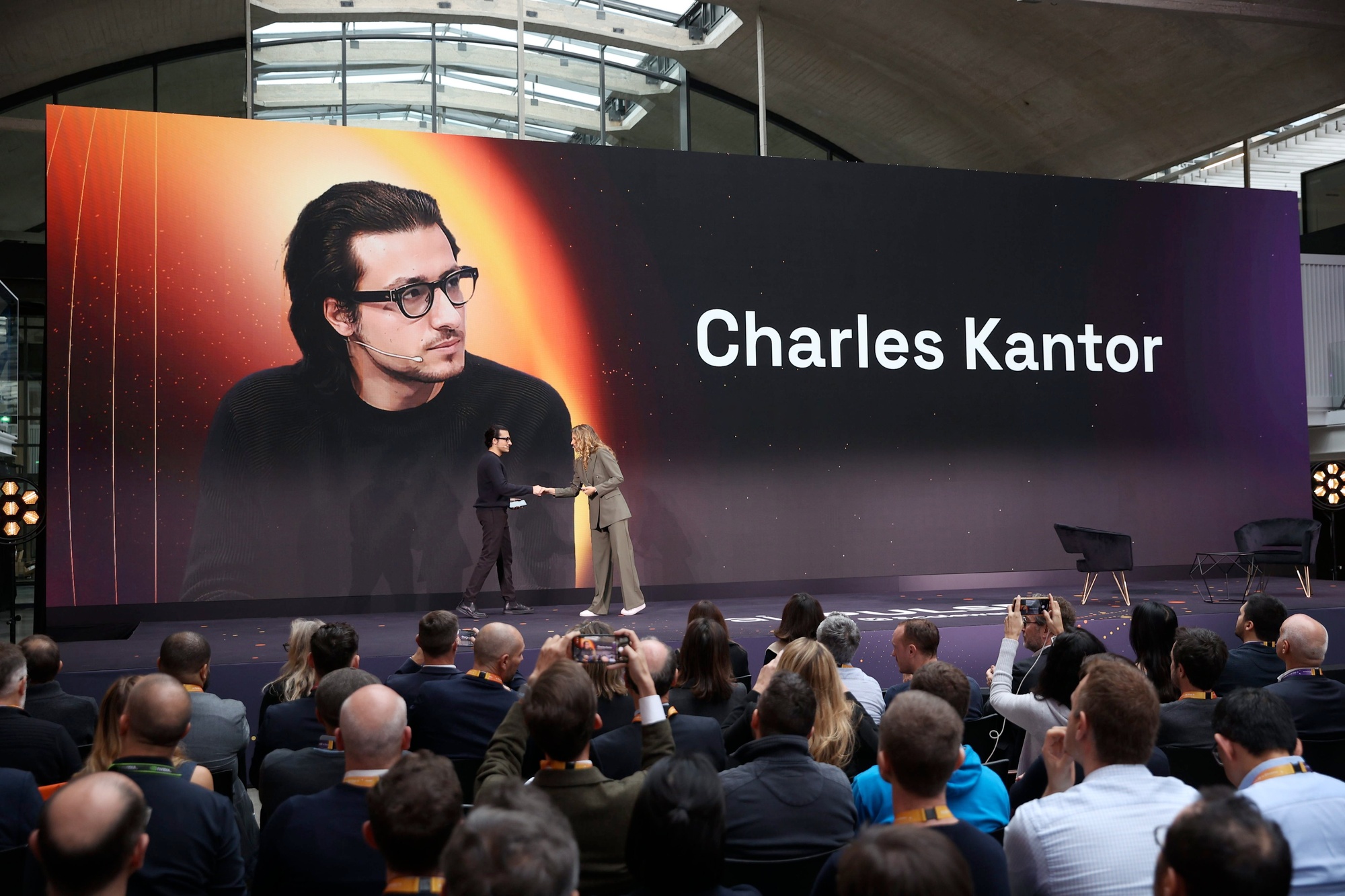
At ai-PULSE in Paris in November 2024, Kantor explained the combination of language models that plan workflows and vision models that recognise interfaces. The idea was to orchestrate these capabilities so a system could take action through a computer. His emphasis on specialising in one industry gave the argument a useful boundary: the broad ambition still needed somewhere specific to start.
“the goal is to focus on one industry and master it”Charles Kantor · ai-PULSE 2024
Runner H entered private beta that November. Kantor’s announcement thanked a team he described as resilient and creative and called building H an intense, rewarding experience. It was a more personal register than the financing announcement. For a moment, the venture appeared as daily work with colleagues, including Sifre, rather than a collection of investors and predictions.
- Understand
the request - Plan
the steps - Read
the interface - Act
then review
A conceptual sequence, rather than a performance claim.
The practical attraction is familiar to anyone who has spent an afternoon ferrying information between windows. Software often leaves its user to provide the connection between tools. An agent capable of reading an interface and performing a sequence offers a different division of labour. The human supplies the objective and checks the result; the machine deals with some of the clicking. Office civilisation has endured worse proposals.
A product launch, followed by a handover
In June 2025, H presented Runner H, Surfer H and Tester H. Workflow automation, browser navigation and testing gave the original action-model thesis more concrete forms. Kantor’s explanation of his own use was agreeably ordinary: connecting emails and documents, preparing billing information and drafting material for review. Even a founder pursuing advanced intelligence has correspondence to get through.
He also described a boundary around agency. In his account, an agent could prepare an email while the human retained the decision to send it. That detail is more revealing than a sweeping prediction. It places usefulness inside a working relationship: delegation, followed by judgement. A capable assistant still needs to know when the signature belongs to somebody else.
On June 11, H announced Gautier Cloix as its new chief executive. Cloix had previously led Palantir in France and was joining to expand commercial operations with enterprise customers. Sifre remained CTO. Kantor remained an important shareholder, with continued involvement described in that capacity. His period as founding CEO had ended; the company he helped establish continued under different executive leadership.
The sequence is worth keeping intact. H raised capital, lost three co-founders, released products and changed its chief executive. Each event says something different about the enterprise. None, by itself, provides the whole verdict on Kantor. A profile reduced to the funding would be an advertisement. One reduced to the handover would stop before the next page.
- 2023
- H takes shape towards the end of the year.
- 2024
- $220m seed round; Runner H private beta.
- 2025
- Gautier Cloix succeeds Kantor as H’s CEO.
- 2026
- Blackfuel makes its public debut.
The next chapter has a power supply
Blackfuel puts Kantor alongside co-founders Xavier Fischer and Dali Kilani. It describes itself as a cloud provider focused on inference, the running of trained AI models. The shift moves his work towards the infrastructure supporting model use. There is a clear connection with the earlier venture: software agents need computing capacity every time they perform their work.
The first deployment is planned for Barcelona, at Digital Realty’s BCN1 facility, using Dell infrastructure and AMD accelerators. Digital Realty confirmed the arrangement in September 2026. Other deployments are being advanced in Spain, Finland and France. These are plans and projects with named industrial partners, and their progress will give the new company more concrete tests than the elegance of its pitch.
Blackfuel calls its proposed network an AI Token Grid. The commercial idea is to let customers reserve model-serving capacity with agreed requirements for performance and location. Its launch announcement reported more than $250 million in contracted revenue. Those commitments concern business to be delivered over multiple years. They are an opening obligation as well as an opening headline.
Kantor’s route now runs from mathematics to agents to the facilities that supply their computing. The company names have changed in length; the desired scale has remained considerable. At H, his promise depended on getting software to perform useful actions. At Blackfuel, it depends on supplying the capacity behind those actions predictably. The future, it turns out, has both a browser window and a cooling bill.
Follow the next chapter
Personal website · LinkedIn · X · Hugging Face
Watch: ai-PULSE 2024 opening keynotes
H’s June 2025 governance announcement
The June 2025 product interview
Blackfuel’s launch announcement
The Barcelona deployment announcement