A company can change its name, its owners and its place on the stock exchange. Finding someone who remembers how the machinery fits together is another matter. On February 1, 2024, Charles Drucker returned as chief executive of Worldpay, a business he had helped build, expand and sell. The familiar executive had an unfamiliar assignment: make a very large payments company behave with the urgency of an independent one again.
There was a pleasing circularity to the appointment. Drucker had led the business out of Fifth Third Bancorp in 2009, taken it public as Vantiv in 2012 and helped combine it with Britain's Worldpay in 2018. After the sale to FIS in 2019, he eventually left. Now the business was separating once more, with private equity firm GTCR owning 55 percent and FIS keeping 45 percent. Corporate history had apparently asked for an encore.
But the interesting part of Drucker's career sits beneath that procession of transactions. Again and again, he has worked on the same practical problem: helping merchants accept money while the ways people pay keep changing. The ownership diagrams are complicated. The shopkeeper's request is refreshingly brief. Please let the payment go through.
A bank division gets its own front door
Drucker's working life in financial services predates the Worldpay name. Before Fifth Third, he held roles at Wells Fargo and First Data, including leadership of STAR Debit Services. These were jobs inside the infrastructure of commerce, where distribution, processing and relationships with financial institutions mattered. They provided experience in payments long before his later acquisitions became the headline attraction.
He joined Fifth Third's processing business as president in 2004 and became CEO in 2009. That year brought its separation from the bank. A business once housed inside a larger institution now had to operate on its own. Its customers still expected their transactions to work, however much the ownership paperwork had changed. The name that eventually appeared over the door was Vantiv.
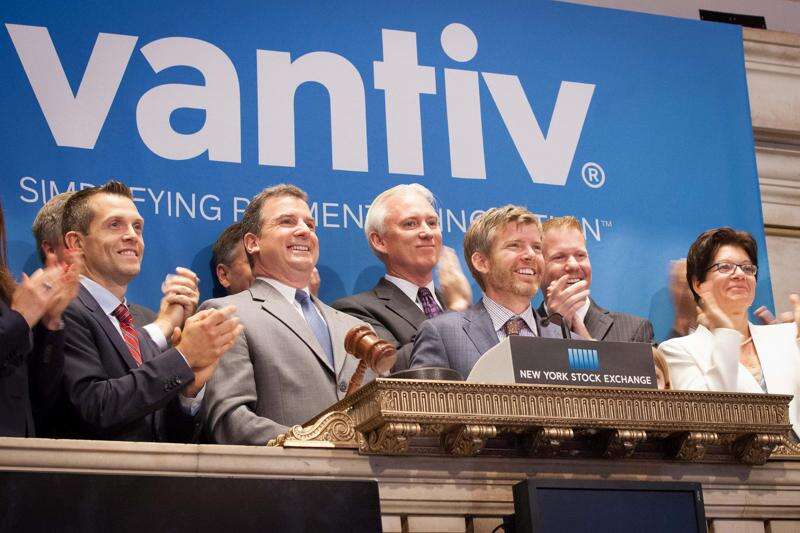
On March 22, 2012, Vantiv began trading on the New York Stock Exchange. The offering raised approximately $500 million. Drucker called it “the start of a great adventure.” The phrase had a little more romance than payment processing usually allows, but it suited the moment. Going public gave the company another means of financing its expansion and a new set of shareholders to satisfy.
The adventure soon acquired a shopping list. Vantiv bought Litle, an e-commerce payments business, in 2012 for about $361 million. In 2014 came the proposed $1.65 billion acquisition of Mercury Payment Systems. Each addressed a particular part of the company Drucker wanted to build: online payments in one case, payments integrated with business software in the other.
Mercury's network included more than 3,000 point-of-sale software developers and dealers. When Drucker and Mercury CEO Matt Taylor discussed the combination, the emphasis was on getting more products to customers through those relationships. That detail helps explain the larger strategy. A processor could grow by becoming part of the software a business already used to run its day, rather than waiting to be chosen separately at the counter.
The Atlantic was a business problem
Worldpay offered a larger version of that logic. The British company had its own banking ancestry, having emerged from Royal Bank of Scotland. Vantiv had a substantial North American business; Worldpay brought international reach and e-commerce capabilities. Their combination closed in January 2018. The American buyer adopted the Worldpay name, and Drucker became executive chairman and co-CEO alongside Philip Jansen.
On January 16, the two executives appeared together at the New York Stock Exchange after ringing the closing bell. Asked by Richard Quest what the combination would do, Drucker went straight to online commerce. When the conversation turned to new payment methods, he brought it back to the merchant. His job, as he put it, was to “simplify that complexity.”
It is a useful phrase because payments has a habit of making progress look like additional homework. A new wallet arrives. A customer wants another currency. A merchant expands into another country. Each development can create a new technical or commercial requirement. Drucker's answer was to put more of those capabilities inside the processor serving the business.
Integrated software channels
Global e-commerce
Somebody has to end the meeting
The less photogenic part came before the celebration. As leaders from Vantiv and Worldpay planned their integration, they debated the differences between the businesses. Mark Heimbouch, who became president and chief operating officer of the combined company, later recalled a moment when Drucker settled the question: the company would use Vantiv's functional operating model.
Heimbouch described the decision as a clarifying moment early in the integration. It offers a more concrete glimpse of Drucker than an adjective on a corporate biography. Here was a leader willing to close a debate about how the organization would work. A merger announcement can accommodate two proud histories. An operating company eventually needs people to know who decides what.
That choice alone did not perform the integration. Teams had to organize the work, establish reporting relationships and pursue the promised savings while serving customers. Heimbouch emphasized an integration-management office and people drawn from both businesses. The anecdote suggests Drucker's place in that effort: establish the direction clearly enough for other people to execute it.
There was also a quieter investment in management. Worldpay's people-leader development program included road shows with the CEO and chief human resources officer. Managers discussed strategy, new programs and their own responsibilities in person. Kathleen Peirson, the company's HR leader, singled out Drucker's willingness to make time for those conversations. The executive associated with large transactions was also spending hours explaining what leadership required inside the business.
A departure with another chapter attached
Drucker became Worldpay's sole CEO in January 2019. Later that year, FIS acquired the company in a transaction valued at approximately $43 billion including debt. For a career built around expanding a payments business, it was a substantial destination. It also placed Worldpay inside another larger organization, returning a degree of corporate enclosure to a business that had grown through independence.
He served as FIS vice chairman before leaving in March 2020. His next chapter included co-founding Artius Acquisition with Boon Sim. Artius combined with Origin Materials in 2021, and Drucker joined the materials company's board. Payments remained his main professional association, but this period took his investment and governance work beyond the merchant checkout.
The return began before he formally resumed the CEO job. In February 2023, FIS appointed him a strategic adviser to help separate its merchant business, with the expectation that he would lead Worldpay afterward. That summer, the plan took the form of a majority investment by GTCR. The transaction closed in February 2024. Drucker also stepped down from Origin's board as he returned to Worldpay.
“We will be faster and nimbler while bringing even more value to our clients and partners.”
Charles Drucker · February 2024
The promise was specific enough to invite a test. Worldpay planned greater investment in technology, products and client solutions, along with acquisitions across markets and geographies. GTCR committed up to $1.3 billion in additional equity for opportunities. Drucker was returning with access to capital and a stated mandate to accelerate the business. Familiarity with its customers and operations was part of the proposition.
Calling this simply a comeback misses the work involved. He had led a separation before, but the company had changed in scale and ownership. The job required using the knowledge he brought back while organizing Worldpay for another period of investment. History could shorten the introduction. It could hardly complete the assignment.
The next owner, and the same old checkout
Worldpay's independent chapter proved relatively short. In April 2025, Global Payments agreed to acquire it from GTCR and FIS. The transaction closed on January 9, 2026, and was announced as completed on January 12. GTCR described the agreed consideration as $24.25 billion in cash and stock. Another ownership diagram was ready for circulation.
At the closing, Drucker credited Worldpay colleagues and the partnership with GTCR for expanding processing capabilities and introducing payment innovations. Global Payments CEO Cameron Bready described the combined group's plans, including three distribution channels and annual investment of more than $1 billion. Those plans belonged to the combined organization, rather than to standalone Worldpay.
The sequence resists a tidy business fable. Independence helped define Drucker's first expansion and his later return; larger combinations also featured repeatedly in the company's growth. His career shows how often a payments executive must move between buying capabilities, joining organizations and separating them again. The corporate structure changes faster than the underlying request from the customer.
That is what gives the return its interest. Drucker's contribution can be followed through particular decisions: take a bank business out on its own, buy access to software channels, combine domestic scale with international commerce, settle the operating model, come back for another separation. Behind every one of those moves waits a merchant with something to sell. The paperwork may run to hundreds of pages. The customer is still waiting to pay.