Cameron Bready’s route to the checkout counter ran through the electricity grid. Before payments became his business, he worked in utility finance, assessing infrastructure investments and overseeing the money behind transmission. The industries look different from the pavement. One has pylons; the other has card terminals. Both ask customers to trust a system whose workings they would generally prefer to ignore.
That connection is a useful way to read his career. Bready, the Atlanta-based chief executive of Global Payments, has spent years moving from the finances of large systems to their operation. His latest assignment adds an awkward twist: make an organization bigger while making its purpose easier to explain. Corporate complexity has a habit of arriving with its own stationery.
On January 12, 2026, Global Payments completed its purchase of Worldpay and the sale of its Issuer Solutions business to FIS. The paired transactions concentrated the company on commerce solutions for merchants. A business that had served both sides of the payments machinery chose a clearer center of gravity. Bready’s next chapter would be measured at the places where people actually buy things.
The apprenticeship behind the title
His education began in a much smaller Atlanta setting. Bready graduated from Oglethorpe University in 1994 with a bachelor’s degree in business administration. His early professional experience included audit work at Arthur Andersen and transaction advisory work at Ernst & Young. Those are jobs in which a promising story still has to survive contact with the accounts.
He subsequently held senior management roles at Mirant, the wholesale electricity generator. At Northeast Utilities, his responsibilities included the financial assessment and structuring of regulated transmission and distribution investments. In April 2009, he joined ITC Holdings. He became its executive vice president and chief financial officer, responsible for accounting, finance, treasury and corporate development.
The progression matters because it gives substance to a familiar executive biography. Bready’s preparation covered both checking a business’s numbers and deciding where money should go. Utilities also put finance alongside infrastructure, regulation and long investment horizons. It would be too neat to claim that power lines taught him everything about payments. They did give him experience financing something other people depended on.
In June 2014, he joined Global Payments as executive vice president and CFO. The change of industry did not immediately mean a change of profession. His responsibilities remained anchored in finance, but the company around him was expanding. By March 2017, he had been promoted to senior executive vice president, continuing to lead the finance organization and worldwide corporate development.
Recognition followed the financial work. Institutional Investor named him among America’s Best CFOs multiple times; Crain’s Detroit Business and the Atlanta Business Chronicle also recognized him as CFO of the Year. The honors belong to an earlier phase of his career. They explain some of the credentials he brought to the chief executive’s office, rather than predicting what he would accomplish there.
Learning the business beyond the balance sheet
In 2019, Bready became president and chief operating officer. His remit stretched across merchant solutions in North America, Europe, Asia Pacific and Latin America, alongside worldwide operations, risk management, product and real estate. The list is revealing. A CFO can describe the result of a business decision in financial terms. An operator must also deal with the people, products and processes producing it.
Global Payments had acquired Heartland Payment Systems and merged with TSYS during his years in senior leadership. His experience therefore included the less photogenic companion to dealmaking: integration. Announcing a combination is an event. Getting the combined organization to work is an occupation. It brings the arithmetic back to ordinary questions about customers, responsibilities and which systems employees use.
When the company announced its succession plan in May 2023, outgoing chief executive Jeff Sloan had worked beside Bready for nearly nine years. Sloan publicly backed him as his successor. Bready became CEO and joined the board on June 1. It was an internal handover to someone who had already held the financial and operating jobs, with their different views of the same enterprise.
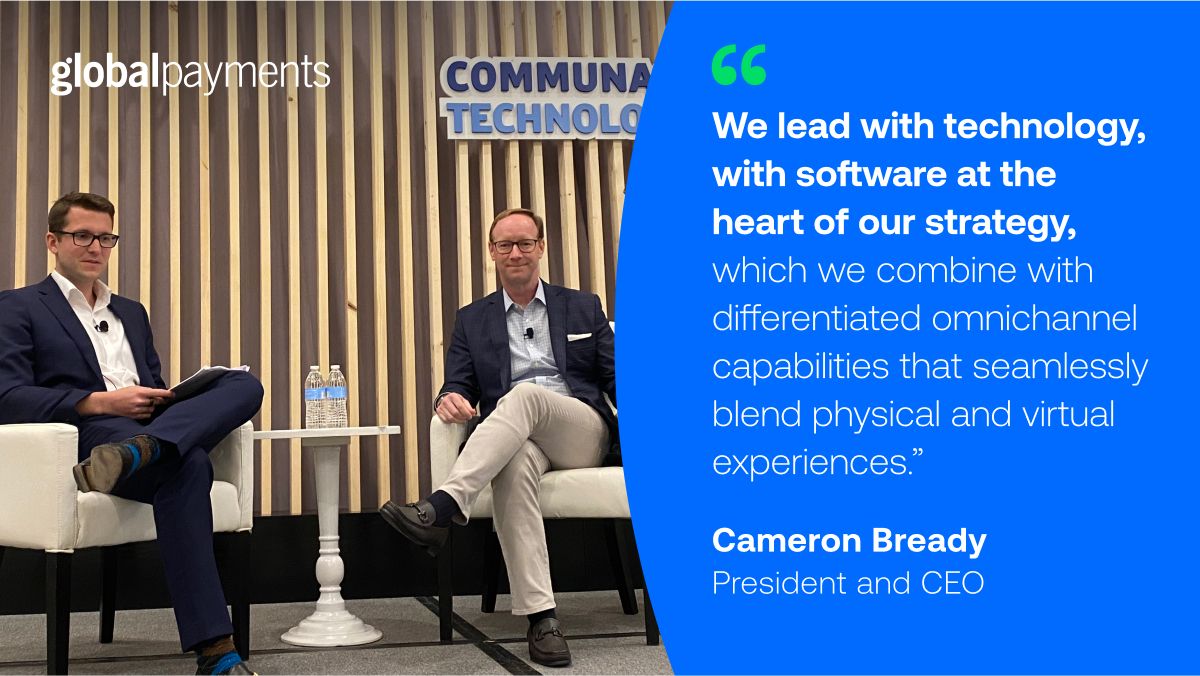
His early public appearances as CEO included a June 2023 television interview about the digitization of business-to-business payments, consumer spending and competition in payments technology. By September, he was discussing the company’s technology strategy at the Goldman Sachs Communacopia and Technology Conference. The subjects were already broader than moving a card payment from one place to another.
A purchase, a sale, a more precise ambition
The Worldpay agreements, announced in April 2025, gave that broader ambition a more focused corporate shape. Global Payments agreed to buy Worldpay from GTCR and FIS while selling Issuer Solutions to FIS. The announcement put the Worldpay net purchase price at $22.7 billion, or $24.25 billion including anticipated tax assets. Issuer Solutions carried a $13.5 billion valuation.
These figures describe different parts of a linked transaction; they should not be casually added together into a trophy number. The strategic point is more intelligible. Global Payments would concentrate on merchants, from small businesses to large enterprises, and the software and platforms serving them. Buying and selling were both part of the same decision about where the company should spend its attention.
Two transactions. A merchant-focused company.
At completion, the company described a combined footprint exceeding six million merchant locations, with $3.7 trillion in annual payment volume and approximately 94 billion annual transactions across more than 175 countries. Those are measures of the combined business’s reach, rather than growth achieved after integration. They establish the size of the assignment Bready took on.
The January announcement organized the route to customers into three channels: Enterprise, SMB, and Integrated & Platforms. It also outlined more than $1 billion in annual innovation investment. The practical possibilities included bringing Global Payments’ Genius point-of-sale offering to Worldpay’s small-business customers and Worldpay’s enterprise and ecommerce capabilities to Global Payments clients. The rationale depends on those combinations becoming useful in daily trade.
Genius faces the checkout test
A merchant experiences a payments company through smaller things than a transaction announcement. Can a sale be completed? Can a business keep its operations moving? Does the software make a day easier to manage? These are the questions behind Genius, the point-of-sale and business management platform that has become central to Bready’s agenda.
Its rollout gives the strategy a visible sequence. Genius for Restaurants launched in 2025, followed by Genius for Retail in June and an enterprise offering in September. By May 2026, the company was also discussing a mobile version that had reached 500 locations in fewer than 60 days. An expanding product family gave Bready something more concrete to discuss than the benefits of corporate scale.
Progress still needed to be distinguished from completion. In August 2026, Global Payments reported second-quarter GAAP revenue of $3.32 billion and adjusted net revenue of $3.16 billion. GAAP diluted earnings per share were $0.05; adjusted EPS was $3.46. The difference is material. A portrait of the executive should keep both measures in view, rather than choosing whichever makes the transaction look tidiest.
Reported August 5, 2026. These measures use different accounting treatments and are not interchangeable.
Bready said he was pleased with integration progress. That is an assessment from the chief executive, with further execution ahead. Acquisitions create an opportunity to distribute products more widely; customers decide whether those products deserve a place in their businesses. The distinction leaves the story open, as it should be for a company still combining two organizations.
The university connection that kept working
Alongside the corporate story sits a more personal continuity. Bready became an Oglethorpe trustee in 2012 and chaired its board from 2021 to 2023. He succeeded Chick-fil-A executive Timothy Tassopoulos; Tammy Pearson later succeeded him. The university connection extended well beyond the year printed after his name.
“Much of who I am today stems from my time as a student there.”
Cameron Bready, on Oglethorpe, 2021
One student’s experience puts that connection into human proportions. Max Hannon met Bready while volunteering in career development and serving as a student representative on a trustees committee. Hannon secured an internship in Global Payments’ acquisitions department in summer 2017. He later graduated into an audit analyst role at Deloitte in New Zealand. A committee introduction had become part of a young person’s route into work.
In 2025, Oglethorpe named Bready its Talmage Award recipient, recognizing professional distinction and contributions to the university. His wider commitments include Crawford & Company, the Electronic Transactions Association, Pace Academy, the Woodruff Arts Center and the Metro Atlanta Chamber. They place his career within a set of professional, educational and civic institutions, rather than inside the company alone.
A quieter definition of progress
At the 2025 PayTech Women Leadership Summit in Atlanta, Bready discussed leadership with Theresa Gongora. His account emphasized clear purpose, accountability and being intentional about commitments. Those are his stated priorities, rather than a license to invent a private personality. They fit the public assignment he has chosen: decide what matters, then make a complicated organization act on it.
His September 2026 essay after Genius World made simplicity a competitive argument. He described a future in which software understands the business, payments recede into the customer experience, information supports decisions and platforms can adapt. The test running through those ideas is practical usefulness. A business owner has little reason to admire a technology diagram while wrestling with an awkward sale.
That leaves Bready with an unusually measurable ambition. He has the finance background, the operating apprenticeship and the completed transaction. The next evidence will come through products and customer experiences. After a career helping large systems grow, he is asking whether a larger payments company can make the merchant’s working day feel smaller.
Keep reading & watching
- Global Payments · company website
- Cameron Bready · LinkedIn
- Watch · Bready’s first CNBC interview as CEO
- Read · Five Shifts Defining the Next Era of Commerce
- Worldpay transaction · January 2026 announcement
- Genius · product rollout coverage
- Oglethorpe · the student internship connection
- Global Payments · second-quarter 2026 results