A ship deck is a poor place to discover that your machine needs one more screwdriver. It rolls. The screw rolls. The sea rolls beneath both of them, and a job that looked trivial in the workshop begins charging by the hour. Charles Chiau has lived inside this kind of engineering comedy for two decades. The punch line is always expensive, which is why the autonomous underwater vehicle built by his company, Bedrock Ocean Exploration, joins in two self-aligning halves without loose cables between them. An operator can mate them without peering inside. The design is neat. The reason for it is gloriously untidy.
That distinction, between elegance on paper and usefulness in the wild, is the thread through Chiau's career. He has built and piloted crewed submersibles, worked on autonomous cars and aircraft, contributed to robotics at SRI, and helped design avionics systems for SpaceX's Crew Dragon. His machines have operated on land, at sea, in the air and in space. Yet he keeps returning to water, the domain where radio waves disappear, pressure rises, visibility collapses, and a vehicle must make decisions beyond the reach of an anxious engineer.
“I love the ocean because it levels the playing field. I love it because it makes us work together.”Charles Chiau, reflecting on maritime engineering in 2026
The first loopAn island, three robots and a very small budget
Chiau was born in Taiwan and spent his childhood moving between Taiwan and the United States: seven years in Philadelphia, six in Taiwan, then back to America for high school and college. He later described the result as belonging to both cultures while never fitting perfectly inside either. Moving alone taught him independence by trial and error. It also gave him a taste for assembling a life from different systems, which is not the worst preparation for a systems integrator.
At the University of California, Berkeley, he studied electrical engineering and computer science. As an undergraduate he assisted with research and operations at the Berkeley Seismological Laboratory. By 2006, working with Berkeley and the Office of Naval Research, he helped develop an island-defense concept involving port security and fleets of autonomous systems. His later account puts the most memorable number at less than $5,000: the cost of delivering three unmanned underwater vehicles. At the time, he recalled, few people cared about subsea autonomy. He disagreed and built it anyway.
The résumé that followed reads like somebody repeatedly changing the physics but keeping the job. At DeepFlight, he engineered and piloted human-occupied submersibles, including craft connected with Tom Perkins, Richard Branson and Steve Fossett. He worked on DARPA projects and autonomous cars. He became a named co-inventor on underwater vehicle and fiber-optic tether filings. At SpaceX, he worked on Crew Dragon avionics. At Reliable Robotics, he integrated systems for autonomous aircraft. Each move supplied another chapter in the same private manual: how to make complicated vehicles behave when the environment is indifferent to your deadline.
The Bedrock turnThey went shopping for a robot
When Chiau and maritime software founder Anthony DiMare started Bedrock in 2020, the sensible plan was to buy an autonomous underwater vehicle, add third-party mission software, and concentrate on the higher-value data system. Sensible plans have a short half-life in salt water. Suitable vehicles were too expensive, too large, or difficult to integrate. Components refused to converse politely. The team began removing boards, bypassing software, replacing propulsion and rethinking actuation. Before long, nearly the entire machine had become theirs.
The first version reached water trials six months after the team's initial drawings. Four months of deeper engineering produced a rebuilt architecture. By mid-2021, Bedrock had made its own circuit boards, battery, propulsion unit and submersible antennas. When its control system proved limiting, the company rewrote guidance, navigation and control software too, along with mission planning, telemetry and cloud tools. The business that meant to own the useful layer above the hardware discovered that, underwater, every layer is useful and every interface is a potential mutiny.
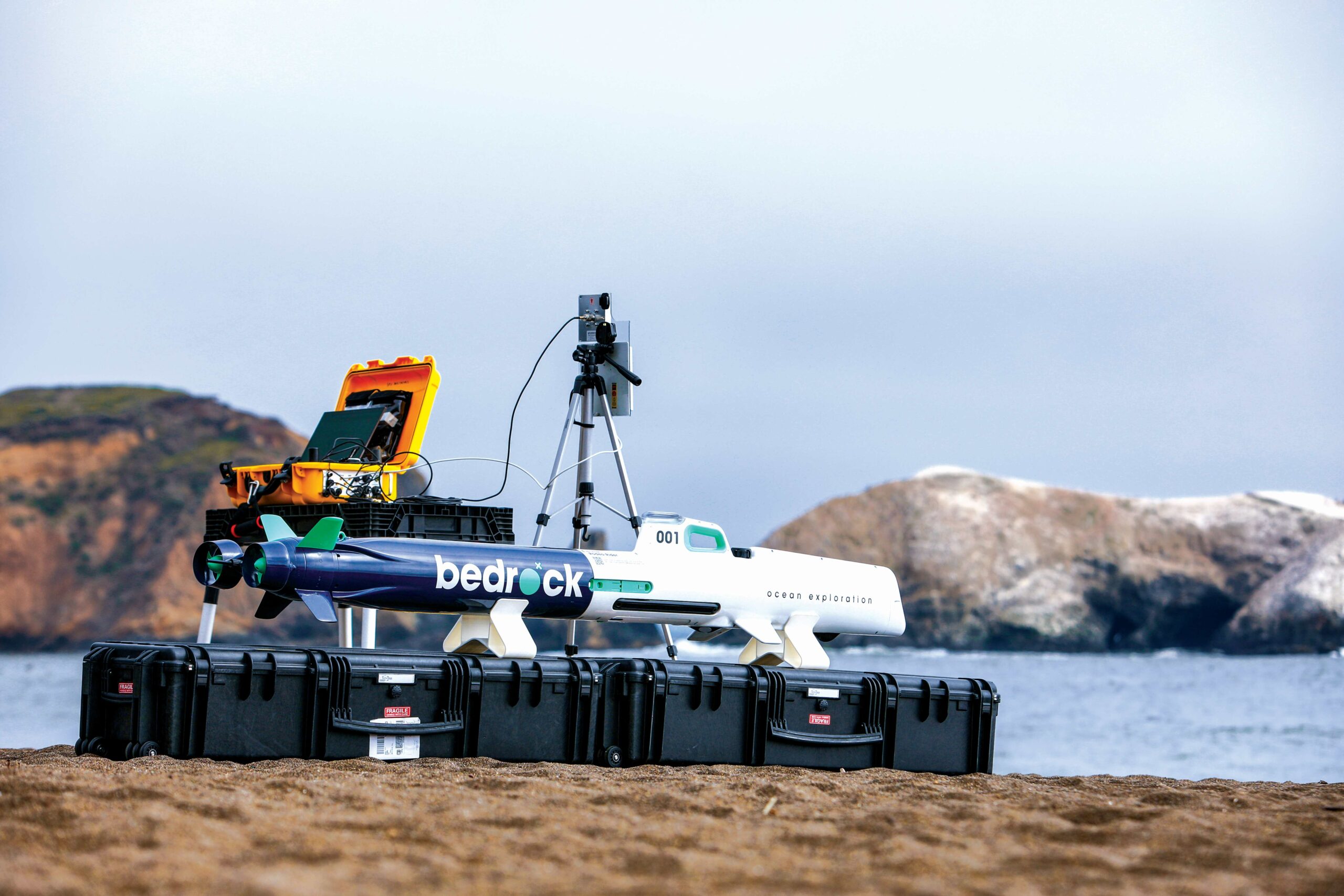
The autonomy stack first ran as a complete Bedrock system at Lake Tahoe in the summer of 2022. Then an inertial-navigation component reached the end of its production life, a supply-chain trap with perfect comic timing. Bedrock worked with navigation specialist Exail on a compact alternative. In February 2023, a prototype entered the ocean at Monterey Bay. By October, three vehicles completed a subsea corridor survey together. In overlapping bathymetric measurements, the difference was 0.02 meter. The robots were no longer merely swimming. They were agreeing.
A compact vehicle's working envelope
Designed by annoyancesThe operator is part of the machine
Chiau's most revealing design language is not heroic. He talks about snagged cables, misplaced tools, shipping rules, dead suppliers and hard drives lost by couriers. Bedrock's vehicle processes data at the edge because sending terabytes around the world is slow and fragile. Its batteries are built in-house and qualified for air transport because an autonomous vehicle that cannot reach a job is an exquisite paperweight. Redundant power strings and buses give it a route home when individual components fail. A forward-looking sonar maps terrain so the vehicle can adjust before the seafloor rises to meet it.
The same practicality explains why the AUV carries interchangeable sensor payloads. One configuration surveys broad bathymetry. Another flies low with side-scan sonar, magnetometer and a sub-bottom profiler. The machine is not sold as a gadget. Bedrock sells the survey and the resulting intelligence, joining vehicle, mission control, data processing and cloud access into one service. Chiau's full-stack instinct is less empire-building than blame reduction. When the ocean provides only a narrow window to work, there is little pleasure in discovering that three vendors each believe the fourth owns the problem.
There is also mischief in the workshop. A white vehicle is called Beluga. Serial number 007 became James Bond. A yellow unit is Oppenheimer, through the scientist's association with Yellowstone. This is consistent with the young engineer who once announced that being a geek did not require being boring. He danced in a hip-hop crew, flew radio-controlled aircraft, went clubbing, counseled at summer camps and spoke about playing hard. Serious machines, in his telling, need not be built by solemn people.
“It just needs to move enough for the economics.”Chiau on the seductive complexity of AUV powertrains
A founder changes depthFrom the workbench to the corner office and back
Bedrock's corporate path has demanded a different sort of systems integration. The company announced an $8 million seed round in 2021, then raised a $25 million Series A-2 in 2025. When DiMare moved to the chairman role in 2024, Chiau added chief executive to his existing CTO duties. He spent roughly two and a half years carrying both titles while Bedrock moved from research and development toward revenue, expanded its fleet, demonstrated systems with naval customers and ran repeat missions in the North Sea.
- 2020
Chiau and Anthony DiMare co-found Bedrock Ocean Exploration. - 2022
The full in-house hardware and software system runs autonomously at Lake Tahoe. - 2023
First Monterey Bay ocean deployment, followed by a multi-vehicle corridor survey. - 2025
A $25 million Series A-2 supports fleet and commercial expansion. - 2026
Chiau returns to a CTO-only role as Bedrock expands operations in Europe.
In April 2026, former Satellogic executive Matthew Tirman became CEO. Chiau returned to full-time technical leadership, concentrating on hardware, software and Bedrock's dual-use roadmap. It was a change of title that brought the founder closer to his oldest habit: building. Later that year, Bedrock and partners demonstrated an architecture linking underwater vehicles, a Wave Glider at the surface and shore-based digital twins across constrained communications. The company also established a UK and European hub with First Marine Solutions in Aberdeen and trained partner operators to run its systems.
The handoff carries a quiet lesson. Deep-tech founders are often celebrated for refusing to let go. Chiau's more interesting move was choosing what to hold. Commercial leadership went to a specialist. The engineer returned to the parts of the problem where accumulated experience gives him unusual leverage: reliability, autonomy, sensors, interfaces, production and the unromantic mechanics of getting a vehicle into and out of rough water.
The unfinished machineMaking an expedition feel ordinary
The next bottleneck is launch and recovery. AUVs can survey beyond the horizon, but people and deck machinery still tend to put them into the sea and pull them back. Chiau imagines surface robots handling that transfer, allowing fleets below to deploy, recharge and return with less human exposure. Bedrock is also pushing into deeper water and automating the path from raw sensor readings to decisions. The technical ambition is considerable. The desired customer experience is almost boring: point to a place, then receive a trustworthy picture of what lies below.
That future loops back to the engineer in Berkeley who wanted robotics to help the next generation dream beyond his own. Chiau has said his purpose is not merely to make technology, but to build infrastructure for the people who follow. The statement could sound grand if his career were not so full of O-rings, battery paperwork and rolling screwdrivers. Those details rescue the dream from abstraction. They are how a frontier becomes a service.
The ocean will keep winning small arguments. It will corrode the exposed part, break the neat schedule, scramble the radio and make the simple operation five times harder. Chiau's wager is that a team can remember each defeat and install the memory into the next machine. A self-aligning connector here. A redundant bus there. A map that appears before the ship reaches port. Progress, at sea, looks less like conquering nature than becoming a more attentive student. The pressure remains. The vehicle learns to live with it.