On a long flight after leaving Kraken, Michael Gronager began turning Bitcoin’s public record into something more useful. In his later telling, the trip lasted eleven hours. He already had software that indexed the blockchain. Adding a way to group related addresses took a few more database tables. Soon he could query the results and start recognizing exchanges. A ledger was becoming a map.
- Read the receipts. Connect blockchain transfers to known services and wallets.
- Make a decision. Give investigators and compliance teams tools to act.
- Move earlier. Detect scam destinations and threats before more money disappears.
That recollection, shared on Chainalysis’s Public Key podcast in 2024, contains the company’s central insight. A public transaction is observable. Its meaning takes work. You can see money move without knowing whether the recipient is an exchange, a scam operation, or somebody paying for something perfectly ordinary.
Gronager, Jonathan Levin, and Jan Møller founded Chainalysis in 2014. They built around the space between seeing and understanding. The mission, “build trust in blockchains,” sounds abstract until you imagine the customer: an investigator staring at an address, wondering where to begin.
The expensive part is knowing whose
Chainalysis combines blockchain records with attributions linking addresses to real-world services and wallets. It then clusters related addresses. In its published methodology, the company describes starting with verified observations and applying reproducible rules, with human review. The distinction matters. A label should have a reason behind it.
Consider an exchange deposit. An investigator may follow funds to an address associated with a service. Identifying the service can give the investigation somewhere to go next. Establishing the individual behind a customer account can require additional records and legal process. The line on the screen is a lead; the work continues outside the software.
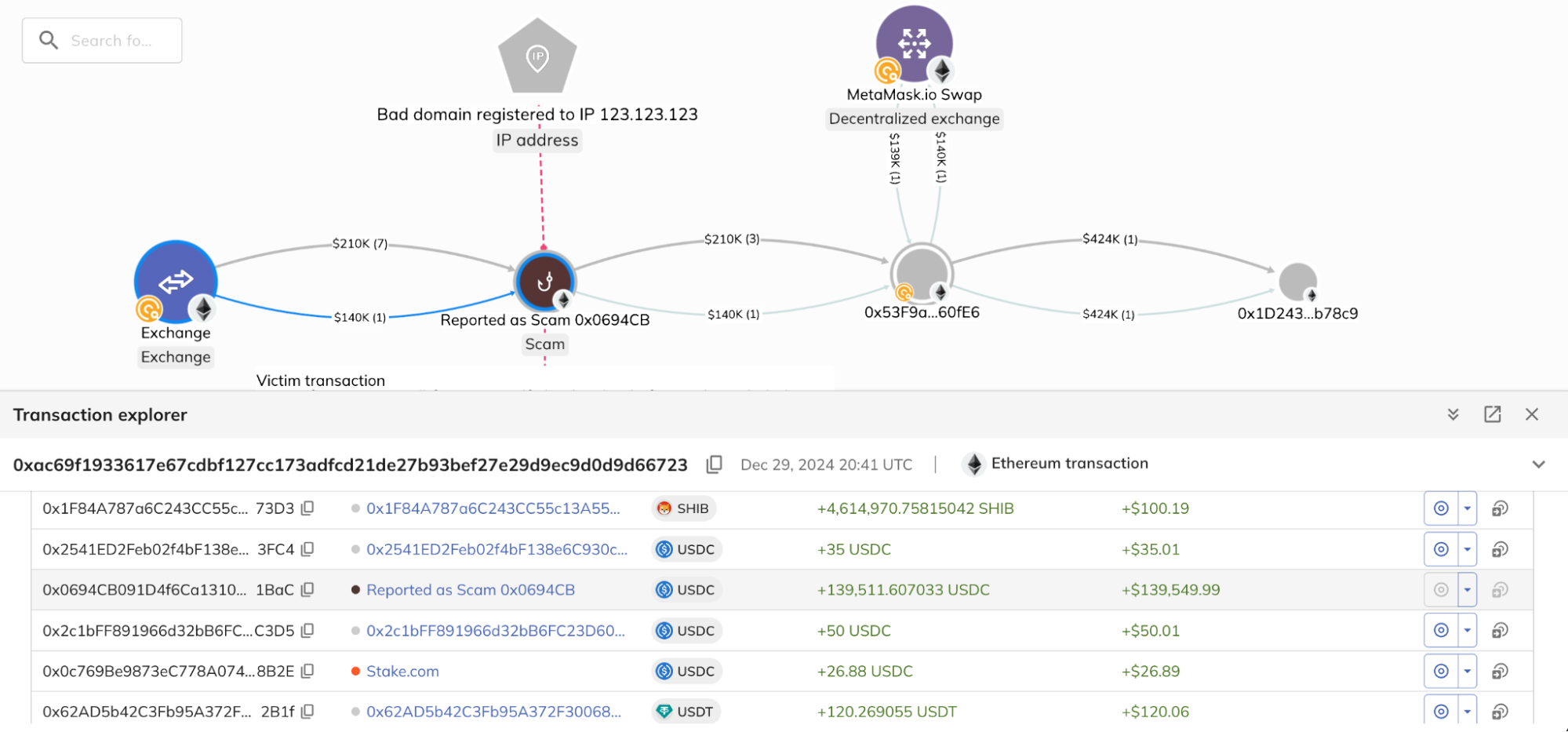
This is the company’s expertise: blockchain engineering, attribution research, financial-crime analysis, and the workflows that connect them. It occupies the institutional intelligence layer of crypto. Its competitive case rests on the evidence behind its data, its investigation experience, and the products built around both.
Three desks, three different questions
At the investigator’s desk, Reactor visualizes transfers and relationships across blockchains. Rapid supplies AI-assisted address triage. Data Solutions supports customized monitoring and analysis. Expert services and training help organizations translate software access into investigative capability.
At the compliance desk, KYT, short for Know Your Transaction, monitors incoming and outgoing transfers. Teams can configure risk thresholds, review alerts, and manage cases. Address Screening helps assess wallet exposure. The practical benefit is less time assembling context before deciding what deserves attention.
At the exchange’s fraud desk, the question arrives earlier: should this payment leave? Alterya connects scam-related signals to payment identifiers. Hexagate brought technology for detecting on-chain threats around smart contracts and protocols. Different desks share an underlying need for usable intelligence.
In February 2025, Chainalysis reported more than 1,500 organizational customers across 100 countries. Named relationships include Coinbase, Robinhood, and BNY Mellon. These customers buy subscriptions, data access, and services. They are purchasing working infrastructure for decisions that can carry financial and legal consequences.
The boom paid. The winter collected.
In May 2022, GIC led a $170 million Series F at an $8.6 billion valuation. The announcement described a growing private-sector business. It also supplied a revealing economic detail: 150 customers each accounted for more than $100,000 in annual recurring revenue. That was a customer cohort, not a price list. Buyers approach sales for a contract.
At an $8.6bn financing valuation
Then the market made expansion harder. Chainalysis cut staff in February 2023 and confirmed another reduction of 15% that October. Reporting described a greater emphasis on government contracting as commercial demand weakened. The strain appeared in the growth plan and cost base. Selling tools for trust did not exempt the seller from crypto’s cycle.
The company’s later direction addressed another constraint: tracing a loss is downstream of the customer’s worst moment. Levin became CEO in December 2024. That month Chainalysis acquired Hexagate. The following January it acquired Alterya. Together, the deals made prevention a larger part of the business.

“Build trust in blockchains.”
THE CHAINALYSIS MISSION
Arrive before the withdrawal
“We would need to expand our business beyond investigations and into prevention,” Levin wrote when announcing Hexagate. In February 2026, OKX announced it would adopt Alterya. That partnership makes the strategy tangible: put intelligence into the payment workflow while an institution can still intervene.
March 2026 brought an announcement of blockchain intelligence agents for investigations and compliance. Chainalysis emphasized audit trails and human control, with rollout planned from summer. The useful test is whether automation preserves the evidence behind a conclusion while reducing the work required to reach it.
The company’s public culture makes a related demand of employees: question assumptions, work with rigor, and revise convictions when information changes. Its careers page describes both office and remote teams. Those are stated practices, but they suit a business whose product depends on checking what a label claims. In October 2026, Chainalysis reported that Reactor-based evidence had survived appellate scrutiny in the Sterlingov case. Defensibility is part of what institutional buyers are paying for.
There are alternatives. TRM Labs and Elliptic also sell blockchain investigation and compliance tools. A buyer should test the assets they actually encounter, the evidence supporting an attribution, the volume of alerts, and the connection to existing systems. A feature checklist cannot answer those questions.
A map needs someone who can act
Copy the sequence: verify a signal, put it inside a real decision, give someone responsibility for acting. Budget for integration and analyst time alongside the license. Without dependable attribution, relevant coverage, or an organization able to respond, a handsome graph has limited practical value.
Chainalysis itself says it does not provide investigation assistance to individual victims. Tracing does not guarantee recovery. Its opportunity lies with institutions that can turn context into action. The company began by making the trail legible. Its next challenge is making the warning arrive in time.