The room had no windows. This was not a metaphor devised years later to improve the origin story. It was the backroom of White Castle Roofing in Lincoln, Nebraska, where Chad Wilken went to work on an app for keeping contractors' photographs in order. He had left Hudl, a sports-technology company already on its way, for a product whose first great virtue was that a local roofing crew found it useful. The sensible career move had good light. Wilken chose the room.
CompanyCam's problem was plain enough to explain across a kitchen table. Roofers took pictures for inspections, insurance claims, quality checks, marketing and conversations with customers. The images came back with names like IMG_0420.jpg and no memory of which roof, street or conversation gave them meaning. A photograph could prove something important, assuming anyone could find it. Luke Hansen, working in his family's roofing business, wanted the pictures organized by address. A local development shop built a prototype. Then the idea needed someone to live with it.
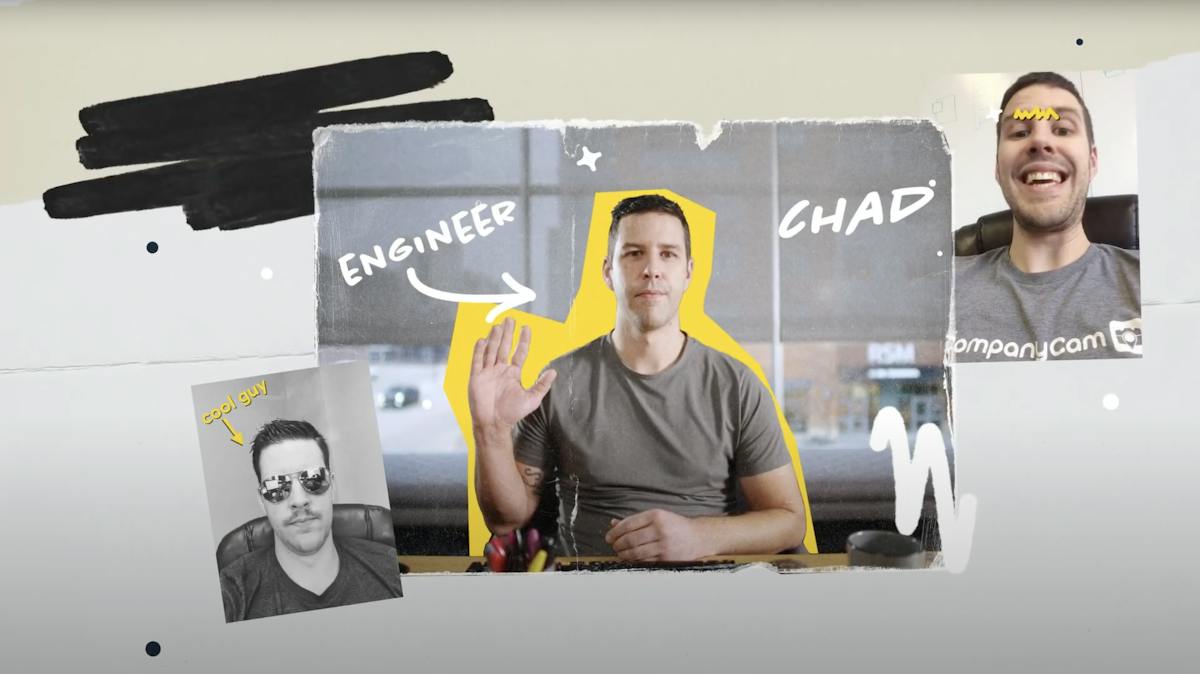
Hansen had met Wilken at Startup Weekend Omaha. His recruiting pitch eventually persuaded Wilken to trade a software-engineering job at Hudl for CompanyCam, where Wilken became employee number one in 2015. The title would shift between CTO and founding engineer. The assignment was steadier: turn a promising piece of software into a product that could be trusted by people working on ladders, roofs and job sites.
A career found in one class
Wilken had not arrived at Southeast Community College with a founder's biography rehearsed. He was generally interested in computers and chose a networking specialty because it was familiar. Then he took a programming course with instructor Glenn Ray. “I’d never programmed before coming to SCC and I really didn’t think I had the chops for it,” he later recalled. One class supplied a new answer.
He graduated in 2011 with a computer-support focus, but the wider technical grounding proved immediately useful. During an internship interview at a local technology company, he faced question after question about how the internet worked and how data moved from one computer to another. Wilken believed the interviewer, who had a doctorate in computer science, expected him to falter. Instead, his coursework let him keep answering. The internship became full-time work. He worked as a developer at I2rd, then joined Hudl a little more than a year later.
“I took one class with Glenn, and I was like, ‘Oh, this is awesome.’”Chad Wilken, on discovering programming
The technical knowledge opened the first door. Wilken credits Hudl with improving his human networking, the less diagrammable kind. That led him into the room where Hansen was pitching CompanyCam. A local career in software can look modest from a distance, but proximity was the mechanism here: a Nebraska college, two Lincoln tech companies, a weekend gathering in Omaha, a roofing family with an aggravating pile of photographs.
Graduates from Southeast Community College; an internship leads to full-time technical work.
Joins Hudl as a software engineer and expands the network that will shape his next move.
Becomes CompanyCam's first employee and begins rebuilding its early software.
Writes about search infrastructure serving just under 21 million CompanyCam projects.
Leaves after nearly eleven years and makes room to consider what comes next.
The rewrite behind the origin story
Founding-engineer folklore prefers the whiteboard to the maintenance window. Wilken's own technical writing is more candid. He inherited a web application, iOS app and Android app built around a .NET backend and SQL Server database. A few months into the job, he began moving the API to Ruby on Rails while keeping the existing product functioning. He liked Ruby's open ecosystem and believed Rails would let a very small team move with less ceremony.
The mobile side demanded another set of tradeoffs. CompanyCam had a universal Xamarin app that Wilken judged harshly. He first rewrote the Android and iOS apps natively, improving their performance and reducing bugs. The trouble was headcount. A small company could not easily keep two native products in step while the same engineer also worked on the web application. In 2016, he described experimenting with React Native as a way to share more work across the phones in contractors' pockets.
These were consequential decisions disguised as plumbing. Rails made one kind of speed possible. React Native promised another. Neither choice could be separated from the number of people available to maintain it. Wilken's recurring subject was not the fashionable framework by itself. It was the fit between a system and the humans responsible for keeping it alive.
Years later, his writing followed the product into less picturesque territory. CompanyCam leaned heavily on Elasticsearch to serve a filterable project feed. By June 2022, the service held just under 21 million projects and added tens of thousands more each day. Changing a searchable field meant reindexing the collection, including values pulled from related records. Wilken described a workflow for doing that work asynchronously rather than treating scale as an excuse for mystery. A second article showed how to carry Rails request IDs into Sidekiq jobs so an engineer could trace which web request had set background work in motion.
The subjects sound narrow until one notices what they share. A contractor needs a photograph to retain its context. An engineer needs a background job to retain the identity of the request that caused it. In both cases, usefulness depends on preserving the thread. Software rarely fails for lack of raw information. It fails when the information loses its address.
Simplicity, with its sleeves rolled up
Wilken's GitHub biography is four short claims: “Ruby on Rails enthusiast. xCompanyCam. Always striving for simplicity, usually looking disheveled.” The last phrase prevents the first three from hardening into personal branding. His public code includes Ruby tools for TipTap documents and for connecting GraphQL with Searchkick. His profile also records a security advisory credit. The pattern is practical and slightly allergic to grandeur.
Simplicity in a growing system is not the absence of complexity. It is the choice to put complexity where it can be understood. The async reindexing workflow, for example, does not pretend that millions of records are small. It divides the work, records its progress and lets operators see what is happening. The request-tracking solution adds a tiny piece of context precisely because distributed work otherwise becomes hard to follow. This is simplicity as legibility, not minimalism for its own sake.
CompanyCam grew beyond its first room and its first trade. Reports, checklists, tags and labels gathered around the original idea. The company said in 2024 that users had captured and stored more than one billion photographs. Each new feature widened the surface that engineering had to keep coherent. The early wager was no longer merely whether contractors wanted photos sorted by address. It was whether a product could remain understandable as customers asked it to do more.
“After nearly 11 years at CompanyCam, Friday will be my last day.”Chad Wilken, January 2026
The discipline of an unfinished answer
When Wilken joined CompanyCam, he thought the move might last a few years. He expected to learn and make connections. Instead, the chapter occupied nearly eleven years, with more highs than lows by his accounting. On January 11, 2026, he announced that the coming Friday would be his last day. He thanked the talented people around him and said the company was positioned to do more good work.
Then he declined the customary flourish. There was no stealth venture teased into existence, no new title waiting after a drumroll. “As for what is next, I’m not sure,” he wrote. He planned to relax, unwind and reflect on his goals. He had ideas, but he was not posting them publicly. He invited people to lunch or a drink.
That restraint belongs in the same story as the rewrites. Engineering is a practice of refusing to call an unknown thing known. A system either carries the request ID or it does not. A migration either preserves the needed behavior or it does not. A person leaving an eleven-year undertaking may honestly possess several possible futures and no need to announce one before it is ready.
Four months later, Wilken returned to Southeast Community College and toured its Lincoln campus. He admired the Sandhills Global Technology Center, especially the way its networking infrastructure remained exposed so students could see how the system worked. He would have loved it as a student, he said. The observation feels apt. His own career has been unusually visible in the same way: not because every private detail is available, but because he kept showing pieces of the machinery.
A first programming class. An interview about packets. A meeting at Startup Weekend. A windowless room. A backend migration. Two mobile rewrites. Millions of projects waiting to be reindexed. None is a complete explanation, but together they show how a software career accumulates. The next piece remains deliberately uninstalled.