Profile · Venture Capital
Chad Byers
The quiet seed investor who wrote the first check into Robinhood, and never quite figured out how to be loud about it.
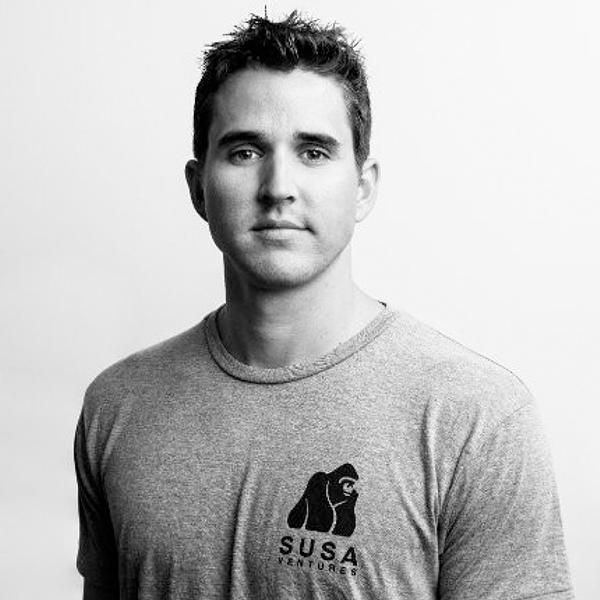
San Francisco / 2026
The Robinhood story is the one everyone wants. Twenty-six years old, $250,000, two grey-haired experts shaking their heads over coffee saying the same sentence in different words. This was tried in the 2000s. It will never work. Chad Byers wrote the check anyway. The position is now worth more than $400 million on paper, and somewhere in the retelling it has become the kind of story that explains a person without quite describing them.
Today he is the co-founder and General Partner at Susa Ventures, the seed-stage firm he started in 2013 with Leo Polovets and Seth Berman from a one-room office in San Francisco. Twelve years later the firm runs out of a brick building on Hampshire Street in the Mission, manages over a billion dollars across five funds, and just closed Fund V at $175 million in March 2025. The firm did not announce it with a billboard. They posted on Twitter and went back to work.
Byers writes checks of $1 million to $2 million into rounds of $2-4 million at the seed stage and then, in his own phrasing, "aggressively follows on" as companies scale. He has led Susa into Robinhood, Flexport, Andela, Newfront Insurance, Mux, Viz, Stord and Sundae Homes - a portfolio whose category headers (marketplaces, fintech, healthcare, logistics) read like a stripped-down version of how the modern internet actually moves money, freight and information around.
He is, by his own admission, an introvert running an extrovert's playbook. Venture capital rewards loud signal. Byers tends to hold a position by holding still. The bet he is best known for - Robinhood - was made when more credentialed people told him not to. The fund he is currently deploying is smaller than the ones his peers have raced to inflate. The portfolio companies he talks about most readily are not the ones with billboards.
The version of Chad Byers that exists today carries two unlikely halves. The first half grew up in Silicon Valley as the son of Brook Byers, the legendary co-founder of Kleiner Perkins. Dinner table conversation had a venture vocabulary. He absorbed it the way some children absorb baseball stats. He also, at age 11, sold Beanie Babies on eBay, which is a small fact that explains an oversized amount about him: he understood internet commerce before he understood how to drive a car.
The second half went to Boulder. He chose the University of Colorado partly so he could ski mid-week, and he picked a major - Environmental Science - that has almost nothing to do with what he does now. That is part of the point. In a profession that runs on credential theater, Byers shows up with a degree in soil and weather and a track record that quietly stacks higher than most CS grads.
Between Boulder and Susa, he stitched together an unusual operator's resume: marketing and product roles at Electronic Arts, Bloom Energy, and Silver Spring Networks. Then he went to Integrate.com as Senior Director of Platform. Each role taught him a different kind of company - gaming, hardware, infrastructure, ad-tech. When he sat down to write his first seed checks, he had already seen four industries from the inside.
His father Brook Byers co-founded Kleiner Perkins. Brook helped pioneer life-sciences venture investing in the 1980s and ran some of the firm's earliest health funds. Chad does not lean on the family name, and his fund does not look anything like his father's. But the genetic line on building something durable in this business is unmissable.
Would I work for this founder?
- His single most-used investment filterOnly work on something worth spending ten years of your life on.
- Advice to foundersSomeone was going to build a beautiful, mobile-first fintech product. We didn't know what the right wedge would be. When Robinhood told us brokerage was the wedge, the lightbulb went off.
- On the Robinhood seedWe invest $1M to $2M checks in rounds that are typically between $2M and $4M at the seed stage. Then we aggressively follow on into those businesses as they build.
- On Susa's check strategyThe pattern is consistent. Byers is willing to be early and willing to be wrong about being early, which turns out to be the only credible way to be early at all. He is not contrarian for sport. He just has a longer clock than most of the people across the table.
Susa Fund V is $175M. That is a deliberate number. It is smaller than the firm could probably raise, and that is part of how the math works at seed: write checks small enough that one outlier returns the fund three times. The whole shape of the firm - tight team, focused thesis, no rush to scale into multistage - is an argument about what venture is supposed to be.
Byers has spent twelve years building toward a quiet thesis: that the best seed investors are the ones who treat each new fund like the seed round of a startup with no product. You sell vision, you sell judgment, you sell the patience to wait out a decade-long J-curve. Then you go back to the office on Hampshire Street and write the next check.