The expensive part of a cable is often the wall around it. Once the drywall is closed, the conduit crowded and the projector mounted somewhere that requires a lift, replacing a video run becomes less like swapping an accessory and more like reopening a construction project. Celerity Technologies built its business around that inconvenience. The Irvine company makes fiber-optic links for moving pristine video, audio, data and control signals across distances where ordinary copper HDMI starts to become awkward. Its cleverest feature is not 8K resolution or a 48-gigabit data rate. It is the connector that comes off.
A full-size HDMI head is broad, electrically busy and unpleasant to drag through narrow conduit. Bare fiber is thin and fast, but terminating it in the field takes equipment, care and time. Celerity split the problem in two: first pull a slim, pre-terminated optical cable; then snap on the transmitter and receiver leads. The company calls the workflow “pre-wire and connect.” It sounds almost comically obvious, which is usually the sign of a useful industrial-design decision.
A cable company that behaves like a systems company
Founded in 2012, Celerity arrived with a detachable fiber-optic HDMI cable designed for electronics-system contractors. The early product sent uncompressed video over long runs, supported audio return and used miniature optical plugs that could fit through concealed spaces. The company has since expanded that original wedge into Universal Fiber Optic, or UFO: cables, couplers and replaceable connector heads for HDMI, DisplayPort and DVI; Keystone wall plates; paired extenders; and modular video-wall hardware.

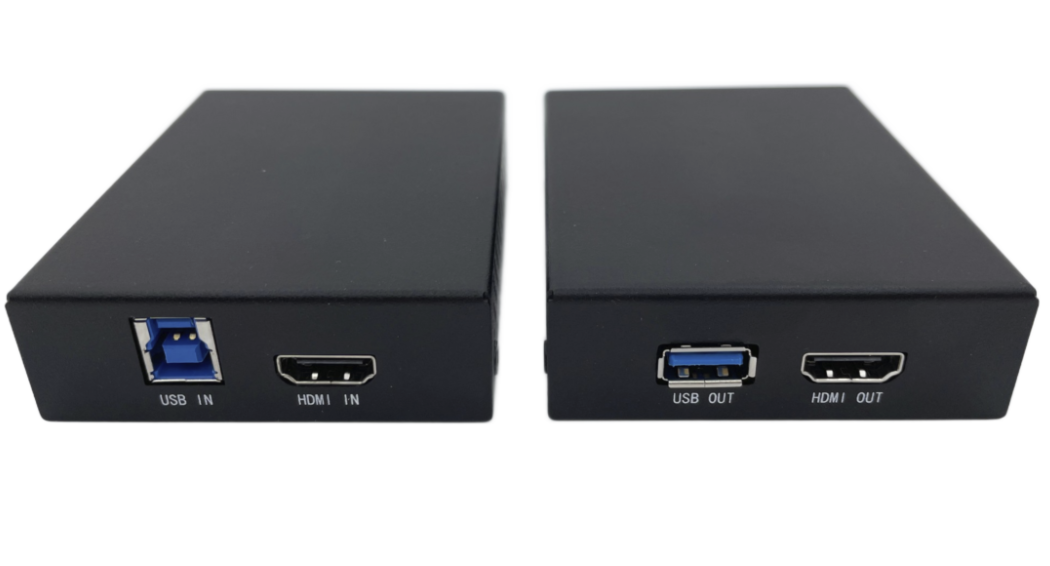
The current UFO-8KH specification reaches up to 48 Gbps, with HDMI 2.1, HDCP 2.3, HDR, Dolby Vision, eARC and resolutions up to 8K at 60 Hz. Finished cable lengths run from 35 to 1,000 feet, with custom increments available. Its Gateway Red pairs add USB 3.2 to HDMI 2.1 over a single fiber run, aimed at installations that need a display plus a remote camera, storage device or control peripheral. The MMX line moves further up the stack, combining matrix switching and video-wall processing.
That catalog makes Celerity more than a premium cable label. It occupies the seam between the physical link and the AV system around it. A home-theater installer might need one long connection to a projector. A broadcaster or command center might need clean, low-latency feeds across a facility. A medical display installation adds sensitivity to electromagnetic interference. A classroom, conference room or video wall may need USB and control signals beside the picture. The common job is moving a large, uncompressed signal without letting distance redesign the room.
The product is less time spent fighting conduit, interference and tiny strands of glass.YesPress analysis
What changed the equation
Celerity describes three waves that pushed fiber from trans-oceanic telecom to data centers and then toward homes. The relevant change was economic as much as technical: optical performance rose while component costs fell. But cheaper fiber alone does not create an installer-friendly product. The company applied telecom and electronics expertise to the ugly last few feet - the pull, the wall plate, the endpoint and the moment something does not light up.

The optical cable itself is bi-directional, so it can be installed from either end. Direction lives in the detachable transmitter and receiver electronics. Locking MPO couplers enforce alignment. Blue LEDs on the heads show whether power is present. If the source does not supply the expected five volts, the transmitter has a USB lead; the receiver requires USB power at the display. These are modest details, but they shorten the diagnostic conversation from “which hidden component is dead?” to “is each endpoint lit?”
What failed first in the company’s own installation logic is even less glamorous: cleanliness. Its manual warns that dust or debris on a precision fiber end can stop signal transmission. Pulling from the connector, pinching the cable or forcing a misaligned coupler can also cause damage. The failure hierarchy is useful because it reveals the conditions behind the two-step promise. Tool-free does not mean care-free. The protective caps stay on until connection, the bend and pull rules still matter, and power must arrive at the endpoint.
The price is not the price
Celerity sells through its own store, professional dealers, manufacturer representatives and a distributor network that includes Liberty AV Solutions and Covid in the United States, plus regional partners abroad. The business model combines complete cable kits with separately sold transmitters, receivers, couplers and wall plates. That modularity creates both an upgrade path and an aftermarket: a damaged or outdated endpoint does not necessarily condemn the cable sealed inside the wall.
Commodity HDMI is cheaper. That is the wrong comparison for many Celerity jobs. The real budget includes skilled termination, extra extenders and power supplies, troubleshooting, repeat visits and the possibility of opening a finished surface. Celerity’s claim is essentially cost per usable gigabit plus avoided labor. Buyers should still calculate it rather than accept “future-proof” as a magic coupon. On a six-foot run behind an accessible television, copper wins with insulting ease. Across 200 feet of noisy infrastructure, the spreadsheet can flip.
Who buys the relief
Celerity addresses professional AV integrators, custom residential installers, broadcasters, education facilities, medical-display teams, control-room builders and OEM customers. Its distributor locator stretches across North America, Europe, Asia, Latin America, the Middle East, Africa and Oceania. One revealing outside endorsement comes from madVR’s Envy cabling guidance, which recommends the Celerity UFO-8KH for display runs over 40 feet to reduce HDMI handshaking trouble. A 2025 California procurement document also names an 80-foot UFO-8KH set among existing control-room equipment. Those are not mass-market scale claims; they show the product living in the sort of fussy, expensive systems it was designed to serve.
Competition comes from several directions: passive copper on short runs; generic active optical HDMI; HDBaseT for structured-cable extension; AV-over-IP for routable networks; and established system vendors such as Extron, Crestron, Lightware and Kramer. Celerity’s difference is architectural. The signal path is optical, the electrical heads are replaceable, the cable can run a long way, and installers do not terminate the fiber. That advantage matters most when bandwidth, distance, interference or future access is genuinely painful.
Where the system earns its keep
- Long, concealed or hard-to-reopen routes
- Uncompressed 4K/8K display links
- Medical, broadcast and control-room EMI concerns
- Projects that value replaceable endpoints
Where it may not work economically
- Short, accessible passive-copper runs
- Sites careless about dust or bend limits
- Displays without convenient endpoint power
- Networked projects that need many-to-many routing
What a builder can copy
First, separate durable infrastructure from fast-changing endpoints. The fiber in a wall should outlive the HDMI electronics attached to it. Second, turn specialist labor into a keyed physical action. Celerity did not ask every installer to become a fiber technician; it designed alignment into the coupler. Third, expose state. A status LED is inexpensive, but uncertainty is not. Fourth, sell the system in pieces. Individual transmitter and receiver heads let customers repair, expand or reconfigure without rebuying the hidden run.
The fifth lesson is restraint: build around the bottleneck the customer actually curses. Celerity can talk about 8K, HDR and 48 billion bits per second, but its memorable promise remains “pre-wire and connect.” That phrase belongs to the person on the ladder, not the person writing the specification sheet. A seven-person company, according to the supplied business record, cannot out-market every broadline AV vendor. It can own a narrow physical problem, patent the useful geometry and make the installation feel obvious.
There are limits. Optical faces still need care. The proprietary system creates vendor dependence at the endpoints, even though Celerity says compatible third-party 12-strand Type-A MPO cable may work. Uncompressed point-to-point fiber is not automatically the right architecture for a large, constantly re-routed campus. And public information offers little visibility into funding or customer count. Judge the company by the evidence you can touch: connector dimensions, supported formats, deployment distance, component replaceability and a manual honest enough to tell you not to pinch the cable.
Celerity’s place in the market is therefore specific and defensible. It is the hardware between a demanding source and a distant display, built for the moment ordinary cabling stops being ordinary. The company did not remove every difficulty from fiber optics. It packaged the difficult parts, detached the bulky ones and put a blue light on the result.