The revealing number in Casting Networks’ history is 21. In January 2024, the company described a media-storage system in which uploaded files became eligible for archiving after 21 days. To an administrator, that sounds like a retention rule. To an actor trying to send another audition, it could mean yesterday’s performance was still occupying tomorrow’s space.
- The job: connect performers, representatives and casting teams, then organize their work.
- The roots: commercial casting, where Beau Bonneau launched LA Casting in 2002.
- The price: U.S. Premium is listed at $29.99 monthly or $299.90 annually.
- The turning point: requested audition uploads became unrestricted and free in August 2024.
On August 24 that year, Casting Networks removed the upload restrictions and discontinued the 21-day policy. The distinction is wonderfully specific: an actor’s profile is a shop window; a requested self-tape is work moving through a hiring process. Treat both as a storage allowance and the allowance can interrupt the very exchange the platform exists to facilitate.
This is a useful way into the company. Casting Networks operates in an industry associated with faces, charisma and improbable discoveries. Its daily business concerns submissions, files, invitations and calendars. A performer may dream of being unforgettable. A casting office would also appreciate knowing which file belongs to which performer.
The original customer needed fewer envelopes
Beau Bonneau came to the problem as a San Francisco casting director. He launched LA Casting in 2002 to give casting directors and agents software for their existing process. Historical reporting describes the shift: commercial casting notices could travel online, representatives could submit photographs, and actors could receive audition material through the internet.
There was an obstacle before the software could become useful. Bonneau told Backstage that agents had grown wary after paying online casting services that subsequently disappeared. Asking them to trust another newcomer meant asking them to repeat an unpleasant experiment. LA Casting’s answer was free access for agents and managers.
“We’re not going to charge you for this service.”
Jôher Coleman, LA Casting communications consultant, on the original agent-access model
That bargain helped shape the business. Performers paid for memberships and photographs while representatives entered without a fee. The people supplying opportunities made the network more valuable to the people seeking them. The distribution choice mattered as much as the interface.
Cheap to join did not mean cheap to operate. In the same historical account, Bonneau said running costs in years four and five were four times his original expectations. Support staff, programming, offices, hardware and bandwidth were part of the bill. The magic of putting something online is that customers stop seeing the machinery. The machinery continues to send invoices.
A role is a sequence of handoffs
Today, Casting Networks serves performers, agents, managers and casting teams across film, television, commercials and other projects. Its particular expertise is the coordination surrounding an audition: publish the role, receive submissions, request material, arrange a session, assemble choices and share them with the people making the decision.
- 01PublishRoles reach reps and talent.
- 02SubmitProfiles meet the brief.
- 03AuditionRequests, tapes and sessions.
- 04ShareSelects reach the client.
A workflow diagram, not a promise of selection.
Casting Billboard is the marketplace where performers browse roles. FastCapture handles recording, organizing and sharing audition sessions. Talent representatives manage rosters and submit performers to projects. These functions sit close together because the same person has to remain identifiable as their headshot becomes a submission, then a tape, then a candidate in a presentation.
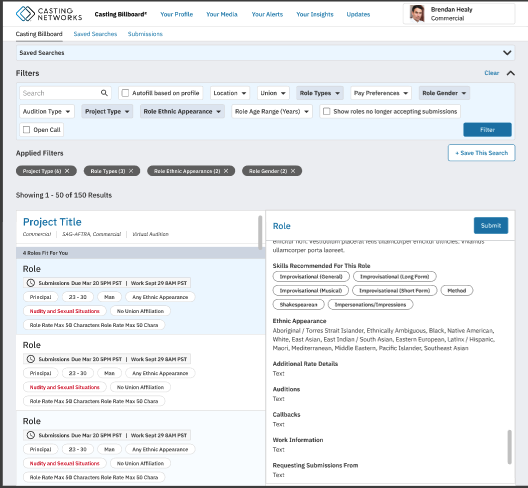
A real customer makes the mechanics clearer. Beau Bonneau Casting tells Bay Area performers that it hosts audition tapes, remote Zoom auditions and in-person callbacks through Casting Networks. It also explains that many principal auditions go directly to local talent agencies. A public job board is therefore only one entrance into the process.
The same casting office makes another distinction newcomers should remember: production clients select who gets hired. The platform helps material arrive and remain organized. A casting director narrows the possibilities. Neither a completed upload nor a paid account constitutes a booking.
The subscription buys tools, access and a little visibility
The U.S. Premium schedule published in March 2026 lists $29.99 a month or $299.90 a year. Twelve monthly payments total $359.88, so annual billing saves $59.98 if a performer uses the service for the full year. That is a billing comparison, not an estimate of what an acting career will cost.
$59.98 difference over 12 months
Calculated from the official March 2026 price schedule. U.S. dollars; local prices differ.Free membership permits a limited profile, browsing and responses to casting requests. Premium enables ordinary self-submissions, more profile media and tools including Role Tracker and Talent Scout. U.S. Premium also includes Thrive, a benefits and discounts program. Paying makes sense only if the additional functions are useful for the performer’s actual work.
Role Tracker addresses a familiar irritation: sending a submission and then knowing remarkably little about it. Launched in January 2024, it displays project and role information, submission dates and statuses including Submitted, Selected and Under Consideration. Those labels provide some visibility. They are not a review of the performance or an explanation of why somebody else got the part.
Talent Scout reverses the direction of another search. Premium performers looking for representation can opt in, specify the kind of representation they want and add a pitch note. Agents and managers can search those profiles. There is a pleasing economy to this: a performer prepares one profile that can participate in more than one professional conversation.
The storage rule found the boundary
The 2024 storage change deserves attention because it exposes where the product’s incentives can collide. Metering files is a tidy software idea. Auditioning is untidy: one request can require several clips, another arrives before the previous material is old enough to archive, and the actor does not control the hiring timetable.
The company’s August announcement removed the storage meter and made uploading requested audition media free for all talent. Profile-media limits remained a separate matter. The lesson worth copying is the boundary: let requested work flow through the system, then charge for additional discovery and presentation features around it.
Pricing tensions resurfaced in October 2025 when Casting Networks proposed subscriptions for U.S. agents and managers. Deadline reported boycott threats and SAG-AFTRA outreach to franchised agents. That episode made the old free-access bargain newly visible. Charging another participant changes the economics of the whole network, because each participant helps make it useful to the others.
One company, several neighboring doors
Casting Networks belongs to Talent Systems. Caltius and management formed that group in 2017; RedBird Capital Partners and StepStone later agreed to acquire a majority stake, with the transaction closing in August 2022. The terms were undisclosed. This was an ownership deal involving the parent, not a publicly priced venture round for Casting Networks alone.
Cast It and Casting Frontier are neighboring brands in that group. Casting Frontier remained a separate platform after its 2020 acquisition. Independent alternatives include Breakdown Services/Actors Access, Backstage and Casting.com. A useful comparison starts with the roles and professionals a performer needs to reach, then considers the tools and price. A longer feature list cannot compensate for the relevant work being elsewhere.

Its Australian partnership gives the network a more tangible form. The 2024 AACTA Young Stars call invited performers aged 13 to 18 to submit video. Finalists received six months of Premium membership and new headshots, alongside the program’s workshops and mentorship. Software supplied an entry point; professionals supplied attention and judgment.
The next improvement may sound like office work
The 2026 release notes tell a quietly revealing story. February brought Copy to Cast It for selected casting directors. August added a way for representatives to submit all their selections across a project’s roles at once. September introduced Live sharing links alongside Snapshot links. Each change concerns a handoff that previously demanded more effort or another step.
For a performer considering the service, a sensible sequence follows: browse the roles, check location and eligibility, find out how your representative works, then decide whether self-submission and the paid tools justify a subscription. If the appropriate productions use another platform, or you only need to respond to requests through a free account, the calculation changes.
The broader lesson is available to anyone building professional software. Watch the work between people. Keep identities and materials attached as responsibility changes hands. Be precise about what a fee buys. Casting Networks’ story is interesting because the administrative details have consequences: a file limit can block a performance; a better sharing link can help the right person see it.
Follow the next audition
Explore the platform and its practical guides, or hear directly from casting professionals.