The first version of Blueshoe was about law firm plumbing: bills, invoices, compliance, the administrative clatter that turns legal work into delayed revenue. Sensible territory for a former lawyer who had also spent time in investment banking and strategy consulting. Casey O'Grady could read a contract and a spreadsheet. His co-founder, Kai Yee Wan, could build the system. Then the pair kept walking toward the trouble.
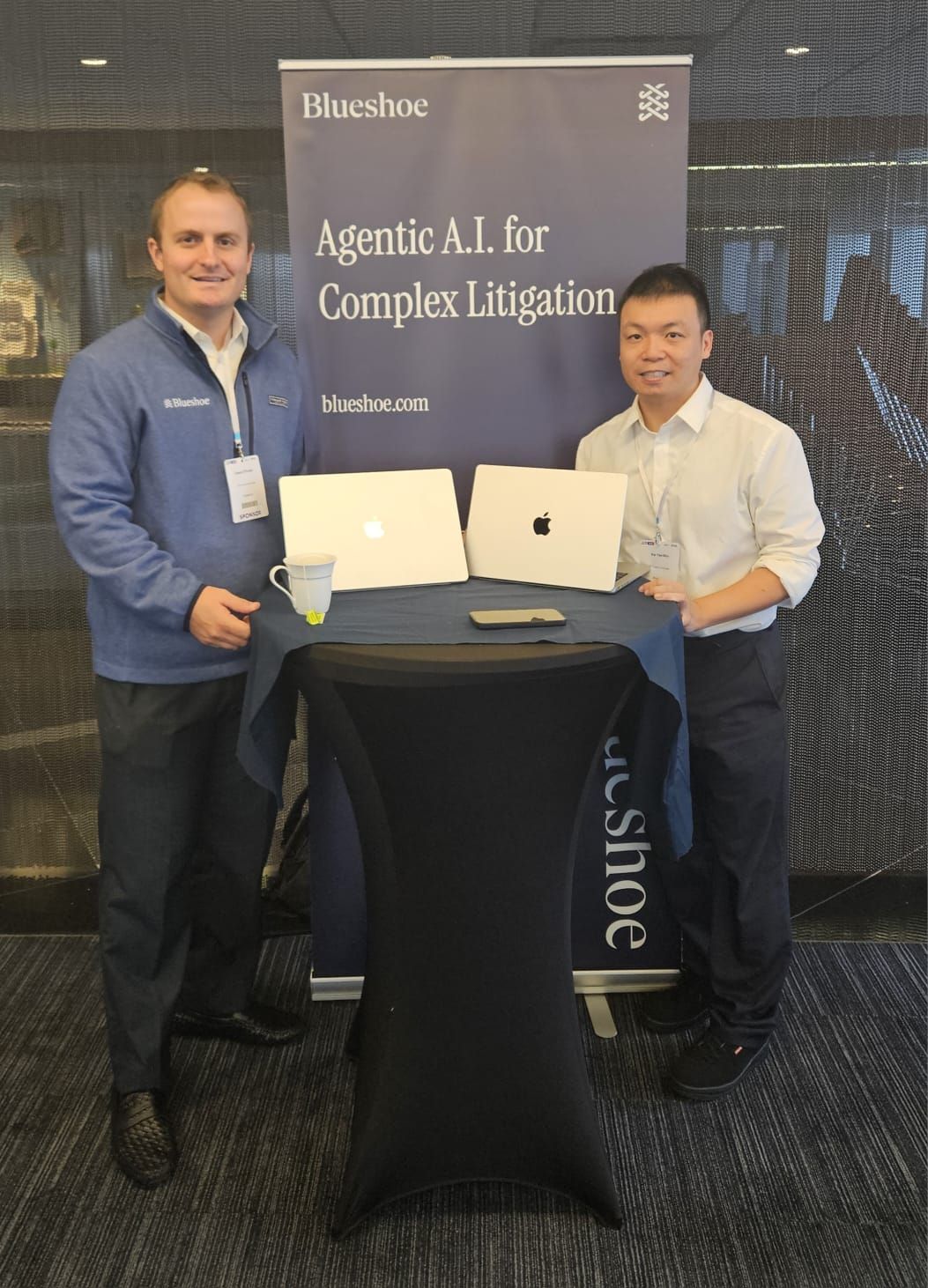
They moved from the business of law into legal research and reasoning. At a Boston conference, their banner promised agentic AI for complex litigation. O'Grady explained that legal AI refuses to stay in the neat drawers product designers prepare for it. Drafting becomes strategy. Intake becomes fact synthesis. Research becomes reasoning. A tool built for one step soon finds the whole case pressing against its edges.
By 2026, Blueshoe had crossed an even more consequential line. It described itself as an AI-native consumer and plaintiff law firm. A person could begin with a question in ordinary language, keep documents and developments in one matter, and invite a licensed attorney into the conversation. The software had stopped waiting politely behind the lawyer's desk. It had become the front door.
01 / The useful detourA career built from rule books
O'Grady's route to this particular front door is cheerfully indirect. He grew up in Phoenix and arrived at Rice University as a middle-distance runner. His high-school bests were 52 seconds in the 400 meters and two minutes in the 800. He had also been a National Merit Scholar and a member of Brophy College Preparatory's 2006 football state championship team. The record suggests someone comfortable with clocks, rules and repetition before anyone handed him a casebook.
At Rice, he studied philosophy and mathematics. In 2011 the philosophy department gave him its James Street Fulton Prize, an annual award for achievement and motivation in the discipline. Philosophy asks what a rule means. Mathematics asks whether the reasoning holds. Law, which came next at Harvard, makes both questions billable.
After law school came an Arizona Attorney General's Office internship and a role as an associate attorney at Osborn Maledon. Then came Lazard, where he worked in investment banking, followed by Altman Solon and strategy consulting. The sequence is less random than it looks. Each profession studies institutions under pressure: what the rules permit, what the numbers reveal, what the client can afford, and who has the authority to decide.
One chapter is particularly easy to miss. In November 2021, an O'Grady for Senate committee registered with the Federal Election Commission. The filing named Casey Sims O'Grady as a Republican U.S. Senate candidate in South Carolina. The committee was later administratively terminated. It did not become the center of his public story, but it belongs in the record. Before trying to rebuild part of the legal system from a startup, O'Grady briefly put his name on a ballot-bound attempt to enter another rule-making institution.
“The tedious parts fall away, and what's left is the actual thinking, the judgment, the building.”Casey O'Grady on working with AI
02 / Coffee, then CaliforniaThe company before the category
Blueshoe began, O'Grady says, in a coffee shop halfway between Charlestown and Cambridge. It is the sort of founding location that sounds invented by a municipal tourism office: specific enough to picture, vague enough to inspire arguments about which café deserves the plaque. He and Yee Wan built there before taking the company and their families west for Y Combinator's 2025 program.
The pairing is clean without being cute. O'Grady brought law and strategy. Yee Wan brought an engineering background that included Google and graduate work in computer science. They agreed that law was unusually fertile terrain for applied AI because it swims in documents, data and decisions. The first public pitch emphasized legal back-office intelligence. AI agents could review invoices, identify compliance problems and give firms a clearer view of pricing and profitability.
That was a credible company. It was also only one view of the bottleneck. By early 2026, Blueshoe was talking about a platform built around the logic of case law. Lawyers, students and researchers could use it for research, argument chains and litigation reasoning. The product moved from what happens after lawyers work to how they think while working.
Then the company moved again, toward the person who has not yet found a lawyer. Blueshoe's current site promises a dedicated attorney without billable hours and frames its mission in unusually direct terms: elite counsel should not require wealth or connections. This is no longer software sold only to firms. It is an attempt to operate the firm itself, with AI carrying context and administrative weight while attorneys handle judgment, advocacy and outcomes.
03 / The accountability questionAn agent needs a grown-up in the room
O'Grady's published work makes the company's progression more interesting. With legal scholar Catherine Gage O'Grady, he co-authored “Agentic Workflows in the Practice of Law - AI Agents as Ethics Counsel,” published in the Georgetown Journal of Legal Ethics in 2025. The paper proposes that specialized, accountable and systematic AI agents could be woven into a firm's workflows to identify ethical concerns and counter recurring human biases.
It is an argument for using AI inside the guardrails, not waving at ethics from the parking lot. The paper does not treat automation as self-justifying. Its agents have jobs, boundaries and accountability. That framework now shadows Blueshoe's larger ambition. Once software is not merely helping a lawyer research but helping a person begin a legal matter, the questions become sharper: Who understands the full context? When does information become advice? Who acts? Who answers for the result?
Blueshoe's answer is to keep the attorney in the system and make the handoff disappear. O'Grady has said people are not turning to AI because they necessarily want to replace lawyers. They go because asking there is quick. His next step is almost comically plain: bring the lawyer into that same conversation.
“Once lawyers start working with AI, use cases evolve in unexpected ways: document drafting becomes litigation strategy, intake becomes fact synthesis, legal research becomes legal reasoning.”Casey O'Grady
04 / The front doorFine print, turned into a case
The problem O'Grady keeps returning to is not abstract intelligence. It is asymmetric leverage. A severance agreement arrives with a deadline. An insurance claim is denied. A lease hides a punishing clause on page fourteen. Institutions have counsel, process and memory. Individuals often have a search box and a story they must tell from the beginning every time the phone changes hands.
Blueshoe's open-source case-builder project makes the operating idea concrete. Someone describes what happened in plain language through an AI assistant. The server creates a structured case with a summary. Documents and updates can be added as the situation develops. When an attorney receives it, the intake is meant to resemble an organized, evidence-backed matter rather than a cold call. The humble achievement is continuity: the story survives the handoff.
This also explains why Blueshoe's shifts feel less like serial pivots than a camera pulling focus. Billing exposed the operational drag on lawyers. Research exposed the limits of point tools. Litigation workflows exposed the need to preserve a case across time. Consumer access exposed the silence before any of that work begins. Each product moved closer to the original human sentence.
O'Grady is candid about his enthusiasm for building with AI. He has written that he went from disliking work to enjoying it because the technology let him move directly from ideas into execution with far less tedium. There is an entrepreneur's appetite in that confession, but also a lawyer's qualifier. He acknowledges serious social and political problems around the transition. His optimism rests on a division of labor: machines absorb the drudgery; human thinking and judgment become more important.
Whether that division holds will be the real case. Blueshoe is tiny, with two founders listed by Y Combinator, and its public identity has changed quickly. A law firm is a sterner test than a demo. Clients do not experience “agentic workflows.” They experience whether someone listened, whether the explanation made sense, whether the deadline was met, and whether an advocate showed up.
That makes O'Grady's wager both ambitious and refreshingly measurable. A person arrives with a question. The system remembers the facts. A lawyer can enter without forcing a restart. Help begins before impatience hardens into surrender. For a founder who has spent a career moving among systems of rules, the end goal sounds less like futuristic software than an old professional courtesy: pick up the phone while the question still matters.